
How does L.B. Foster Company's sales and marketing model convert infrastructure demand into profitable contracts?
L.B. Foster Company shifted from commodity distribution to selling engineered, tech-enabled infrastructure solutions, focusing sales on high-barrier segments with recurring needs. This matters because its 2025 pivot increased margin mix amid steady rail and transit project awards.
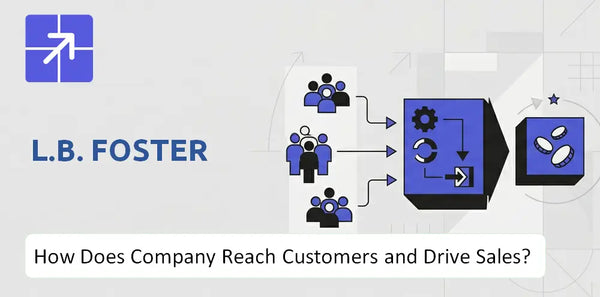
L.B. Foster sells via direct account teams, project bidding, and partner channels; digital content targets engineers and specifiers. Expect more backlog-driven revenue and repeat services as procurement cycles lengthen – see L.B. Foster BCG Matrix Analysis.
Who Does L.B. Foster Want to Sell To?
L.B. Foster Company targets institutional and industrial buyers with long planning cycles and strict safety needs, focusing on Class I railroads, transit agencies, heavy civil contractors, engineering firms, and government DOTs; it wins work by offering specialized engineering specs and customized solutions that lower total cost of ownership.
 Main customer group: Class I railroads & transit agencies
L.B. Foster Company prioritizes Class I railroads and major transit agencies in North America and the UK because these buyers require mission-critical rail technologies and friction management systems with long procurement cycles and high uptime requirements; winning contracts often hinges on meeting strict safety and lifecycle-cost specifications. Recent 2025 public sector rail CAPEX programs in North America exceed $20 billion, creating sustained demand for specialized suppliers.
Additional target segments: heavy civil, engineering, DOTs
Secondary customers include heavy civil contractors, engineering firms, and state/federal departments of transportation that buy bridge, highway, and utility components for large projects; these buyers favor vendors who supply engineered, spec-compliant solutions and predictable logistics. In 2025, U.S. federal infrastructure outlays under continuing programs keep annual bridge and highway contracting near $100 billion, a sizable addressable market.
Market positioning: engineered solutions and lifecycle value
L.B. Foster Company positions itself as a B2B infrastructure supplier marketing engineered, proprietary, or highly customized products that reduce total cost of ownership; the firm competes on technical specification compliance, safety certification, and integrated logistics rather than commodity pricing. Public filings show a strategic emphasis on higher-margin engineered products within its product catalog and distribution channels.
Why this positioning works: specificity, safety, and procurement fit
The positioning appeals because institutional buyers prioritize certified performance, long-term maintenance cost reduction, and vendor reliability; L.B. Foster sales strategy leverages OEM and distributor partnerships, government contracting experience, and trade-show presence to access procurement cycles. See this company overview for operational context: How L.B. Foster Company Works and Makes Money
L.B. Foster SWOT Analysis
- Complete SWOT Breakdown
- Fully Customizable
- Editable in Excel & Word
- Professional Formatting
- Investor-Ready Format

How Does L.B. Foster Get in Front of Customers?
L.B. Foster Company gets in front of customers through a technical direct-sales force, early-stage specification work with engineers, and a digital presence that leverages real-time monitoring data to generate leads and prove ROI.

Technical Field Sales to Rail Operators
L.B. Foster Company deploys a direct sales team of subject matter experts who engage railroad maintenance-of-way departments to demonstrate ROI on friction management and track monitoring, converting technical conversations into program-level contracts.
Specification-Based Selling with Design Firms
L.B. Foster Company works with consulting engineers and architects years before construction to write products into project specifications, securing inclusion in public bids and reducing competitive friction at procurement.
Direct and Channel Sales Networks
Access to customers comes via direct B2B account teams, OEM and distributor partnerships, and government contracting pipelines; these channels support rail and construction product distribution across North America and select international projects.
Data-Driven Demand Generation
L.B. Foster Company uses real – time analytics from monitoring systems as marketing collateral, runs targeted trade-show demonstrations, technical webinars, and proposal-backed pilots to create demand among agencies seeking data-driven safety solutions.
Customer Acquisition Efficiency and Metrics
Public filings and investor materials show L.B. Foster Company focuses on high-value, low-frequency contracts; sales cycles often span 12 – 36 months but yield contract sizes commonly in the $100,000 – $5,000,000 range, improving lifetime value versus acquisition cost.
Most Important Reach Advantage in 2025
The strongest advantage is early specification influence with design firms and rail SMEs, which in 2025 continued to secure project pipeline visibility and higher win rates; see linked company overview for cultural context: Mission, Vision, and Values of L.B. Foster Company
L.B. Foster Business Model Canvas
- One-time Payment
- No Research Needed – Save Hours of Work
- Built by Experts, Trusted by Consultants
- Instant Download, Ready to Use
- 100% Editable, Fully Customizable

How Does L.B. Foster Turn Attention Into Sales?
L.B. Foster Company turns attention into sales by pairing competitive project bidding with growing recurring consumable revenue, and by leveraging local fabrication and fast lead times to convert pipelines into signed contracts and repeat orders.
Core sales model: project-led B2B contracting and contract renewals
Sales are primarily direct B2B through bids, master service agreements, and field sales for rail and infrastructure projects, supplemented by distributor and OEM partnerships for broader reach.
Pricing and monetization logic: value capture on engineering plus recurring consumables
Pricing blends competitive tender rates for capex items with premium margins on engineering services and recurring 'razor and blade' consumables such as lubricants and greases sold under long-term agreements.
Conversion and purchase drivers: speed, local fabrication, and service-backed bids
Contractors choose L.B. Foster Company when lead times matter; localized precast fabrication and guaranteed delivery windows turn the sales funnel into awarded projects, while engineering support raises win rates.
Repeat revenue and customer expansion: MSAs and consumable attach rates
Growth focuses on converting backlog into recurring revenue: the company targets $230,000,000 to $260,000,000 backlog in fiscal 2025 and optimizes pricing so that these projects convert at higher net margins via service packages and consumable sales tied to installed hardware.
L.B. Foster sales strategy emphasizes proposal precision, CRM-driven bid pipelines, trade-show lead capture, and government procurement responsiveness; see further strategic context in this article: Competitive Landscape of L.B. Foster Company
L.B. Foster Marketing Mix
- Complete Marketing Mix Analysis
- Effortlessly Communicate Your Business Strategy
- Investor-Ready Format
- 100% Editable and Customizable
- Clear and Structured Layout

How Strong Does L.B. Foster's Commercial Engine Look Going Forward?
L.B. Foster Company's commercial engine looks materially stronger entering 2025, driven by IIJA-related demand and a leaner portfolio focused on digital rail monitoring and specialized precast. Key supports include a heavier tech-enabled sales mix and reshored manufacturing; risks include supply-chain swings and public-capex timing.
What Supports Future Demand
IIJA funding underpins near-term project pipelines for rail and water, while the divestiture of low-margin legacy units concentrates sales efforts on higher-margin digital rail monitoring and precast products. The shift toward domestic manufacturing and high-spec engineering improves lead times and win rates, supporting 2025 adjusted EBITDA margin targets near 11%.
Channel and Marketing Effectiveness
L.B. Foster sales strategy leverages direct B2B field sales, OEM and distributor partnerships, and targeted government contracting outreach to capture large infrastructure bids. Digital lead generation, trade-show presence, and CRM-enabled funnel management improve conversion for complex project sales and repeat orders.
Risks to Commercial Performance
Timing of public-capex drawdowns creates revenue lumpiness; extended procurement cycles can delay bookings. Global raw-material price volatility and labor constraints could compress margins despite reshoring; losing key distributor or OEM partnerships would reduce market reach.
The Overall Sales and Marketing Outlook
Outlook for 2025/2026 is positive and adaptable: stable backlog replenishment and higher-margin product mix should lift free cash flow, while sales channels – direct, distributor, and government contracting – remain well-aligned to convert IIJA-driven demand into wins. See a focused discussion on Ownership and Control of L.B. Foster Company for governance context: Ownership and Control of L.B. Foster Company
L.B. Foster Boston Consulting Group Matrix
- Built by Experts, Trusted by Consultants
- Structured for Consultants, Students, and Founders
- 100% Editable in Microsoft Word & Excel
- Instant Digital Download – Use Immediately
- Compatible with Mac & PC – Fully Unlocked

Related Blogs
- What Is the History of L.B. Foster Company and How Did It Evolve?
- What Is the Competitive Landscape of L.B. Foster Company and How Does It Compete?
- What Is the Growth Outlook of L.B. Foster Company and Where Is It Heading?
- How Does L.B. Foster Company Work and What Drives Its Business Model?
- What Do the Mission, Vision, and Core Values of L.B. Foster Company Reveal?
- Who Are the Core Customers in L.B. Foster Company's Target Market?
- Who Owns L.B. Foster Company Today and Who Holds Control?
Frequently Asked Questions
L.B. Foster targets institutional and industrial buyers with long planning cycles and strict safety needs. Its main customers include Class I railroads and major transit agencies, with additional focus on heavy civil contractors, engineering firms, and state or federal DOTs that need engineered, spec-compliant solutions.
Disclaimer
All information, articles, and product details provided on this website are for general informational and educational purposes only. We do not claim any ownership over, nor do we intend to infringe upon, any trademarks, copyrights, logos, brand names, or other intellectual property mentioned or depicted on this site. Such intellectual property remains the property of its respective owners, and any references here are made solely for identification or informational purposes, without implying any affiliation, endorsement, or partnership.
We make no representations or warranties, express or implied, regarding the accuracy, completeness, or suitability of any content or products presented. Nothing on this website should be construed as legal, tax, investment, financial, medical, or other professional advice. In addition, no part of this site - including articles or product references - constitutes a solicitation, recommendation, endorsement, advertisement, or offer to buy or sell any securities, franchises, or other financial instruments, particularly in jurisdictions where such activity would be unlawful.
All content is of a general nature and may not address the specific circumstances of any individual or entity. It is not a substitute for professional advice or services. Any actions you take based on the information provided here are strictly at your own risk. You accept full responsibility for any decisions or outcomes arising from your use of this website and agree to release us from any liability in connection with your use of, or reliance upon, the content or products found herein.