
Who are Mastercard Incorporated's core customers among consumers, banks, and merchants?
Mastercard Incorporated serves consumers, issuing banks, merchants, and fintech partners; these segments drive transaction volume and fee revenue. This matters because Mastercard reported over 27 billion dollars in 2025 net revenue, signaling broad demand across its multi-sided network.
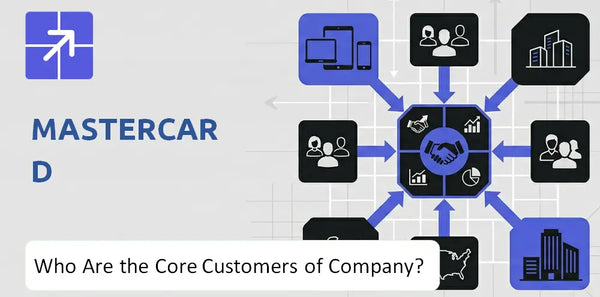
Focus on cardholders, issuer banks, merchant acquirers, and digital-wallet partners; each group shapes product roadmaps. See Mastercard BCG Matrix Analysis for where flagship offerings sit in the portfolio.
Who Is Mastercard Trying to Win?
Mastercard Incorporated targets financial institutions (over 20,000 banks and credit unions), fintechs and neo-banks, commercial clients from SMEs to multinationals, and government agencies; recently it expanded to technology platforms embedding finance and real-time payment rails.
 Main customer group: Banks and card issuers
Banks and credit unions (over 20,000) generate the bulk of transaction volume and interchange relationships, making them Mastercard target market priority for card issuance, processing, and network services.
Secondary groups: Fintechs, neo-banks, digital wallets
Mastercard customers now include fintech enablers, neo-banks, and wallet providers that drive volume and product innovation; by 2025 – early 2026 these partnerships accelerated embedded finance integrations and tokenization projects.
Customer type and market role: Mixed – institutions and businesses
Mastercard serves institutions (issuers, acquirers), businesses (merchants, SMEs, corporates), and indirect consumer cardholders; commercial payment solutions address expense, B2B, and cross-border needs alongside consumer credit and debit.
Most important segment: Issuing banks and payment processors
Issuing banks and payment processors remain the highest revenue drivers via transaction fees and network services; in 2025 network volumes and cross-border transactions continued to account for a majority of gross dollar volume growth.
Mastercard target audience now emphasizes technology platforms integrating embedded finance and real-time rails, merchants adopting contactless/mobile payments, SMEs using small business solutions, and governments for disbursements; see Competitive Landscape of Mastercard Company for market context: Competitive Landscape of Mastercard Company
Mastercard SWOT Analysis
- Complete SWOT Breakdown
- Fully Customizable
- Editable in Excel & Word
- Professional Formatting
- Investor-Ready Format

What Do Mastercard's Customers Care About Most?
Mastercard customers demand fast, secure, and insight-driven payments: banks want high authorization rates and fraud protection; merchants want higher conversion and lower cart abandonment; cardholders want seamless, value-rich experiences that go beyond simple transactions.

Reliability and Authorization Performance
Financial institutions prioritize near-perfect authorization rates and millisecond latency for approvals to protect revenue flow and customer experience; Mastercard's Decision Intelligence processes over 145 billion transactions annually with millisecond latency to meet this need.
Conversion and Checkout Friction
Merchants focus on conversion rates and reducing cart abandonment; demand for seamless checkout tech like Click to Pay and tokenization rises because they directly lift sales and reduce checkout drop-off.
Data-Driven Insights and Predictive Analytics
Across Mastercard target market segments, executives now expect actionable analytics and predictive models to optimize pricing, loyalty, and fraud prevention; value-added services drive strategic decisions.
Value-Added Services and Revenue Mix
Customers increasingly buy services beyond processing: predictive analytics, loyalty management, and cybersecurity consulting now account for approximately 38 percent of total revenue in the 2025/2026 cycle, reflecting demand for holistic business optimization.
Trust, Security, and Fraud Mitigation
Security is non-negotiable for consumer credit card users and banks; advances in AI-driven fraud detection and tokenization reduce chargebacks and protect brand trust for merchant and partner businesses.
Retention and Loyalty Drivers
Retention rests on measurable ROI: merchants and issuers stick with platforms that boost authorization, conversion, and deliver loyalty program lift; integrated analytics and rewards management increase repeat usage.
Why Customers Choose Mastercard
Clients choose Mastercard for scale, speed, and ecosystem reach – serving banks and financial institutions, online shoppers, and merchants across developed and emerging markets – backed by proven authorization performance and expanding service revenue. Read more in How Mastercard Company Works and Makes Money
Mastercard Business Model Canvas
- One-time Payment
- No Research Needed – Save Hours of Work
- Built by Experts, Trusted by Consultants
- Instant Download, Ready to Use
- 100% Editable, Fully Customizable

Where Is Demand Strongest for Mastercard?
Demand peaks in cross-border transactions and emerging digital economies, concentrated in Southeast Asia, Latin America, and Africa, while B2B demand in developed markets like the United States is also very strong.
Cross-border and E – commerce Hubs
Cross-border transaction volume grew faster than domestic spending in 2025, driven by record international travel and global e-commerce; cross-border yields per transaction are materially higher, supporting higher margins for Mastercard target market activities.
High-growth Emerging Economies
Southeast Asia, Latin America, and Africa show the fastest expansion as governments push financial inclusion and cash reduction; digital wallets and mobile payments penetration rose double digits in several markets in 2025, expanding the Mastercard customers base among digital natives.
B2B and Corporate Payments in Developed Markets
In the United States, demand is concentrated in B2B where Mastercard Incorporated displaces paper checks with virtual cards and automated clearing alternatives; corporate and expense cards saw notable volume gains in 2025 as businesses sought efficiency and reconciliation benefits.
Open Banking and Real-time Rails
Open banking platforms and real-time settlement rails created new demand for interoperable solutions in 2025; banks and fintechs partnered to offer instant payouts and tokenized rails, widening the Mastercard target audience to include fintechs and financial institutions that partner with Mastercard.
See related analysis on tactical go-to-market moves in Sales and Marketing Strategy of Mastercard Company
Mastercard Marketing Mix
- Complete Marketing Mix Analysis
- Effortlessly Communicate Your Business Strategy
- Investor-Ready Format
- 100% Editable and Customizable
- Clear and Structured Layout

How Does Mastercard Keep Its Audience Growing?
Mastercard Incorporated grows its audience by expanding acceptance across rails, deepening integrations with banks and merchants, and monetizing value-added services to reach adjacent segments and improve retention.
Expanding Acceptance and Multi-rail Reach
Mastercard target market expansion relies on a multi-rail strategy – card, bank-account, and blockchain rails – so it can serve consumer credit card users, business and corporate clients, and merchant and partner businesses; acceptance grew to over 115 million merchant locations by early 2026, widening the Mastercard target audience and attracting e-commerce merchants and contactless/mobile payment users.
Customer Retention Drivers
Retention is driven by deep integration with financial institutions that partner with Mastercard, embedding cybersecurity, data analytics, and processing services; switching costs rise as banks and merchants adopt these tools, locking in business and corporate clients and small business solutions target customers.
Loyalty, Repeat Demand, and Customer Depth
Repeat demand comes from Value-Added Services – fraud prevention, tokenization, and data-driven offers – that drive cardholder stickiness across premium and rewards cards and corporate/expense cards; these services help capture more of the estimated $125 trillion global B2B payment market and boost lifetime customer value.
Strongest Growth Lever in 2025/2026
The pivot to a platform-for-platforms is the key lever: by enabling partners and developers to build on Mastercard rails, the firm secures mid-teens revenue growth in 2025 and 2026 and expands core customers of Mastercard company across demographics, including millennials and Gen Z digital natives; see Ownership and Control of Mastercard Company for governance context: Ownership and Control of Mastercard Company
Mastercard Boston Consulting Group Matrix
- Built by Experts, Trusted by Consultants
- Structured for Consultants, Students, and Founders
- 100% Editable in Microsoft Word & Excel
- Instant Digital Download – Use Immediately
- Compatible with Mac & PC – Fully Unlocked

Related Blogs
- What Is the History of Mastercard Company and How Did It Evolve?
- What Is the Competitive Landscape of Mastercard Company and How Does It Compete?
- What Is the Growth Outlook of Mastercard Company and Where Is It Heading?
- How Does Mastercard Company Work and What Drives Its Business Model?
- How Does Mastercard Company Reach Customers and Turn Demand into Sales?
- What Do the Mission, Vision, and Core Values of Mastercard Company Reveal?
- Who Owns Mastercard Company Today and Who Holds Control?
Frequently Asked Questions
Mastercard's main customer groups are banks and card issuers, especially banks and credit unions. The company also serves fintechs, neo-banks, digital wallets, commercial clients, merchants, SMEs, corporates, and government agencies. The blog highlights that Mastercard has expanded further into technology platforms using embedded finance and real-time payment rails.
Disclaimer
All information, articles, and product details provided on this website are for general informational and educational purposes only. We do not claim any ownership over, nor do we intend to infringe upon, any trademarks, copyrights, logos, brand names, or other intellectual property mentioned or depicted on this site. Such intellectual property remains the property of its respective owners, and any references here are made solely for identification or informational purposes, without implying any affiliation, endorsement, or partnership.
We make no representations or warranties, express or implied, regarding the accuracy, completeness, or suitability of any content or products presented. Nothing on this website should be construed as legal, tax, investment, financial, medical, or other professional advice. In addition, no part of this site - including articles or product references - constitutes a solicitation, recommendation, endorsement, advertisement, or offer to buy or sell any securities, franchises, or other financial instruments, particularly in jurisdictions where such activity would be unlawful.
All content is of a general nature and may not address the specific circumstances of any individual or entity. It is not a substitute for professional advice or services. Any actions you take based on the information provided here are strictly at your own risk. You accept full responsibility for any decisions or outcomes arising from your use of this website and agree to release us from any liability in connection with your use of, or reliance upon, the content or products found herein.