
How does Mastercard Incorporated operate as a payments infrastructure provider and what drives its revenue mix?
Mastercard Incorporated routes transactions between issuers and merchants, earning fees per transaction and data-driven services; it scales with consumer spending without credit risk. This matters as Mastercard reported strong 2025 volume growth and rising cross-border activity, signaling durable network effects.
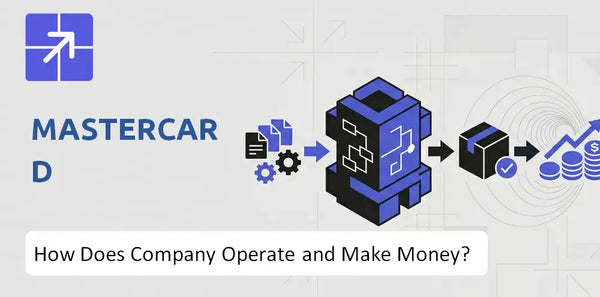
Focus on interchange routing, network fees, and value-added data services; optimize merchant adoption and cross-border volumes. See Mastercard BCG Matrix Analysis for product-level strategy and positioning.
What Does Mastercard Actually Sell?
Mastercard Incorporated sells a global payment network and protocols that connect cardholders, merchants, issuers, and acquirers, plus non-transactional services such as cybersecurity, fraud prevention, data analytics, and loyalty management that customers pay for as subscriptions or per-use fees.
 Core Payment Network and Connectivity
Mastercard offers a real-time transaction switch supporting credit, debit, and prepaid flows across currencies and borders, charging transaction processing fees and network access fees as part of the Mastercard business model.
Enterprise Services and Intelligence
Non-transactional products include fraud prevention, identity and tokenization, cybersecurity tooling, data analytics, and loyalty platforms sold to banks, merchants, and fintechs via subscriptions, licensing, and usage-based pricing.
Who Buys It
Buyers are issuing banks and credit unions, merchant acquirers and large merchants, fintech partners, government/payments programs, and processors that integrate Mastercard APIs and licensing into card issuing and acquiring products.
Practical Value Customers Get
Customers get instant, secure transaction routing, lower fraud losses via advanced detection, behavioral analytics to boost authorization rates, tokenization for mobile wallets, and loyalty tooling that increases spend and retention.
Why the Offering Stands Out
Mastercard stands out for global scale, standardized protocols, extensive bank and merchant partnerships, and integrated APIs that accelerate fintech launches – driving network effects that increase acceptance and reduce per-transaction marginal cost.
Revenue Mix and Recent Trends
By fiscal 2025 Mastercard reported material growth in non-transaction revenue: value-added services accounted for about 36% of revenue, while network and transaction-related fees remained the largest line; total cross-border volume rose over 8% year-over-year, supporting higher gross dollar volumes and licensing income. See Competitive Landscape of Mastercard Company for context.
Mastercard SWOT Analysis
- Complete SWOT Breakdown
- Fully Customizable
- Editable in Excel & Word
- Professional Formatting
- Investor-Ready Format

How Does Mastercard Run Its Business Day to Day?
Mastercard runs payments by routing authorizations, clearing, and settlement across a global network that validates transactions in milliseconds, enforces fraud controls, and posts net settlement between banks. Daily operations center on uptime, multi-rail routing (cards, account-to-account, blockchain), and partner integrations that keep funds flowing to over 100 million merchant locations.

Operating model: network-first transaction routing
Mastercard business model relies on a global switching and messaging backbone that authorizes, clears, and settles payments while applying risk rules and tokenization. The delivery flow runs from merchant acquirer to Mastercard to issuer, with settlement and fee reconciliation occurring in batch and net settlement processes each day.
Product delivery: seamless payment acceptance
Customers access services via issuing banks, merchant acquirers, fintech SDKs, and APIs; merchants accept cards, digital wallets, or account-to-account (A2A) transfers. Transaction processing fees, token services, and value-added APIs are billed to banks and processors, while merchants pay acquiring fees set by partners.
Production & development: continuous platform engineering
Mastercard develops core switching, fraud detection, and API products in-house and via partnerships; it sources cloud, data centers, and blockchain nodes from major providers. R&D and engineering teams deploy incremental updates with blue/green releases to maintain near-100% availability.
Sales channels: B2B partnerships and platform distribution
Distribution runs through over 20,000 financial institution partners, global acquirers, fintech platforms, and technology giants; Mastercard also licenses branded card programs to issuers. Direct sales target banks and enterprise merchants; channel partners integrate APIs to embed payments.
Key assets & partnerships: data, network, and certification
Critical assets include transaction switches, tokenization systems, fraud analytics, and data lakes; strategic ties span >100 payment schemes, major cloud providers, and fintechs. Partnerships with banks, processors, and merchants underpin interchange flows and licensing revenues.
What makes it work: scale, latency, and trust
Scale delivers low marginal cost per transaction; sub-second authorization latency and near-perfect uptime preserve merchant conversion. Risk models, EMV/tokens, and continuous monitoring keep fraud losses down while APIs expand revenue beyond card fees – see Growth Outlook of Mastercard Company for related trend analysis.
Mastercard Business Model Canvas
- One-time Payment
- No Research Needed – Save Hours of Work
- Built by Experts, Trusted by Consultants
- Instant Download, Ready to Use
- 100% Editable, Fully Customizable

How Does Revenue Flow Through Mastercard?
Mastercard generates revenue mainly from fees tied to transaction volume and services, not interest. Demand (consumer and merchant card use) becomes revenue through assessments, processing fees, cross-border fees, and growing data and value-added services.
Network Assessments: Core volume-based fees
Mastercard collects domestic assessments based on the total dollar volume on Mastercard Incorporated branded products; in fiscal 2025 gross dollar volume reached approximately $9.4 trillion, so a small basis point charge on that flow is the primary income source.
Cross-border and Processing Fees
Cross-border volume fees – applied when merchant and issuer are in different countries – carry the highest margins. Transaction processing fees are charged per message or switch event, so higher transaction frequency lifts revenue linearly.
Pricing and Monetization Model
Mastercard monetizes through assessments, per-transaction processing fees, licensing/brand royalties to issuers, and value-added service subscriptions or usage fees; it does not depend on net interest income but on per-dollar and per-message charges.
What Drives Revenue Most
Volume and mix: more online and cross-border commerce raises high-margin cross-border fees; by 2025 roughly 38 percent of revenue came from value-added services and data analytics, so product mix and transaction geography are key drivers.
See further context on ownership and governance in this article: Ownership and Control of Mastercard Company
Mastercard Marketing Mix
- Complete Marketing Mix Analysis
- Effortlessly Communicate Your Business Strategy
- Investor-Ready Format
- 100% Editable and Customizable
- Clear and Structured Layout

What Makes Mastercard's Model Sustainable or Fragile?
Mastercard Incorporated's model rests on powerful network effects and high switching costs: merchants accept Mastercard because billions of consumers carry it, and consumers carry it because of near – universal acceptance. That creates steady transaction volume and high operating margins, but regulatory pressure on interchange fees and sovereign real – time payment systems pose durable threats.
Network effects and acceptance moat
Mastercard business model benefits from two – sided network effects: more cardholders raise merchant acceptance, and vice versa, locking in usage across retail, e – commerce, and travel. In 2025 Mastercard processed over 140 billion transactions globally, supporting resilient transaction processing fees and predictable revenue streams.
Key assets and technology stack
Mastercard company overview shows deep technical assets: global switch infrastructure, APIs for fintechs, and advanced fraud detection (AI/ML). These assets enable growth in B2B payments, digital identity, and tokenization, boosting non – interchange revenue like network and processing fees.
Dependencies and regulatory constraints
How Mastercard works depends on banks and merchants for card issuing and acquiring; interchange fees (which fund much of merchant pricing) are vulnerable to regulation. In several jurisdictions regulators have capped or litigated fees, pressuring margins and forcing more emphasis on services revenue.
Exposure to alternative payment rails
Sovereign real – time systems – FedNow in the US and UPI in India – can bypass card rails and reduce merchant transaction fees. Still, Mastercard has positioned itself as a service provider to some national rails and expanded Mastercard partnerships with banks and fintechs to remain relevant.
Profitability and margin durability
Mastercard reported operating margins frequently above 54 percent in recent years, driven by low capital intensity and scaling of transaction processing. In 2025, network revenue growth and services revenue helped offset pressure on interchange, keeping adjusted operating margin near historical levels.
How durable the model looks in 2025/2026
Overall the Mastercard business model looks resilient: dominant global acceptance and data – driven services provide durable cash flows, while expansion into B2B payments and digital identity offers new revenue streams. Regulatory and sovereign rail risks make parts of the model fragile, but the company's strategic moves reduce single – point exposure; see Target Customers and Market of Mastercard Company for customer segmentation and market detail.
Mastercard Boston Consulting Group Matrix
- Built by Experts, Trusted by Consultants
- Structured for Consultants, Students, and Founders
- 100% Editable in Microsoft Word & Excel
- Instant Digital Download – Use Immediately
- Compatible with Mac & PC – Fully Unlocked

Related Blogs
- What Is the History of Mastercard Company and How Did It Evolve?
- What Is the Competitive Landscape of Mastercard Company and How Does It Compete?
- What Is the Growth Outlook of Mastercard Company and Where Is It Heading?
- How Does Mastercard Company Reach Customers and Turn Demand into Sales?
- What Do the Mission, Vision, and Core Values of Mastercard Company Reveal?
- Who Are the Core Customers in Mastercard Company's Target Market?
- Who Owns Mastercard Company Today and Who Holds Control?
Frequently Asked Questions
Mastercard sells a global payment network plus software-driven services. Its core offering is transaction routing for credit, debit, and prepaid payments, and its other products include fraud prevention, identity and tokenization, cybersecurity tooling, data analytics, and loyalty platforms sold through subscriptions, licensing, and usage-based pricing.
Disclaimer
All information, articles, and product details provided on this website are for general informational and educational purposes only. We do not claim any ownership over, nor do we intend to infringe upon, any trademarks, copyrights, logos, brand names, or other intellectual property mentioned or depicted on this site. Such intellectual property remains the property of its respective owners, and any references here are made solely for identification or informational purposes, without implying any affiliation, endorsement, or partnership.
We make no representations or warranties, express or implied, regarding the accuracy, completeness, or suitability of any content or products presented. Nothing on this website should be construed as legal, tax, investment, financial, medical, or other professional advice. In addition, no part of this site - including articles or product references - constitutes a solicitation, recommendation, endorsement, advertisement, or offer to buy or sell any securities, franchises, or other financial instruments, particularly in jurisdictions where such activity would be unlawful.
All content is of a general nature and may not address the specific circumstances of any individual or entity. It is not a substitute for professional advice or services. Any actions you take based on the information provided here are strictly at your own risk. You accept full responsibility for any decisions or outcomes arising from your use of this website and agree to release us from any liability in connection with your use of, or reliance upon, the content or products found herein.