
Who are Mills Company's core customers in Brazil's industrial rental market?
Mills targets construction contractors, infrastructure developers, and heavy-industrial firms that favor high-utilization rental solutions. This matters because by March 2026 Mills shifted to industrial services, supporting an EBITDA margin >46% and a BRL 5 billion fleet replacement value.
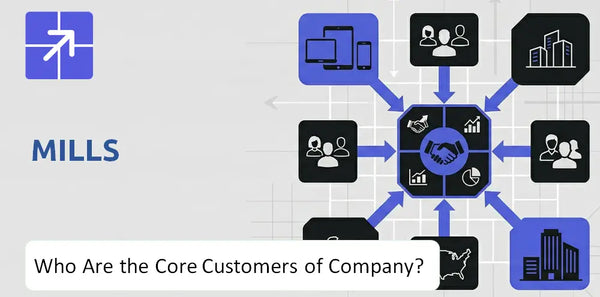
Mills prioritizes long-term contracts with infrastructure projects and repeat commercial builders; focus on utilization drives capital efficiency. See the company's product positioning in Mills BCG Matrix Analysis.
Who Is Mills Trying to Win?
Mills Company tries to win large institutional clients and Tier 1 contractors in safety-critical heavy industries, plus growing mining and infrastructure operators that outsource fleet and logistics.
 Main customer group: Institutional industrial operators
Industrial maintenance firms in oil & gas, pulp & paper, and steel drive the core revenue mix; they require uninterrupted access platform availability for complex turnarounds and safety compliance, accounting for an estimated ~60% of rental revenue in 2025.
Secondary customer groups: Mining and infrastructure consortia
Major mining operators and federal concession consortia in Brazil are a fast-growing segment; Mills expanded its Heavy Rental division by +35% capacity in 2025 to serve outsourced fleet management and balance-sheet preservation needs.
Customer type and market role: B2B institutional partner
Mills Company primarily serves businesses and institutions (not consumers); buyers are procurement and engineering teams, maintenance managers, and EPC contractors seeking integrated access, shoring, and logistics for multi-billion dollar projects.
Most important segment by revenue and scale
The industrial maintenance segment – oil & gas, pulp & paper, and steel – remains most important by revenue and recurring usage, representing ~60% of 2025 utilization hours and driving long-term service contracts; mining is the fastest-growing by CAGR in 2024 – 2025.
For a sales and marketing angle and buyer persona detail see Sales and Marketing Strategy of Mills Company
Mills SWOT Analysis
- Complete SWOT Breakdown
- Fully Customizable
- Editable in Excel & Word
- Professional Formatting
- Investor-Ready Format

What Do Mills's Customers Care About Most?
For Mills Company core customers, uptime and regulatory safety compliance drive purchase decisions; they demand a young, reliable fleet, technical engineering support, and bundled sourcing to minimize costly site downtime and administrative friction.

Operational continuity and safety compliance
Clients hire Mills Company to prevent stoppages and meet NR-18 and NR-35 safety standards; avoiding downtime that can cost contractors tens of thousands per day is central.
Practical buying drivers: total cost of operation
Decision-makers prioritize lifecycle operating costs over headline rental rates, seeking predictable maintenance, fuel efficiency, and fleet age – Mills Company's fleet averages under 6 years as of early 2026.
Emotional and reputational factors
Procurement and site managers prefer vendors that reduce reputational risk from accidents; trusted partners lower stress and signal professional competence to stakeholders.
What customers value most
They value integrated technical engineering support, certified training programs, and bundled equipment supply – platforms, shoring, and earthmoving – from a single vendor to cut logistics and admin time.
Loyalty and repeat demand drivers
Consistent uptime, rapid field service response times, and documented compliance training drive repeat contracts; long-term rental agreements and service SLAs increase customer lifetime value.
Why customers choose Mills Company
Mills Company core customers choose them for a young, reliable fleet, engineering and training services, and one-stop procurement that lowers total operating costs; see Growth Outlook of Mills Company for context.
Mills Business Model Canvas
- One-time Payment
- No Research Needed – Save Hours of Work
- Built by Experts, Trusted by Consultants
- Instant Download, Ready to Use
- 100% Editable, Fully Customizable

Where Is Demand Strongest for Mills?
Mills Company finds the most demand in Brazil's industrial Southeast and infrastructure-heavy Northeast, with strongest activity in pulp & paper and renewable energy maintenance; 2025 growth hotspots are central-west and northern mining hubs driven by Heavy Rental demand.
Main Market: Industrial Southeast & Northeast Brazil
Demand is concentrated in the industrial Southeast and infrastructure-rich Northeast, where large-scale construction and plant maintenance account for roughly 45% of Mills Company core customers' spend in 2025; these regions set purchase cadence and fleet requirements.
Secondary Markets: Mining Hubs & Central-West Growth
The central-west and northern mining hubs show the most aggressive expansion in 2025 – 2026, led by Heavy Rental contracts that drove a 28% year-over-year revenue increase in that segment through Q3 2025.
Where Mills Company Is Strongest: Industrial Maintenance Niche
Mills Company target market strength is in industrial maintenance contracts (recurring opex-funded work), which now represent 38% of revenue versus 22% from one-off construction in 2025, improving customer lifetime value and revenue predictability.
Fastest-Growing Demand: Pulp & Paper and Renewables
Pulp and paper capacity expansion and wind farm maintenance are the fastest-growing customer segments in 2025, together accounting for 33% of new equipment bookings; digital channels now handle > 30% of service requests, signaling a shift to tech-enabled equipment management. See Ownership and Control of Mills Company for corporate context: Ownership and Control of Mills Company
Mills Marketing Mix
- Complete Marketing Mix Analysis
- Effortlessly Communicate Your Business Strategy
- Investor-Ready Format
- 100% Editable and Customizable
- Clear and Structured Layout

How Does Mills Keep Its Audience Growing?
Mills Company keeps its audience growing by cross-selling heavy machinery to aerial-platform customers, expanding geographically into underpenetrated regions, and maintaining retention via fleet renewal and service contracts.
How Mills Company Expands Its Customer Base
Mills Company pulls adjacent Mills Company target market segments by using leadership in aerial work platforms to introduce excavators and telehandlers, increasing wallet share per account and entering new US Sun Belt and European industrial regions.
Customer Retention Drivers
Retention is driven by a >15 percent annual fleet renewal rate, an expanding electric/hybrid lineup to meet ESG mandates, and long-term industrial service contracts that reduce churn among Mills Company core customers.
Loyalty, Repeat Demand, or Customer Depth
Mills Company buyer personas – rental fleets, contractors, and municipal fleets – deliver repeat demand via multi-year rentals and service renewals; lifetime value rises as clients adopt electrified units and add heavy-machinery lines.
The Strongest Customer-Base Growth Lever
The key lever is cross-selling from aerial platforms into heavy equipment while securing long-term service contracts; Mills Company is projected to sustain a ROIC of 16 – 18 percent in 2025/2026 and to outperform the construction index through rental-market consolidation and industrial-service expansion. See the Competitive Landscape of Mills Company for context.
Mills Boston Consulting Group Matrix
- Built by Experts, Trusted by Consultants
- Structured for Consultants, Students, and Founders
- 100% Editable in Microsoft Word & Excel
- Instant Digital Download – Use Immediately
- Compatible with Mac & PC – Fully Unlocked

Related Blogs
- What Is the History of Mills Company and How Did It Evolve?
- What Is the Competitive Landscape of Mills Company and How Does It Compete?
- What Is the Growth Outlook of Mills Company and Where Is It Heading?
- How Does Mills Company Work and What Drives Its Business Model?
- How Does Mills Company Reach Customers and Turn Demand into Sales?
- What Do the Mission, Vision, and Core Values of Mills Company Reveal?
- Who Owns Mills Company Today and Who Holds Control?
Frequently Asked Questions
Mills Company's core customers are large institutional industrial operators, especially firms in oil & gas, pulp & paper, and steel. The company also serves Tier 1 contractors and growing mining and infrastructure operators that outsource fleet and logistics, making its business primarily B2B and project-focused.
Disclaimer
All information, articles, and product details provided on this website are for general informational and educational purposes only. We do not claim any ownership over, nor do we intend to infringe upon, any trademarks, copyrights, logos, brand names, or other intellectual property mentioned or depicted on this site. Such intellectual property remains the property of its respective owners, and any references here are made solely for identification or informational purposes, without implying any affiliation, endorsement, or partnership.
We make no representations or warranties, express or implied, regarding the accuracy, completeness, or suitability of any content or products presented. Nothing on this website should be construed as legal, tax, investment, financial, medical, or other professional advice. In addition, no part of this site - including articles or product references - constitutes a solicitation, recommendation, endorsement, advertisement, or offer to buy or sell any securities, franchises, or other financial instruments, particularly in jurisdictions where such activity would be unlawful.
All content is of a general nature and may not address the specific circumstances of any individual or entity. It is not a substitute for professional advice or services. Any actions you take based on the information provided here are strictly at your own risk. You accept full responsibility for any decisions or outcomes arising from your use of this website and agree to release us from any liability in connection with your use of, or reliance upon, the content or products found herein.