
How does Mills's sales and marketing model convert equipment demand into recurring rental contracts?
Mills pairs fleet rentals with technical engineering services and regional account teams to drive fleet utilization and long-term contracts. This matters as Mills expanded to 200+ branches by 2025, boosting utilization and revenue resilience in a high-rate Brazilian market. Mills BCG Matrix Analysis
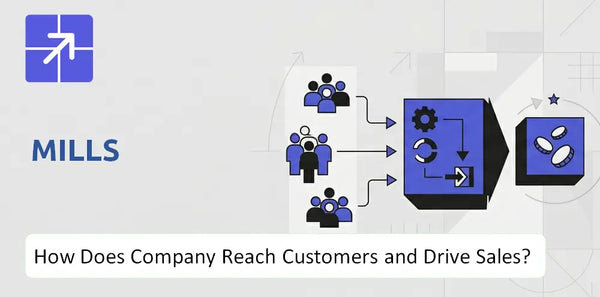
Mills focuses sales on large industrial clients and project managers, using on-site engineers and flexible pricing to shorten sales cycles and lock multi-month rentals. Expect higher renewal rates where on-site services are offered.
Who Does Mills Want to Sell To?
Mills Company wants to sell to large B2B buyers with strict safety and logistics needs, chiefly Tier 1/2 construction firms, major mining operators, and industrial maintenance providers; it wins them via tailored equipment, project-scale focus, and non-discretionary PAC-linked contracts.
 Primary: Tier 1 and Tier 2 Construction & Mining
These clients run large, capital-intensive projects and demand specialized access platforms (AWP) and heavy earthmoving equipment. Mills Company marketing targets firms involved in Brazil's federal Growth Acceleration Program (PAC), where infrastructure spend is non-discretionary, reducing demand volatility.
Secondary: Industrial Maintenance and Agribusiness
Industrial maintenance providers and agribusiness operations need reliable lift and earthmoving gear; together with mining and agribusiness they represent about 30 percent of the heavy equipment mix, helping Mills Company mitigate civil-construction cyclicality.
Market Positioning: Project-Scale, Safety-First Provider
Mills Company sales strategy positions the firm as a specialist for large-scale, safety-critical projects, emphasizing certified safety features, logistics support, and fleet uptime guarantees to downstream contractors and operators.
Why This Positioning Works
The messaging highlights reduced project downtime and compliance with strict safety regs, aligning with buyer procurement criteria; Mills Company customer acquisition leans on proven ROI metrics and case wins in PAC projects to close large contracts.
Mills Company distribution channels blend direct field sales, rental fleets, and authorized dealers to reach procurement teams; demand generation and lead generation methods focus on project pipeline tracking, targeted bids, and digital marketing campaigns to convert large RFQs. See Mission, Vision, and Values of Mills Company for more context: Mission, Vision, and Values of Mills Company
Mills SWOT Analysis
- Complete SWOT Breakdown
- Fully Customizable
- Editable in Excel & Word
- Professional Formatting
- Investor-Ready Format

How Does Mills Get in Front of Customers?
Mills Company gets in front of customers through a dense network of branches, a consultative field sales force, and a digital platform that together drive awareness, capture leads, and convert demand into rentals and services.

Branch network as the primary acquisition channel
Mills Company marketing relies on a physical footprint of over 110 branches placed near Brazil's industrial and infrastructure hubs to generate local awareness and enable quick site service; proximity reduces delivery time and supports repeat business from contractors and planners.
Digital marketing and online reach via platform and app
Mills Company digital marketing campaigns center on the Mills Rental platform and mobile app, which streamline procurement, enable real – time fleet management, and capture leads through search, paid media, and email – converting online inquiries into field deployments.
Sales channels: field force and B2B distribution access
Mills Company sales strategy uses a specialized sales team of over 400 professionals for consultative selling to large infrastructure planners and maintenance contractors, supported by branch logistics and partnerships with local distributors for extended reach.
Demand generation tactics combining local and digital actions
Demand generation mixes targeted industry campaigns, on-site demos, urgent rental promotions, and content marketing; events and account-based outreach convert long – lead infrastructure projects while app-driven push notifications capture short – term maintenance demand.
Customer acquisition efficiency and conversion performance
Mills Company customer acquisition shows efficiency via shorter lead – to – rental cycles where branch proximity and field sales cut deployment time by up to 30% versus remote competitors, improving conversion rates for urgent rentals and large contracts.
Most important reach advantage: omnichannel proximity
The strongest advantage is the hybrid omnichannel approach: physical branches plus a digital procurement stack that together capture both planned projects and rapid-response needs, enabling Mills Company customer acquisition at scale in 2025/2026. Read more on Ownership and Control of Mills Company Ownership and Control of Mills Company
Mills Business Model Canvas
- One-time Payment
- No Research Needed – Save Hours of Work
- Built by Experts, Trusted by Consultants
- Instant Download, Ready to Use
- 100% Editable, Fully Customizable

How Does Mills Turn Attention Into Sales?
Mills Company turns attention into sales by bundling equipment rentals with engineering support and mandatory safety training, converting inquiries into high-margin, compliance-focused contracts. Fleet utilization between 68% and 72% and long-term mining service agreements drive predictable revenue conversion and higher customer lifetime value.
Solution-Centric Sales Model
Sales are direct B2B engagements: field sales and engineering teams qualify needs, propose bundled rentals plus technical engineering and mandatory safety training, and close contracts that solve regulatory and operational hurdles.
Pricing and Monetization Logic
Revenue mixes rental usage fees, project-based engineering fees, and recurring service agreements; cross-sell bundles (aerial platforms plus shoring systems) raise average contract value and margin on each sale.
Conversion and Purchase Drivers
Conversion relies on trust from technical competence, regulatory risk mitigation, competitive fleet availability, and a utilization-focused sales KPI; maintaining 68 – 72% fleet utilization improves revenue per asset and shortens sales cycles.
Repeat Revenue and Customer Expansion
One-stop-shop cross-selling converts initial rentals into broader equipment and services; long-term mining service agreements create recurring cash flows and higher customer lifetime value through renewals and multi-year contracts.
Field teams turn leads from Mills Company marketing and Mills Company digital marketing campaigns into contracts by emphasizing compliance and uptime; Mills Company sales strategy tracks leads through Mills Company sales funnel stages and prioritizes accounts with high fleet utilization potential. For background on the firm's go-to-market evolution see History and Background of Mills Company.
Mills Marketing Mix
- Complete Marketing Mix Analysis
- Effortlessly Communicate Your Business Strategy
- Investor-Ready Format
- 100% Editable and Customizable
- Clear and Structured Layout

How Strong Does Mills's Commercial Engine Look Going Forward?
The commercial engine at Mills Company looks robust heading into 2025/2026, supported by strong margins, diversified product mix, and disciplined capital allocation; downside risks include market cyclicality and rate-sensitive project delays. Key drivers: Heavy equipment rental stabilizes revenue and high EBITDA margins underpin cash generation for growth.
What Supports Future Demand
Heavy equipment expansion provides a counterweight to aerial platform volatility, improving product-market fit and channel reach. Strong brand recognition in Brazil plus infrastructure spending should sustain Mills Company marketing pull and Mills Company demand generation.
Channel and Marketing Effectiveness
Field sales, rental yards, and targeted B2B outreach drive lead conversion; digital campaigns and account-based approaches support Mills Company customer acquisition. Distribution channels and retail partnerships amplify coverage while e-commerce and CRM improve Mills Company conversion tactics.
Risks to Commercial Performance
Construction slowdowns or reduced Brazil infrastructure spending would pressure utilization and rental rates; interest-rate hikes could raise fleet financing costs. Competitive pricing pressure and operational execution on Heavy segment scale-up are additional risks to Mills Company sales strategy.
The Overall Sales and Marketing Outlook
Outlook is bullish: professional judgment expects 15 to 20 percent annual revenue growth and an EBITDA margin of 47 to 50 percent in 2025 driven by Heavy rental consolidation. Financial strength – ROIC > 19 percent and Net Debt/EBITDA ~ 1.6x – supports continued investment in Mills Company sales funnel stages and Mills Company lead generation methods.
See detailed context in this analysis: Growth Outlook of Mills Company
Mills Boston Consulting Group Matrix
- Built by Experts, Trusted by Consultants
- Structured for Consultants, Students, and Founders
- 100% Editable in Microsoft Word & Excel
- Instant Digital Download – Use Immediately
- Compatible with Mac & PC – Fully Unlocked

Related Blogs
- What Is the History of Mills Company and How Did It Evolve?
- What Is the Competitive Landscape of Mills Company and How Does It Compete?
- What Is the Growth Outlook of Mills Company and Where Is It Heading?
- How Does Mills Company Work and What Drives Its Business Model?
- What Do the Mission, Vision, and Core Values of Mills Company Reveal?
- Who Are the Core Customers in Mills Company's Target Market?
- Who Owns Mills Company Today and Who Holds Control?
Frequently Asked Questions
Mills mainly sells to large B2B buyers with strict safety and logistics needs. Its core targets are Tier 1 and Tier 2 construction firms, major mining operators, and industrial maintenance providers, with agribusiness also part of the mix. The focus is on project-scale, safety-critical work and PAC-linked contracts.
Disclaimer
All information, articles, and product details provided on this website are for general informational and educational purposes only. We do not claim any ownership over, nor do we intend to infringe upon, any trademarks, copyrights, logos, brand names, or other intellectual property mentioned or depicted on this site. Such intellectual property remains the property of its respective owners, and any references here are made solely for identification or informational purposes, without implying any affiliation, endorsement, or partnership.
We make no representations or warranties, express or implied, regarding the accuracy, completeness, or suitability of any content or products presented. Nothing on this website should be construed as legal, tax, investment, financial, medical, or other professional advice. In addition, no part of this site - including articles or product references - constitutes a solicitation, recommendation, endorsement, advertisement, or offer to buy or sell any securities, franchises, or other financial instruments, particularly in jurisdictions where such activity would be unlawful.
All content is of a general nature and may not address the specific circumstances of any individual or entity. It is not a substitute for professional advice or services. Any actions you take based on the information provided here are strictly at your own risk. You accept full responsibility for any decisions or outcomes arising from your use of this website and agree to release us from any liability in connection with your use of, or reliance upon, the content or products found herein.