
Who are OSI Systems core customers among government, healthcare, and commercial security buyers?
OSI Systems sells mission-critical screening and medical devices to governments, airports, hospitals, and defense contractors; these buyers pay premiums for reliability and compliance. Backlog topped $1.9 billion in early 2026, signaling sustained institutional demand. See OSI Systems BCG Matrix Analysis
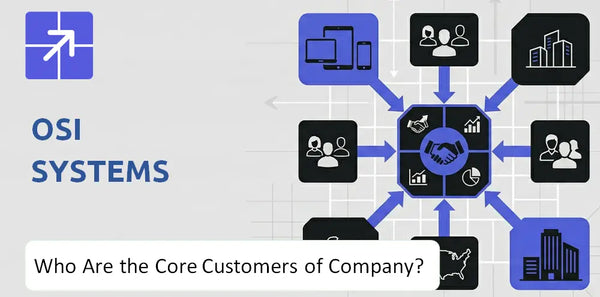
Focus on procurement cycles: multi-year contracts and certifications (e.g., CBP, FDA) drive stickiness and revenue visibility; prioritize sales teams that navigate RFPs and regulatory timelines.
Who Is OSI Systems Trying to Win?
OSI Systems tries to win large, institutional buyers across security, healthcare, and defense: national customs and airport authorities, mid-to-large hospital systems, and Tier 1 aerospace/defense OEMs.
 Primary: Government and Airport Security Customers
OSI Systems target customers are mainly national customs agencies, border protection units, and international airport authorities that run procurement cycles lasting multiple years; the Security division drives about 62% of 2025 revenue, so aviation security customers and tenders for airport screening matter most.
Secondary: Healthcare Equipment Buyers
Spacelabs targets mid-to-large hospital systems and surgical centers that buy patient monitoring and anesthesia equipment; hospitals buying OSI Systems medical devices represent a steady recurring-revenue stream and clinical procurement partners.
Customer Type and Market Role
OSI Systems serves institutions and businesses, not retail consumers: government and defense buyers, healthcare administrators, and OEM partners for OSI Systems optoelectronics components form the core customer segments.
Most Important Segment by Revenue
The Security division is the most important segment by revenue and strategic weight – contributing roughly 62% of 2025 sales – followed by Healthcare (Spacelabs) and Optoelectronics serving defense OEMs and surveillance integrators; see market context in Competitive Landscape of OSI Systems Company.
OSI Systems SWOT Analysis
- Complete SWOT Breakdown
- Fully Customizable
- Editable in Excel & Word
- Professional Formatting
- Investor-Ready Format

What Do OSI Systems's Customers Care About Most?
OSI Systems target customers prioritize uninterrupted operations, higher throughput, and strict regulatory compliance; buying decisions hinge on AI-driven accuracy in screening, real-time medical monitoring reliability, and Total Cost of Ownership (TCO) including 24/7 support and equipment longevity.

Rapid, Accurate Screening for Security Operations
Aviation security customers and security integrators need fast passenger and cargo throughput without accuracy loss; AI-driven automated threat recognition (ATR) that reduces manual review time addresses throughput bottlenecks and staffing limits.
Practical Buying Drivers: TCO and Support
Across OSI Systems core markets, procurement teams – airports and airlines, government and defense buyers, and healthcare equipment buyers – choose solutions with lower lifecycle costs, predictable maintenance, and 24/7 technical support to minimize downtime.
Emotional or Aspirational Appeal: Trust and Safety
Buyers value the reputational upside of reliable screening and clinical safety; procurement officers and hospital administrators prefer vendors that signal professionalism and risk reduction to stakeholders and patients.
What Customers Value Most: Reliability and Interoperability
Healthcare administrators and clinical labs prioritize data interoperability and uptime for continuous patient monitoring; defense contractors and government agencies prioritize proven accuracy and integration with legacy systems.
Loyalty and Repeat Demand: Service and Upgrades
Repeat purchases come from long-term service contracts, timely firmware and AI model updates, and spare-parts availability; OEM partners and retailers value clear upgrade paths that extend asset life and reduce TCO.
Why Customers Choose OSI Systems
OSI Systems customers airports and airlines, hospitals buying OSI Systems medical devices, and government agencies procuring OSI Systems technology pick the company for measurable throughput gains, regulatory-grade performance, and vendor-backed lifecycle support; recent procurement trends show screening customers demand AI-enabled ATR and healthcare buyers require verified interoperability.
Ownership and Control of OSI Systems Company
OSI Systems Business Model Canvas
- One-time Payment
- No Research Needed – Save Hours of Work
- Built by Experts, Trusted by Consultants
- Instant Download, Ready to Use
- 100% Editable, Fully Customizable

Where Is Demand Strongest for OSI Systems?
Demand for OSI Systems is strongest in international border security and large-scale infrastructure modernization, with peak activity in the Middle East and Latin America and significant U.S. demand tied to federal checkpoint and port-screening upgrades.
Primary Market: International Border Security and Infrastructure
The Middle East and Latin America show the fastest growth for OSI Systems target customers, driven by turnkey contracts that bundle equipment, staffing, and maintenance; contracts awarded in 2025 exceeded $220 million in aggregate for security systems in those regions.
Secondary Markets: U.S. Federal and Healthcare
Domestically, aviation security customers like TSA and CBP are shifting to CT-based checkpoint screening and non-intrusive inspection (NII) for ports, supporting strong procurement by airports and airlines; healthcare equipment buyers favor ambulatory and remote patient monitoring as hospitals decentralize care.
Where OSI Systems Is Strongest
OSI Systems is strongest where turnkey integration matters: government and defense buyers plus security integrators purchasing screening solutions represent the largest revenue mix, with optoelectronics and screening divisions contributing over 60% of 2025 segment revenue.
Fastest-Growing Demand Areas for 2025 – 2026
Demand is growing fastest for CT checkpoint screening, NII port inspections, and optoelectronics for unmanned systems – defense spending boosts OEM partners for OSI Systems optoelectronics components; ambulatory monitoring adoption from hospitals buying OSI Systems medical devices rose by 18% in 2025 year-over-year. Read the Growth Outlook of OSI Systems Company for more context: Growth Outlook of OSI Systems Company
OSI Systems Marketing Mix
- Complete Marketing Mix Analysis
- Effortlessly Communicate Your Business Strategy
- Investor-Ready Format
- 100% Editable and Customizable
- Clear and Structured Layout

How Does OSI Systems Keep Its Audience Growing?
OSI Systems keeps its audience growing by shifting sales toward recurring Screening-as-a-Service and long-term maintenance contracts, reinvesting in R&D, and scaling AI-driven software subscriptions to deepen wallet share across existing government, aviation security customers, and healthcare equipment buyers.
Expanding OSI Systems target customers
OSI Systems broadens OSI Systems core markets by converting a record backlog into revenue and cross-selling AI software to aviation security customers, healthcare equipment buyers, and government and defense buyers; international airport procurement and clinical labs provide adjacent growth channels.
Customer Retention Drivers
High retention stems from recurring service contracts and Screening-as-a-Service, which create predictable cash flows and improve Security division margins; maintenance renewals and enterprise subscriptions reduced churn in 2025 as service revenue rose versus one-time hardware sales.
Loyalty, Repeat Demand, and Customer Depth
Repeat demand is driven by long-term maintenance, software renewals, and upgrades; hospitals buying OSI Systems medical devices and airports and airlines purchasing screening solutions routinely add modules and AI subscriptions, increasing lifetime value and ecosystem stickiness.
Strongest Customer-Base Growth Lever
The key growth lever in 2025/2026 is converting backlog into recurring revenue via Screening-as-a-Service and AI-driven subscriptions; with roughly 7 percent of revenue reinvested in R&D and a record backlog, OSI Systems customers see faster product upgrades and higher retention, especially among government agencies procuring OSI Systems technology. Read more: How OSI Systems Company Works and Makes Money
OSI Systems Boston Consulting Group Matrix
- Built by Experts, Trusted by Consultants
- Structured for Consultants, Students, and Founders
- 100% Editable in Microsoft Word & Excel
- Instant Digital Download – Use Immediately
- Compatible with Mac & PC – Fully Unlocked

Related Blogs
- What Is the History of OSI Systems Company and How Did It Evolve?
- What Is the Competitive Landscape of OSI Systems Company and How Does It Compete?
- What Is the Growth Outlook of OSI Systems Company and Where Is It Heading?
- How Does OSI Systems Company Work and What Drives Its Business Model?
- How Does OSI Systems Company Reach Customers and Turn Demand into Sales?
- What Do the Mission, Vision, and Core Values of OSI Systems Company Reveal?
- Who Owns OSI Systems Company Today and Who Holds Control?
Frequently Asked Questions
OSI Systems mainly serves institutional buyers, not retail consumers. Its core customers include national customs agencies, border protection units, international airport authorities, mid-to-large hospital systems, surgical centers, and Tier 1 aerospace/defense OEMs. These groups buy across security, healthcare, and optoelectronics segments.
Disclaimer
All information, articles, and product details provided on this website are for general informational and educational purposes only. We do not claim any ownership over, nor do we intend to infringe upon, any trademarks, copyrights, logos, brand names, or other intellectual property mentioned or depicted on this site. Such intellectual property remains the property of its respective owners, and any references here are made solely for identification or informational purposes, without implying any affiliation, endorsement, or partnership.
We make no representations or warranties, express or implied, regarding the accuracy, completeness, or suitability of any content or products presented. Nothing on this website should be construed as legal, tax, investment, financial, medical, or other professional advice. In addition, no part of this site - including articles or product references - constitutes a solicitation, recommendation, endorsement, advertisement, or offer to buy or sell any securities, franchises, or other financial instruments, particularly in jurisdictions where such activity would be unlawful.
All content is of a general nature and may not address the specific circumstances of any individual or entity. It is not a substitute for professional advice or services. Any actions you take based on the information provided here are strictly at your own risk. You accept full responsibility for any decisions or outcomes arising from your use of this website and agree to release us from any liability in connection with your use of, or reliance upon, the content or products found herein.