
How does OSI Systems' sales and marketing model convert technical demand into durable contracts?
OSI Systems sells complex security and healthcare equipment via specialist direct sales, long procurement cycles, and technical pilots; marketing targets procurement and clinical decision-makers. This matters because a record-high backlog in 2025 signals strong funnel conversion but delayed revenue realization.
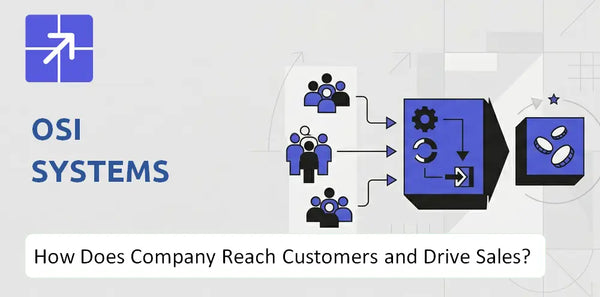
OSi teams pair field engineers with procurement leads to close contracts and upsell services; near-term focus: convert the 2025 backlog into revenue within 12 – 24 months. See product analysis: OSI Systems BCG Matrix Analysis
Who Does OSI Systems Want to Sell To?
OSI Systems wants to sell to institutional, mission-driven buyers with high switching costs: government security agencies, hospitals and clinical leaders, and Tier 1 aerospace/defense and medical imaging OEMs. The company wins by offering certified, reliable systems, long-term service contracts, and regulatory-compliant solutions that prioritize uptime and lifecycle value.
 Primary buyer: Government security and airport operators
OSI Systems targets customs agencies, border protection authorities, and airport operators that demand high-throughput cargo and baggage screening. These buyers value equipment certified to standards such as TSA, ECAC, and ICAO, and they sign service-heavy contracts often exceeding $1 million per program, driving OSI Systems marketing and sales strategy toward long procurement cycles and formal RFQs.
Secondary buyer: Hospitals and clinical department heads
Under the Spacelabs brand, OSI Systems sells patient monitors and anesthesia systems to hospital administrators and nursing/clinical leaders focused on reliability and regulatory compliance (FDA, CE). Typical contracts for monitoring platforms and service bundles range from $200k to $2M, so the OSI Systems sales funnel emphasizes clinical trials, hospital pilots, and ROI studies to shorten adoption windows.
Tertiary buyer: Tier 1 OEMs in aerospace, defense, and medical imaging
OSI Systems' Optoelectronics and Manufacturing segment supplies precision components to Tier 1 OEMs that prioritize long-term reliability and contractually enforced quality metrics (PPM targets, AS9100). Purchase orders are often engineered-to-order with multi-year frameworks; a single program can represent $5M+ in lifetime revenue, aligning OSI Systems customer acquisition with relationship-based account management.
Market positioning: Trusted, compliant, service-led supplier
OSI Systems positions itself as a reliability-first, compliance-driven partner rather than a low-cost vendor. The messaging centers on uptime guarantees, lifecycle service, and certifications – this supports demand generation OSI Systems and higher-margin, contract-backed sales versus commodity deals.
Why the positioning works: Low switching risk, high service value
Target customers face high switching costs and strict performance standards, so OSI Systems converts product interest into sales via pilots, formal approvals, and long-term maintenance agreements; reported recurring revenue and service contracts composed roughly 30 – 35% of segment revenue in recent fiscal reporting, reinforcing its sales strategy and customer retention and upsell strategies. Read more in this related piece: Mission, Vision, and Values of OSI Systems Company
OSI Systems SWOT Analysis
- Complete SWOT Breakdown
- Fully Customizable
- Editable in Excel & Word
- Professional Formatting
- Investor-Ready Format

How Does OSI Systems Get in Front of Customers?
OSI Systems gets in front of customers via a dual-channel approach: a specialized direct sales force for large government, healthcare, and enterprise accounts, plus an extensive international distributor and local representative network that drives awareness, generates demand, and converts opportunities into contracts.

Direct Sales for Strategic, High-Value Contracts
OSI Systems sales strategy centers on a specialized direct sales team that pursues multi-year government and infrastructure procurements through competitive bids and trade missions, capturing large, high-margin contracts that often exceed $50 million per program in recent years.
Digital Presence and Targeted Online Outreach
OSI Systems marketing uses targeted digital channels – SEO, technical content, LinkedIn thought leadership, and email campaigns – to nurture B2B leads; paid search and content syndication support lead generation for optoelectronics and healthcare segments.
Distributors and Local Representatives Expand Reach
OSI Systems distribution channels include hundreds of international distributors and authorized resellers that provide local sales coverage, compliance support, and after-sales service, accounting for roughly 40-60% of non-US commercial revenue in 2025.
Demand Gen via Events, GPOs, and Clinical Demos
Demand generation OSI Systems relies on includes participation in major trade shows, defense and infrastructure RFP outreach, Group Purchasing Organizations (GPOs) in Healthcare, and clinical demonstrations at medical conferences that convert trials into procurement – GPO contracts drive recurring purchase volumes.
Engineer-to-Engineer Sales in Optoelectronics
For optoelectronics, OSI Systems employs an engineer-to-engineer sales funnel: embedding technical teams into customer R&D to secure design wins that lead to multi-year supply agreements and predictable revenue streams.
Efficiency of Customer Acquisition
Customer acquisition efficiency reflects long sales cycles but high lifetime value: typical defense and infrastructure deals close over 12 – 36 months, while once onboarded, contracts deliver sustained revenue; OSI reported steady backlog growth into 2025 supporting conversion rates.
Key Reach Advantage in 2025
The primary reach advantage is a hybrid model combining direct government-facing teams plus broad distributor coverage, enabling scale across markets; this mix, supported by technical sales and GPO access, underpins OSI Systems customer acquisition and retention in 2025.
For detailed customer segments and market context see Target Customers and Market of OSI Systems Company
OSI Systems Business Model Canvas
- One-time Payment
- No Research Needed – Save Hours of Work
- Built by Experts, Trusted by Consultants
- Instant Download, Ready to Use
- 100% Editable, Fully Customizable

How Does OSI Systems Turn Attention Into Sales?
OSI Systems turns attention into sales by pairing hardware wins with multi-year service and software contracts, shifting buyers from one-time capital purchases to recurring operational spending; this razor-and-blade approach, plus turnkey screening offerings, converts interest into predictable revenue.
Core sales model: hardware-led, service-backed contracts
OSI Systems sales strategy centers on direct B2B deals for screening hardware and medical devices, then attaching long-term service contracts, software subscriptions, and turnkey operations to lock customers into an ecosystem.
Pricing and monetization logic: capex to opex conversion
Pricing mixes one-time equipment fees with recurring service and software revenue; by fiscal 2025, service and software made up about 35 percent of total sales, creating steadier margins and predictable cash flow.
Conversion and purchase drivers: turnkey value and data lock-in
Deals convert when OSI Systems demonstrates lower total cost of ownership and operational simplicity via turnkey delivery, proven detection performance, and proprietary remote monitoring – making competitor displacement costly.
Repeat revenue and expansion: service renewals and upsells
After installation, customers renew maintenance contracts, buy software upgrades, and expand services; ecosystem stickiness and data platforms support upsell rates and extended contract lengths, boosting lifetime value.
OSI Systems marketing and OSI Systems customer acquisition lean on trade shows, direct sales teams, and channel partners to seed the funnel; lead qualification focuses on CAPEX cycles and compliance needs, so demand generation OSI Systems activities target procurement windows and security budgets. For deeper operational and financial context see How OSI Systems Company Works and Makes Money.
OSI Systems Marketing Mix
- Complete Marketing Mix Analysis
- Effortlessly Communicate Your Business Strategy
- Investor-Ready Format
- 100% Editable and Customizable
- Clear and Structured Layout

How Strong Does OSI Systems's Commercial Engine Look Going Forward?
OSI Systems commercial engine enters 2025/2026 strong, backed by a near $1.9 billion backlog and rising recurring service revenue that smooths lumpiness; port/border modernization and healthcare replacement cycles support demand, while geopolitics and supply-chain swings could weaken execution.
What Supports Future Demand
Security modernization and Healthcare monitoring renewals drive sustained order flow; the backlog near $1.9 billion and recurring service revenue growing 12 – 14 percent annually provide predictable revenue tails that boost OSI Systems marketing and OSI Systems sales strategy effectiveness.
Channel and Marketing Effectiveness
OSI Systems mixes direct B2B sales, distributor partners, and channel OEM deals; trade shows, targeted federal procurement outreach, and digital lead generation shorten the OSI Systems sales funnel and improve customer acquisition conversion rates.
Risks to Commercial Performance
Large government contract timing remains lumpy; supply-chain delays and component inflation can push margins, and shifting geopolitics may slow border-security spending – risks to demand generation OSI Systems relies on.
The Overall Sales and Marketing Outlook
Outlook is strong and adaptable: expect mid-to-high single-digit organic growth and EBITDA margins moving toward 20 percent, supported by recurring service growth and diversified OSI Systems distribution channels; see Growth Outlook of OSI Systems Company for more context: Growth Outlook of OSI Systems Company
OSI Systems Boston Consulting Group Matrix
- Built by Experts, Trusted by Consultants
- Structured for Consultants, Students, and Founders
- 100% Editable in Microsoft Word & Excel
- Instant Digital Download – Use Immediately
- Compatible with Mac & PC – Fully Unlocked

Related Blogs
- What Is the History of OSI Systems Company and How Did It Evolve?
- What Is the Competitive Landscape of OSI Systems Company and How Does It Compete?
- What Is the Growth Outlook of OSI Systems Company and Where Is It Heading?
- How Does OSI Systems Company Work and What Drives Its Business Model?
- What Do the Mission, Vision, and Core Values of OSI Systems Company Reveal?
- Who Are the Core Customers in OSI Systems Company's Target Market?
- Who Owns OSI Systems Company Today and Who Holds Control?
Frequently Asked Questions
OSI Systems mainly sells to government security agencies, hospitals and clinical leaders, and Tier 1 aerospace, defense, and medical imaging OEMs. The company focuses on buyers with high switching costs who value certified systems, long-term service contracts, and regulatory-compliant solutions that prioritize uptime and lifecycle value.
Disclaimer
All information, articles, and product details provided on this website are for general informational and educational purposes only. We do not claim any ownership over, nor do we intend to infringe upon, any trademarks, copyrights, logos, brand names, or other intellectual property mentioned or depicted on this site. Such intellectual property remains the property of its respective owners, and any references here are made solely for identification or informational purposes, without implying any affiliation, endorsement, or partnership.
We make no representations or warranties, express or implied, regarding the accuracy, completeness, or suitability of any content or products presented. Nothing on this website should be construed as legal, tax, investment, financial, medical, or other professional advice. In addition, no part of this site - including articles or product references - constitutes a solicitation, recommendation, endorsement, advertisement, or offer to buy or sell any securities, franchises, or other financial instruments, particularly in jurisdictions where such activity would be unlawful.
All content is of a general nature and may not address the specific circumstances of any individual or entity. It is not a substitute for professional advice or services. Any actions you take based on the information provided here are strictly at your own risk. You accept full responsibility for any decisions or outcomes arising from your use of this website and agree to release us from any liability in connection with your use of, or reliance upon, the content or products found herein.