
Who are Outbrain's core customers among premium publishers and performance advertisers?
Outbrain targets premium publishers seeking diversified ad revenue and performance advertisers chasing scalable, contextual reach outside walled gardens. This matters because in 2025 Outbrain shifted to full-funnel media offerings, boosting publisher RPMs and advertiser ROAS versus open-web peers.
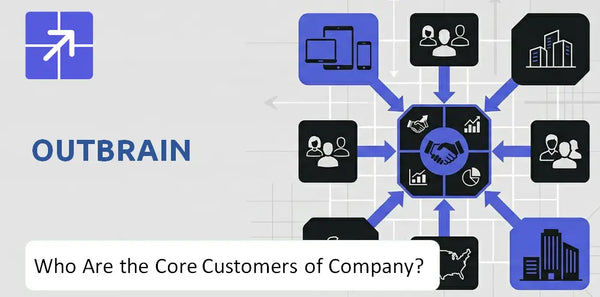
Focus on publishers with high-quality content and advertisers prioritizing intent-driven placements; leverage Outbrain's first-party signals to improve conversion rates. See Outbrain BCG Matrix Analysis.
Who Is Outbrain Trying to Win?
Outbrain tries to win performance marketers, direct-to-consumer brands, global advertising agencies, and premium digital publishers who need measurable outcomes and advanced monetization beyond social feeds.
 Main customer group: Performance advertisers and Fortune 500 brands
Performance marketers, e-commerce advertisers, and post-Teads Fortune 500 brand teams that prioritize video and attention metrics form Outbrain target market core customers – these buyers drove a reported uplift in video spend after the Teads integration in late 2024 and through 2025.
Secondary customer groups: Publisher partners and SMB advertisers
Premium publishers such as CNN, Sky News, and Washington Post supply inventory and use Outbrain publisher tools to offset display declines, while a self-service segment of small-to-medium businesses uses native advertising to scale cost-efficiently.
Customer type and market role: B2B marketplace linking advertisers and publishers
Outbrain serves a mixed B2B customer base – digital advertising agencies, advertisers, and institutional publisher partners – with platform marketplace economics that route ad spend to premium inventory and measure outcomes outside social ecosystems.
Most important segment by revenue and strategic relevance
The highest-value segment is brand advertisers and large agencies prioritizing high-impact video and attention-based metrics; post-2024 integration moves contributed materially to attracting bigger direct deals and higher CPMs for premium inventory.
Mission, Vision, and Values of Outbrain Company
Outbrain SWOT Analysis
- Complete SWOT Breakdown
- Fully Customizable
- Editable in Excel & Word
- Professional Formatting
- Investor-Ready Format

What Do Outbrain's Customers Care About Most?
Advertisers on Outbrain care most about measurable ROI and safe, relevant placements; publishers care most about maximizing RPM while preserving user experience. Both value privacy-safe targeting post-2025, AI automation, and formats that drive conversions without increasing churn.

Precise performance and privacy-first targeting
Advertisers need reliable ROAS and low CPA; since the 2025 privacy shift they rely on Outbrain target market capabilities like the proprietary interest graph for cookie-free precision. Performance marketers and digital advertising agencies expect measurable lift: programmatic campaigns report median conversion rate improvements of around +12% in comparable native placements.
Practical buying drivers: yield, cost, and ease
Advertisers pick Outbrain target audience for predictable ROAS and automated bidding that lowers CPA; publishers choose Outbrain to boost RPM without invasive units. Agencies and small businesses favor straightforward campaign setup and measurable CPA targets tied to native advertising advertisers results.
Emotional and aspirational appeal
Brands and performance marketers seek trust and brand-safety in placement; publishers want reputation protection so readers stay engaged. Clients feel reassured by privacy-first messaging and AI tools that promise smarter, time-saving optimization.
What customers value most
Advertisers value measurable ROAS and lower CPA; publishers value higher RPM and non-intrusive formats that reduce bounce. Both segments prize AI-driven automation – automated bidding for advertisers and layout optimization for publisher partners – to scale results while protecting UX.
Loyalty and repeat demand
Repeat demand hinges on consistent ROAS for advertisers and steady RPM for publishers. Transparent reporting, privacy compliance post-2025, and AI features that cut operational time increase retention among Outbrain core customers and advertising agencies.
Why customers choose Outbrain
Outbrain wins because it delivers privacy-first targeting via its interest graph, AI automation that reduces CPA and boosts RPM, and native ad placements that fit editorial flows – making it a preferred choice for advertisers, publisher partners, and agencies focused on performance and user experience. Read more on Ownership and Control of Outbrain Company Ownership and Control of Outbrain Company
Outbrain Business Model Canvas
- One-time Payment
- No Research Needed – Save Hours of Work
- Built by Experts, Trusted by Consultants
- Instant Download, Ready to Use
- 100% Editable, Fully Customizable

Where Is Demand Strongest for Outbrain?
Outbrain finds most demand in the United States and Western Europe, which together drive roughly 70% of revenue; mobile-web and Connected TV (CTV) environments show the highest engagement and spend.
Main Market: US and Western Europe
The Outbrain target market is concentrated in the United States and Western Europe, where publisher partners and native advertising advertisers deliver the bulk of impressions and monetization; this matters because these regions account for about 70% of total revenue in 2025.
Secondary Markets and Vertical Demand
Asia-Pacific – especially retail and finance verticals – is the fastest-growing region for Outbrain target audience demand in 2025 – 2026, while high-consideration sectors like automotive, insurance, and technology drive industry-specific spend from advertisers and agencies.
Where Outbrain Is Strongest
Outbrain core customers are strongest on mobile-web and CTV, with video-based native ads now making up over 40% of total ad spend; publishers and digital advertising agencies rely on Outbrain for long-form educational content distribution.
Where Demand Is Growing Fastest
Demand is growing fastest in Asia-Pacific in 2025 and 2026, led by e-commerce and finance advertisers scaling native advertising; performance marketers and publisher partners are allocating more budget to CTV and mobile video formats. Read a related analysis in Growth Outlook of Outbrain Company
Outbrain Marketing Mix
- Complete Marketing Mix Analysis
- Effortlessly Communicate Your Business Strategy
- Investor-Ready Format
- 100% Editable and Customizable
- Clear and Structured Layout

How Does Outbrain Keep Its Audience Growing?
Outbrain keeps its audience growing by retaining publishers through multi-year integrations and by diversifying ad formats and channels to reach adjacent segments like retail media and shoppable commerce; product depth, first-party data, and tech scale drive retention and advertiser demand.
How Outbrain Expands Its Customer Base
Outbrain expands reach by converting publisher partners with exclusive, multi-year Onyx and Keystone integrations and by adding formats (shoppable video, interactive units) that attract new advertisers across retail media and e-commerce. The Teads acquisition widened the Outbrain target market and increased global inventory, helping win digital advertising agencies and native advertising advertisers seeking scale.
Customer Retention Drivers
Publisher retention exceeds 92 percent (Q1 2026) due to deep platform embedding, revenue-share models, and multi-year contracts; first-party data and improved targeting reduce churn for advertisers by boosting campaign ROI and lowering acquisition costs for performance marketers.
Loyalty, Repeat Demand, and Customer Depth
Repeat demand rises as ad formats evolve: shoppable and interactive video units increased ARPU by 15 percent year-over-year, and integrated analytics/attribution tools deepen advertiser stickiness and renewals for agencies and brands focused on performance.
Strongest Customer-Base Growth Lever
The key lever is scale plus first-party data: Outbrain's combined inventory and Teads synergies expand the total addressable market and position the platform as essential for advertisers navigating the post-cookie era, supporting credible professional judgment of double-digit growth in 2025/2026. Read more in the company history: History and Background of Outbrain Company
Outbrain Boston Consulting Group Matrix
- Built by Experts, Trusted by Consultants
- Structured for Consultants, Students, and Founders
- 100% Editable in Microsoft Word & Excel
- Instant Digital Download – Use Immediately
- Compatible with Mac & PC – Fully Unlocked

Related Blogs
- What Is the History of Outbrain Company and How Did It Evolve?
- What Is the Competitive Landscape of Outbrain Company and How Does It Compete?
- What Is the Growth Outlook of Outbrain Company and Where Is It Heading?
- How Does Outbrain Company Work and What Drives Its Business Model?
- How Does Outbrain Company Reach Customers and Turn Demand into Sales?
- What Do the Mission, Vision, and Core Values of Outbrain Company Reveal?
- Who Owns Outbrain Company Today and Who Holds Control?
Frequently Asked Questions
Outbrain's core customers are performance marketers, e-commerce advertisers, Fortune 500 brand teams, digital advertising agencies, and premium publishers. The blog also notes that small-to-medium businesses use its self-service native advertising tools, while publisher partners use Outbrain to monetize inventory and offset display declines.
Disclaimer
All information, articles, and product details provided on this website are for general informational and educational purposes only. We do not claim any ownership over, nor do we intend to infringe upon, any trademarks, copyrights, logos, brand names, or other intellectual property mentioned or depicted on this site. Such intellectual property remains the property of its respective owners, and any references here are made solely for identification or informational purposes, without implying any affiliation, endorsement, or partnership.
We make no representations or warranties, express or implied, regarding the accuracy, completeness, or suitability of any content or products presented. Nothing on this website should be construed as legal, tax, investment, financial, medical, or other professional advice. In addition, no part of this site - including articles or product references - constitutes a solicitation, recommendation, endorsement, advertisement, or offer to buy or sell any securities, franchises, or other financial instruments, particularly in jurisdictions where such activity would be unlawful.
All content is of a general nature and may not address the specific circumstances of any individual or entity. It is not a substitute for professional advice or services. Any actions you take based on the information provided here are strictly at your own risk. You accept full responsibility for any decisions or outcomes arising from your use of this website and agree to release us from any liability in connection with your use of, or reliance upon, the content or products found herein.