
How does Outbrain reach customers and convert demand through its sales and marketing model?
Outbrain sells access to premium publisher audiences via a performance-driven platform that combines native recommendation, programmatic buying, and publisher-first data. This matters as advertisers favor first-party signals in 2025 – 2026 after cookie deprecation; Outbrain reported growth in publisher partnerships in 2025.
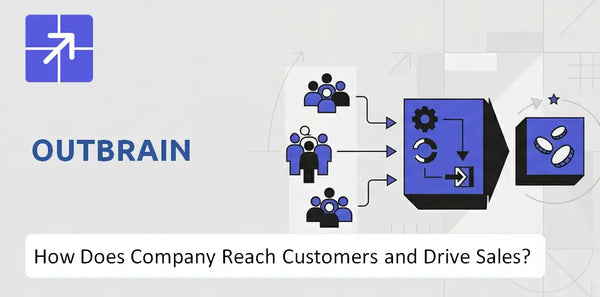
Outbrain layers self-serve and managed-sales teams to scale demand while preserving publisher relationships; add targeted creative testing and measurement to shorten funnel and lift conversion. See Outbrain BCG Matrix Analysis
Who Does Outbrain Want to Sell To?
Outbrain wants to sell to two core groups: premium publishers needing yield and audience tools, and advertisers seeking awareness, performance, or programmatic efficiency. The company wins them via exclusive publisher partnerships, segmented product lines, and automated mid-market tools to improve ROAS.
 Primary customer: Tier-one publishers
Outbrain signs long-term, often exclusive agreements with publishers such as CNN, MSN, and Sky News to provide yield optimization and audience engagement tools; these partnerships drive high reach across premium inventory and underpin Outbrain marketing as a content recommendation platform.
Additional targets: Advertisers and agencies
Demand-side customers split into three segments: global brand advertisers using the Onyx platform for high-impact awareness, performance marketers focused on lead generation and e-commerce ROAS, and advertising agencies seeking programmatic efficiency and campaign optimization.
Market positioning: Premium reach plus performance
Outbrain positions itself as a content recommendation platform that blends premium publisher inventory with performance tools; by early 2026 the company reported increased mid-market penetration and automation features that lowered onboarding time and cost per acquisition for SMBs.
Why this positioning works
The differentiated message – premium publisher scale plus measurable ROAS – appeals to brands and agencies; programmatic integration, audience targeting Outbrain features, and Outbrain campaign optimization tools drove reported revenue growth in 2025 and higher conversion rates versus standard display in several case studies. See Mission, Vision, and Values of Outbrain Company for corporate context: Mission, Vision, and Values of Outbrain Company
Outbrain SWOT Analysis
- Complete SWOT Breakdown
- Fully Customizable
- Editable in Excel & Word
- Professional Formatting
- Investor-Ready Format

How Does Outbrain Get in Front of Customers?
Outbrain reaches customers via enterprise sales for large publishers and holding companies, a self-service dashboard for advertisers, and programmatic DSP integrations that open inventory to automated buying; the 2024 Teads acquisition expanded outstream video reach and luxury brand access.

Consultative Enterprise Sales
Direct sales teams sign multi-year contracts and strategic alliances with major publishers and global holding companies, driving stable revenue and large guaranteed deals – enterprise deals accounted for a material share of Outbrain's publisher revenue in 2025.
Self-Service Dashboard and Rapid Ad Deployment
The proprietary self-service platform lets advertisers launch campaigns in minutes with real-time optimization and audience targeting Outbrain features; platform users report faster time-to-market and improved Outbrain campaign optimization metrics versus managed buys.
Programmatic DSP Integrations
Deep integrations with major Demand Side Platforms enable inventory to be bought via automated auctions, increasing reach across programmatic channels and lowering acquisition costs through bid optimization and audience segmentation.
Demand Generation and Activation Tactics
Outbrain drives demand with targeted campaigns, case-study led sales cycles, co-marketing with publishers, and leveraging content recommendation platform placements to funnel high-intent users into conversion paths.
Customer Acquisition Efficiency
Mixing high-touch sales for large contracts with scalable self-serve reduces blended CAC; programmatic access and real-time conversion tracking improve ROAS – platform reported year-over-year improvement in cost per acquisition in 2025.
Reach Advantage from Teads Acquisition
The 2024 acquisition of Teads added outstream video inventory and immediate access to luxury and lifestyle advertisers, increasing total addressable inventory and boosting video CPMs and viewability metrics across Outbrain advertising in 2025.
For a deeper market and customer breakdown see Target Customers and Market of Outbrain Company
Outbrain Business Model Canvas
- One-time Payment
- No Research Needed – Save Hours of Work
- Built by Experts, Trusted by Consultants
- Instant Download, Ready to Use
- 100% Editable, Fully Customizable

How Does Outbrain Turn Attention Into Sales?
Outbrain turns attention into sales by using SmartLogic AI to predict which content or product recommendation will drive clicks and conversions; advertisers pay on Cost-Per-Click (CPC) or Cost-Per-Acquisition (CPA) terms, aligning incentives. Automated bid tools and contextual targeting then push higher-value traffic toward conversion.
Core sales model: programmatic self-serve plus managed accounts
Outbrain marketing sells via a hybrid model: a self-serve programmatic platform for performance advertisers and managed accounts for larger direct-sell clients. Revenue comes from campaign spend on the content recommendation platform and partnerships with publishers across its network.
Pricing and monetization logic: CPC and CPA-first bidding
Outbrain advertising primarily charges on CPC and CPA; CPM-like buys exist for publishers. Advertisers set budgets and bids while the platform earns take rates on clicks and conversions, with programmatic fees and premium managed services for enterprise accounts.
Conversion and purchase drivers: SmartLogic AI and CBS
SmartLogic AI predicts which recommendation will prompt action and feeds the Conversion Bid Strategy (CBS) that auto-adjusts bids in real time based on conversion likelihood. This combination drives higher click-through and conversion rates, shortening the path from attention to sale.
Repeat revenue and customer expansion: sticky contextual targeting
Top-tier advertisers often increase spend year-over-year; Outbrain reports net revenue retention for key accounts exceeding 100% as clients shift budgets to contextual native advertising strategies that resist privacy headwinds and deliver incremental ROI.
SmartLogic AI (predictive recommendation) and CBS (conversion bid strategy) work together: SmartLogic ranks options by conversion probability, CBS bids to win clicks with high expected value, and the CPC/CPA billing ties Outbrain's revenue to advertiser outcomes – so higher conversion rates mean higher platform revenue. Case evidence: platforms like Outbrain report median click-through and conversion uplifts in optimized campaigns, and advertisers using campaign optimization and audience targeting Outbrain techniques typically see improved sales lift when combining contextual targeting with retargeting strategies. For implementation details and ownership context see Ownership and Control of Outbrain Company
Outbrain Marketing Mix
- Complete Marketing Mix Analysis
- Effortlessly Communicate Your Business Strategy
- Investor-Ready Format
- 100% Editable and Customizable
- Clear and Structured Layout

How Strong Does Outbrain's Commercial Engine Look Going Forward?
Outbrain's commercial engine looks resilient heading into 2025/2026, supported by rising video revenue and improved unit economics; core strengths include a diversified product mix and stabilized Ex-TAC margins near 22-24%, while macro ad spend weakness remains a downside risk.
What Supports Future Demand
Video-centric assets plus native advertising strategies boost average yields; Outbrain marketing mix shifts more revenue to higher-margin branding and video, lifting publisher RPMs and advertiser ROI, supporting sustainable demand.
Channel and Marketing Effectiveness
Open Web reach across the publisher network and predictive demographics for audience targeting Outbrain preserve targeting efficiency post-cookie; programmatic integration and campaign optimization tools improve CPA and conversion rates.
Risks to Commercial Performance
Global ad spend volatility and advertiser budget tightening can reduce demand; increased competition from social platforms and potential yield pressure on long-tail publishers could weaken margins despite improved Ex-TAC.
The Overall Sales and Marketing Outlook
Outbrain appears positioned for steady, disciplined growth with professional judgment pointing to Adjusted EBITDA margin expansion toward 20% in 2025/2026, driven by operational efficiencies and scale in native and video advertising.
See this analysis for broader context: Growth Outlook of Outbrain Company
Outbrain Boston Consulting Group Matrix
- Built by Experts, Trusted by Consultants
- Structured for Consultants, Students, and Founders
- 100% Editable in Microsoft Word & Excel
- Instant Digital Download – Use Immediately
- Compatible with Mac & PC – Fully Unlocked

Related Blogs
- What Is the History of Outbrain Company and How Did It Evolve?
- What Is the Competitive Landscape of Outbrain Company and How Does It Compete?
- What Is the Growth Outlook of Outbrain Company and Where Is It Heading?
- How Does Outbrain Company Work and What Drives Its Business Model?
- What Do the Mission, Vision, and Core Values of Outbrain Company Reveal?
- Who Are the Core Customers in Outbrain Company's Target Market?
- Who Owns Outbrain Company Today and Who Holds Control?
Frequently Asked Questions
Outbrain mainly sells to tier-one publishers and to advertisers or agencies. Its publisher side focuses on long-term partnerships for yield optimization and audience engagement, while its demand-side offering serves brand advertisers, performance marketers, and agencies looking for awareness, ROAS, and programmatic efficiency.
Disclaimer
All information, articles, and product details provided on this website are for general informational and educational purposes only. We do not claim any ownership over, nor do we intend to infringe upon, any trademarks, copyrights, logos, brand names, or other intellectual property mentioned or depicted on this site. Such intellectual property remains the property of its respective owners, and any references here are made solely for identification or informational purposes, without implying any affiliation, endorsement, or partnership.
We make no representations or warranties, express or implied, regarding the accuracy, completeness, or suitability of any content or products presented. Nothing on this website should be construed as legal, tax, investment, financial, medical, or other professional advice. In addition, no part of this site - including articles or product references - constitutes a solicitation, recommendation, endorsement, advertisement, or offer to buy or sell any securities, franchises, or other financial instruments, particularly in jurisdictions where such activity would be unlawful.
All content is of a general nature and may not address the specific circumstances of any individual or entity. It is not a substitute for professional advice or services. Any actions you take based on the information provided here are strictly at your own risk. You accept full responsibility for any decisions or outcomes arising from your use of this website and agree to release us from any liability in connection with your use of, or reliance upon, the content or products found herein.