
Who are Piston Group's core customers among OEMs and EV powertrain makers?
Piston Group sells engineered assemblies to global vehicle manufacturers and EV powertrain suppliers; these customers drive its revenue and demand high-spec, low-defect systems. As of 2025 the firm reported Tier 1 contracts tied to three major platform launches, signaling deeper OEM integration.
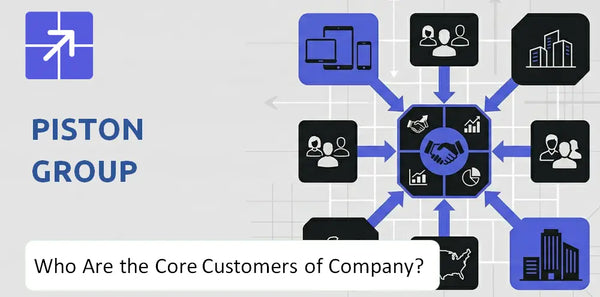
Piston Group's core buyers are OEM procurement teams and EV module integrators; focus on platform lifespan, supplier risk, and electrification readiness. See product insight: Piston Group BCG Matrix Analysis
Who Is Piston Group Trying to Win?
Piston Group tries to win large global OEMs and high-growth EV manufacturers plus Tier 1 suppliers; procurement leaders for high-complexity modules are the primary buyers the company pursues.
 Main customer group: North American Big Three and global OEMs
Piston Group core customers are Global Original Equipment Manufacturers (OEMs), with a concentration on Ford Motor Company, General Motors, and Stellantis, which account for the bulk of backlog and multi-year vehicle-lifecycle contracts – representing an estimated 65 – 80% of large program revenues in 2025.
Secondary customer groups: EV specialists and international OEMs
Piston Group target market also includes EV-focused OEMs and expanding Asia-Pacific manufacturers such as Toyota and Honda; these segments drove an estimated 15 – 25% of new contract wins in 2025 as automakers localize production.
Customer type and market role: B2B, procurement executives and Tier 1s
Piston Group serves a B2B industrial client base: procurement decision makers at OEMs and program managers at Tier 1 suppliers who buy sub-assemblies. The company focuses on buyers responsible for cockpit assemblies, cooling systems, and battery enclosures – high-complexity modules with longer lead times.
Most important segment: high-complexity module programs by large OEMs
The most important segment by revenue and strategic relevance is long-term OEM module contracts; these programs typically span vehicle lifecycles and constituted roughly 70% of Piston Group's contracted backlog value in 2025, while Tier 1 sub-assembly work fills capacity gaps and reduces seasonality.
History and Background of Piston Group Company
Piston Group SWOT Analysis
- Complete SWOT Breakdown
- Fully Customizable
- Editable in Excel & Word
- Professional Formatting
- Investor-Ready Format

What Do Piston Group's Customers Care About Most?
Piston Group core customers prioritize operational reliability, cost-efficiency, and strict technical compliance – seeking near-zero defects, JIT delivery, and measurable sustainability performance. Their buying drivers blend supply-chain risk reduction, diversity spend goals, and the logistics capability to sequence complex assemblies.

Operational reliability and defect control
OEMs and industrial clients for Piston Group demand sub-10 PPM defect rates in 2025/2026 to protect production lines; they hire suppliers that provide validated quality systems, traceability, and first-pass yield metrics.
Practical buying drivers: cost and delivery
Price-competitive quotes, adherence to Just-In-Time schedules, and demonstrable total cost of ownership reductions drive procurement decisions among B2B procurement decision makers and automotive suppliers customer profile buyers.
Emotional and aspirational appeal: diversity spend alignment
As a Minority Business Enterprise, Piston Group helps large OEMs hit multi-billion dollar diversity spend mandates while preserving technical standards – this supports corporate ESG narratives and supplier-base diversity goals.
What customers value most: complex logistics capability
Customers value the ability to sequence thousands of unique part combinations into single modules and manage complex kitting; this reduces OEM assembly time and inventory carrying costs for target industries and clients.
Loyalty and repeat demand drivers
Consistent quality (sub-10 PPM), on-time JIT fills, and documented carbon-neutral or circular manufacturing steps increase retention among long-term buyers and repeat orders from small manufacturers needing Piston Group components and large OEMs as Piston Group customers.
Why customers choose Piston Group
Piston Group wins because it combines rigorous technical compliance, logistics sequencing at scale, and MBE status that helps buyers meet diversity and sustainability KPIs – see Ownership and Control of Piston Group Company for context.
Piston Group Business Model Canvas
- One-time Payment
- No Research Needed – Save Hours of Work
- Built by Experts, Trusted by Consultants
- Instant Download, Ready to Use
- 100% Editable, Fully Customizable

Where Is Demand Strongest for Piston Group?
Demand concentrates in the North American automotive corridor – Michigan, Ohio, Missouri, and Kentucky – driven by proximity to OEM assembly lines and logistics for just-in-time supply; EV and hybrid propulsion systems show the strongest pull.
Core Geographic Market: Automotive Corridor
Primary demand for Piston Group core customers clusters across Michigan, Ohio, Missouri, and Kentucky because assembly-plant proximity cuts transit time and cost for industrial clients for Piston Group.
Secondary Markets: SUV/Light Truck and Thermal Systems
Secondary demand is strong in the SUV and light truck segments and among automotive suppliers customer profile focused on thermal management and battery module assembly, especially for B2B procurement decision makers serving EVs.
Where Piston Group Is Strongest
Piston Group appears strongest in divisions tied to interior trim and climate modules – Detroit Thermal Systems and Irvin Products – where revenue mix and OEM relevance are highest for large OEMs as Piston Group customers.
Fastest-Growing Demand Areas (2025 – 2026)
Demand growth is fastest in EV and hybrid propulsion: as of 2026 Piston Group saw a 25 percent year-over-year increase in RFQs for thermal management and battery module assembly; redesigns for autonomous cabin systems are also rising. Read more in Growth Outlook of Piston Group Company
Piston Group Marketing Mix
- Complete Marketing Mix Analysis
- Effortlessly Communicate Your Business Strategy
- Investor-Ready Format
- 100% Editable and Customizable
- Clear and Structured Layout

How Does Piston Group Keep Its Audience Growing?
Piston Group keeps its audience growing by vertical integration and tech diversification, moving from assembly into engineering and battery power electronics to raise revenue per vehicle and win adjacent OEM and supplier segments; retention rests on flawless high-stakes launches and a land-and-expand play capturing full modular systems.
Expanding Piston Group core customers and target market
Piston Group adds customers by acquiring design and thermal capabilities, selling higher content-per-vehicle to large OEMs and industrial clients for Piston Group, and entering EV power electronics where adjacent automotive suppliers customer profile overlaps. In 2025 Piston Group is projected to exceed $3.8 billion in revenue, which broadens buyer awareness among B2B procurement decision makers and long-tail small manufacturers needing Piston Group components. See the Sales and Marketing Strategy of Piston Group Company for more detail.
Customer Retention Drivers
Retention comes from proven launch execution on programs like the Ford F-150 iterations and GM EV platforms, low defect rates in production, and performance-based contracts that convert single-component wins into larger system scopes. Reliability reduces churn for large OEMs as Piston Group customers and reassures decision makers in companies that purchase from Piston Group.
Loyalty, repeat demand, and customer depth
Repeat demand is driven by modular-system supply agreements, engineering design-ins that lock in lifecycle sourcing, and aftermarket/thermal-service contracts that increase customer depth. Ecosystem stickiness rises as customers consolidate purchasing across pistons, power electronics, and thermal solutions to simplify procurement.
Strongest customer-base growth lever in 2025/2026
The biggest growth lever is vertical integration into battery power electronics and advanced thermal solutions – this increases content-per-vehicle and captures large OEMs as Piston Group customers. For 2026 professional judgment remains bullish as the firm converts ICE programs into diversified powertrain supply, supporting sustained revenue growth and higher margins.
Piston Group Boston Consulting Group Matrix
- Built by Experts, Trusted by Consultants
- Structured for Consultants, Students, and Founders
- 100% Editable in Microsoft Word & Excel
- Instant Digital Download – Use Immediately
- Compatible with Mac & PC – Fully Unlocked

Related Blogs
- What Is the History of Piston Group Company and How Did It Evolve?
- What Is the Competitive Landscape of Piston Group Company and How Does It Compete?
- What Is the Growth Outlook of Piston Group Company and Where Is It Heading?
- How Does Piston Group Company Work and What Drives Its Business Model?
- How Does Piston Group Company Reach Customers and Turn Demand into Sales?
- What Do the Mission, Vision, and Core Values of Piston Group Company Reveal?
- Who Owns Piston Group Company Today and Who Holds Control?
Frequently Asked Questions
Piston Group's core customers are Global Original Equipment Manufacturers, especially Ford Motor Company, General Motors, and Stellantis. The company also serves EV-focused OEMs, international automakers like Toyota and Honda, and Tier 1 suppliers that buy sub-assemblies and high-complexity modules.
Disclaimer
All information, articles, and product details provided on this website are for general informational and educational purposes only. We do not claim any ownership over, nor do we intend to infringe upon, any trademarks, copyrights, logos, brand names, or other intellectual property mentioned or depicted on this site. Such intellectual property remains the property of its respective owners, and any references here are made solely for identification or informational purposes, without implying any affiliation, endorsement, or partnership.
We make no representations or warranties, express or implied, regarding the accuracy, completeness, or suitability of any content or products presented. Nothing on this website should be construed as legal, tax, investment, financial, medical, or other professional advice. In addition, no part of this site - including articles or product references - constitutes a solicitation, recommendation, endorsement, advertisement, or offer to buy or sell any securities, franchises, or other financial instruments, particularly in jurisdictions where such activity would be unlawful.
All content is of a general nature and may not address the specific circumstances of any individual or entity. It is not a substitute for professional advice or services. Any actions you take based on the information provided here are strictly at your own risk. You accept full responsibility for any decisions or outcomes arising from your use of this website and agree to release us from any liability in connection with your use of, or reliance upon, the content or products found herein.