
Who are S-Oil Corporation's core industrial and petrochemical customers in Asia-Pacific?
S-Oil Corporation supplies petrochemical intermediates and refined fuels to Asian industrial manufacturers and transport fleets, shifting toward higher-margin chemical buyers. This matters because the Shaheen Project and Saudi Aramco feedstock deal in 2025 target steady margins amid fuel volatility.
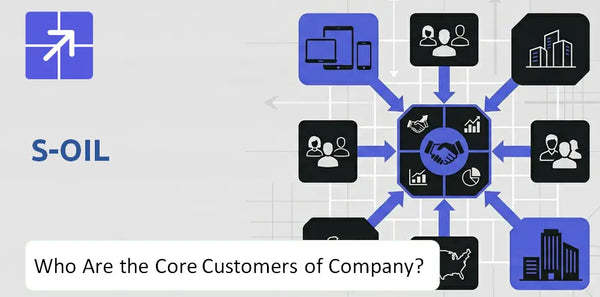
S-Oil should prioritize long-term contracts with appliance and automotive plastic makers to lock demand; see product analysis at S-Oil BCG Matrix Analysis.
Who Is S-Oil Trying to Win?
S-Oil Corporation targets domestic retail/wholesale motorists, international industrial petrochemical buyers, and global premium lubricant blenders to balance fuel, chemicals, and high – value base – oil revenue streams.
 Main customer group: Domestic fuel retail and wholesale
S-Oil target market centers on South Korean retail fuel customers and wholesale partners reached via about 2,150 branded service stations; this stabilizes cash flow from automotive and transport demand and supports lubricant cross – sell.
Secondary groups: Regional petrochemical manufacturers
Industrial customers of S-Oil in China, Japan, and Southeast Asia buy paraxylene, benzene, and propylene for fibers and plastics; by 2026 S-Oil has shifted to secure long – term contracts to absorb expanded chemical output.
Customer type and market role: Mixed B2B and B2C
S-Oil core customers mix consumers (retail motorists) and businesses (B2B petrochemical and lubricant buyers); the firm serves fleet operators, automotive manufacturers, and industrial clients across fuel, petrochemical, and lubricant use cases.
Most important segment by scale: Petrochemical industrial buyers
Petrochemical customers of S-Oil now drive strategic relevance: expanded aromatics and olefins capacity means chemical sales are the highest-margin growth lever and underpin export market customers in Southeast Asia and China.
Mission, Vision, and Values of S-Oil Company
S-Oil SWOT Analysis
- Complete SWOT Breakdown
- Fully Customizable
- Editable in Excel & Word
- Professional Formatting
- Investor-Ready Format

What Do S-Oil's Customers Care About Most?
S-Oil core customers prioritize reliable supply, competitive pricing, and product quality; petrochemical buyers want integrated chain security and high-purity yields; retail and lubricant buyers value brand trust, convenience, and technical consistency. Across segments, demand for lower carbon intensity and ESG-compliant fuels is rising.

Supply security and feedstock integration
Industrial customers of S-Oil need uninterrupted volumes and predictable pricing to run refineries and plants; the 9.3 trillion KRW Shaheen Project investment directly addresses this by strengthening crude processing and integrated petrochemical output.
Price competitiveness and margin predictability
Wholesale and export market customers (Southeast Asia, China) choose S-Oil for competitive spot and contract pricing tied to efficient refinery yields; volume discounts and contract stability drive buying decisions.
High-purity petrochemical output
Petrochemical customers of S-Oil require consistent high-purity naphtha, aromatics, and olefins for downstream polymers; yield consistency reduces downstream processing costs and rejects.
Brand trust and retail convenience
Retail fuel customers of S-Oil prioritize trusted fuel quality and integrated service-station convenience (payments, shops, loyalty); location density and uptime matter for daily drivers and fleets.
Technical performance for lubricants
S-Oil lubricant and industrial oil customers (automotive manufacturers, fleet operators) demand performance aligned to international standards (API, ACEA) and batch-to-batch consistency to avoid warranty and maintenance issues.
Lower carbon intensity and ESG compliance
By 2026 an escalating share of S-Oil customers – airlines, shipping firms, global industrial buyers – require lower carbon fuels; S-Oil is prioritizing sustainable aviation fuel and circular chemicals to meet corporate ESG procurement rules.
What customers value most
Customers value predictable supply, certified quality, and lower lifecycle emissions; institutional buyers place high weight on contract reliability and traceable carbon-intensity metrics.
Drivers of loyalty and repeat demand
Long-term contracts, fuel quality guarantees, loyalty programs at service stations, and demonstrable reductions in carbon intensity support repeat purchases from both B2B and retail segments.
Why customers choose S-Oil
S-Oil target market wins on integrated supply-chain capability, investments like the Shaheen Project (9.3 trillion KRW), consistent petrochemical yields, and an expanding portfolio of low-carbon products that meet global buyer ESG requirements; see Ownership and Control of S-Oil Company for governance context.
S-Oil Business Model Canvas
- One-time Payment
- No Research Needed – Save Hours of Work
- Built by Experts, Trusted by Consultants
- Instant Download, Ready to Use
- 100% Editable, Fully Customizable

Where Is Demand Strongest for S-Oil?
Demand for S-Oil Corporation is strongest in South Korea and the Asia-Pacific export corridor, with domestic refined products forming the high-margin base and exports driving fastest growth.
Primary market: Domestic South Korea and Asia-Pacific exports
South Korea accounts for nearly 50% of S-Oil target market sales volume in refined products, providing margin stability; the broader Asia-Pacific corridor concentrates petrochemical and fuel demand, so it remains the core region for S-Oil core customers.
Secondary markets: China and Southeast Asia
China is the dominant destination for paraxylene exports, while Southeast Asian markets show the strongest appetite for diesel and jet fuel, supporting export volumes that lift overall production value above domestic sales.
Where S-Oil is strongest: Petrochemicals, lubricants, and domestic fuels
S-Oil is strongest in petrochemical output and high-quality base oils: petrochemicals and lubricants together regularly exceed 60% of total production value, and lubricants sell well in North America and Europe where low-viscosity specs are required.
Where demand is growing fastest: Petrochemicals and lubricants exports
Exports of petrochemicals and lubricants are the fastest-growing segment in 2025, with lubricant demand accelerating in North America and Europe and petrochemical lift driven by China and Southeast Asia; see market context in How S-Oil Company Works and Makes Money.
S-Oil Marketing Mix
- Complete Marketing Mix Analysis
- Effortlessly Communicate Your Business Strategy
- Investor-Ready Format
- 100% Editable and Customizable
- Clear and Structured Layout

How Does S-Oil Keep Its Audience Growing?
S-Oil Corporation grows its audience by scaling petrochemical capacity, securing feedstock via long-term crude supply, expanding retail digital engagement, and targeting adjacent industrial segments to boost retention and deepen customer relationships.
Scaling Capacity to Reach New Segments
The Shaheen Project doubles petrochemical output to raise chemical yield from 12 percent to 25 percent, enabling S-Oil target market expansion into plastics, specialty chemicals, and export customers across Southeast Asia and China; this brings larger petrochemical customers and industrial buyers into the S-Oil core customers set.
Customer Retention Drivers
Long-term crude oil supply with Saudi Aramco secures feedstock and cost advantage, stabilizing margins and retention among industrial customers of S-Oil and petrochemical customers of S-Oil; predictable supply reduces churn for commercial customers like chemical and plastics manufacturers.
Loyalty, Repeat Demand, and Customer Depth
Retail fuel customers of S-Oil see integrated service platforms and targeted digital marketing that raise repeat visits at service stations; B2B clients gain contract renewals and deeper procurement ties as S-Oil shifts toward higher-margin chemical sales, increasing customer lifetime value.
Strongest Growth Lever in 2025/2026
The Shaheen Project is the key lever: doubling petrochemical capacity coupled with the Saudi Aramco supply pact creates a durable competitive moat, aligning S-Oil customer segments with rising industrial demand and securing growth among petrochemical buyers, automotive manufacturers and fleet operators, and export market customers.
For context on S-Oil's strategic evolution and customers, see History and Background of S-Oil Company.
S-Oil Boston Consulting Group Matrix
- Built by Experts, Trusted by Consultants
- Structured for Consultants, Students, and Founders
- 100% Editable in Microsoft Word & Excel
- Instant Digital Download – Use Immediately
- Compatible with Mac & PC – Fully Unlocked

Related Blogs
- What Is the History of S-Oil Company and How Did It Evolve?
- What Is the Competitive Landscape of S-Oil Company and How Does It Compete?
- What Is the Growth Outlook of S-Oil Company and Where Is It Heading?
- How Does S-Oil Company Work and What Drives Its Business Model?
- How Does S-Oil Company Reach Customers and Turn Demand into Sales?
- What Do the Mission, Vision, and Core Values of S-Oil Company Reveal?
- Who Owns S-Oil Company Today and Who Holds Control?
Frequently Asked Questions
S-Oil's core customers are domestic retail and wholesale motorists, regional petrochemical manufacturers, and global premium lubricant buyers. The company balances B2C fuel demand with B2B sales in chemicals and base oils, serving consumers, fleet operators, automotive manufacturers, and industrial clients across South Korea and export markets.
Disclaimer
All information, articles, and product details provided on this website are for general informational and educational purposes only. We do not claim any ownership over, nor do we intend to infringe upon, any trademarks, copyrights, logos, brand names, or other intellectual property mentioned or depicted on this site. Such intellectual property remains the property of its respective owners, and any references here are made solely for identification or informational purposes, without implying any affiliation, endorsement, or partnership.
We make no representations or warranties, express or implied, regarding the accuracy, completeness, or suitability of any content or products presented. Nothing on this website should be construed as legal, tax, investment, financial, medical, or other professional advice. In addition, no part of this site - including articles or product references - constitutes a solicitation, recommendation, endorsement, advertisement, or offer to buy or sell any securities, franchises, or other financial instruments, particularly in jurisdictions where such activity would be unlawful.
All content is of a general nature and may not address the specific circumstances of any individual or entity. It is not a substitute for professional advice or services. Any actions you take based on the information provided here are strictly at your own risk. You accept full responsibility for any decisions or outcomes arising from your use of this website and agree to release us from any liability in connection with your use of, or reliance upon, the content or products found herein.