
How does S-Oil Company convert its integrated sales and marketing model into consistent downstream sales?
S-Oil ties refinery feedstock security from Saudi Aramco to an integrated sales and marketing model that pushes refined fuels, lubricants, and petrochemicals across domestic retail and exports. This matters as the Shaheen Project shifted revenue mix toward chemicals in 2025, reducing crack-spread volatility.
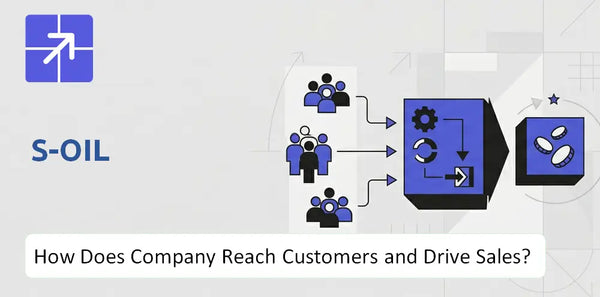
S-Oil focuses channel mix: domestic retail strength plus targeted B2B exports and long-term supply contracts; monitor margins by product and region to spot demand shifts. See S-Oil BCG Matrix Analysis
Who Does S-Oil Want to Sell To?
S-Oil Corporation targets three buyer groups: South Korean motorists and transport firms for retail fuels, global industrial manufacturers for petrochemical feedstocks, and premium lubricant buyers worldwide. The company wins them through integrated S-Oil marketing and tailored B2B sales strategy focused on high-margin chemical off-takers and retail distribution strength.
 Core retail and transport customers
S-Oil prioritizes South Korean motorists, logistics fleets, and commercial transporters that buy gasoline, diesel, and kerosene via S-Oil retail fuel sales and dealer networks. In 2025 domestic fuel volumes remained a material base for revenue, supporting station-level conversions and loyalty programs.
Industrial and petrochemical off-takers
Primary growth focus is on industrial manufacturers in China and Southeast Asia that purchase paraxylene, benzene, and propylene. By 2025 S-Oil aligned its S-Oil customer acquisition and export and international sales approach to absorb 3.2 million tons per year of new petrochemical capacity into its sales mix.
Premium lubricant and specialty buyers
S-Oil targets automotive OEMs, workshops, and industrial lubricant distributors worldwide through S-Oil lubricant sales strategies, e-commerce ordering, and technical service support tied to performance specs and margins.
Market positioning and segmentation
S-Oil positions itself as a fuel and petrochemical supplier combining reliable retail fuel distribution channels with high-value chemical exports. The S-Oil sales strategy emphasizes integrated supply chain and distribution to service stations plus long-term contracts with industrial buyers to stabilize margins.
Why the positioning works
Focus on high-value chemical off-takers increases blended margins and reduces volatility from retail fuel cycles; contract sales and S-Oil trade sales drive predictable cash flow. For context on revenue mix and operations see How S-Oil Company Works and Makes Money.
Key numbers and channels
By 2025 S-Oil directed capacity to support 3.2 million tons annual petrochemical output; domestic retail and B2B sales use dealer partnerships, loyalty programs, and corporate sales teams. S-Oil distribution channels and pricing strategy focus on contract volumes to industrial buyers and promotional tactics at service stations to convert demand into retail sales.
S-Oil SWOT Analysis
- Complete SWOT Breakdown
- Fully Customizable
- Editable in Excel & Word
- Professional Formatting
- Investor-Ready Format

How Does S-Oil Get in Front of Customers?
S-Oil Corporation reaches customers through a multi-channel distribution mix: a domestic retail network of service stations and loyalty platforms, international placement via Saudi Aramco trading links, and a direct B2B sales force for lubricants and petrochemicals that converts demand into long-term contracts and spot-market transactions.

Branded Retail Network Drives Volume
S-Oil marketing centers on its network of over 2,100 branded service stations in South Korea, using the Goo Doil character and in-station promotions to build awareness and convert drive-by demand into fuel and convenience sales.
Digital Marketing and Loyalty Platforms
S-Oil digital marketing strategies use apps, email, search, and paid media plus a digital loyalty platform to increase frequency and retention; in 2025 the expanded digital procurement and customer apps improved transaction speed and loyalty engagement metrics.
Direct B2B Sales and Distributor Access
S-Oil B2B sales teams secure long-term supply agreements with industrial conglomerates and fleets, while partnerships with wholesalers and Saudi Aramco's trading infrastructure extend S-Oil distribution channels into key export markets.
Promotions and Demand Generation
Demand generation tactics include station-level promotions, seasonal fuel pricing, lubricant bundling for workshops, and targeted campaigns tied to loyalty rewards; these tactics lift short-term retail volume and B2B order cadences.
Customer Acquisition Efficiency
S-Oil customer acquisition balances low-cost in-station reach with higher-margin B2B contracts; the 2025 digital procurement expansion reduced wholesale transaction times and increased spot-market capture efficiency.
Key Reach Advantage in 2025
The strongest reach advantage is the combination of a domestic service-station footprint of 2,100+ sites and access to Saudi Aramco's global trading logistics, enabling rapid placement of refined products into high-demand regions.
For corporate context and channel history see History and Background of S-Oil Company.
S-Oil Business Model Canvas
- One-time Payment
- No Research Needed – Save Hours of Work
- Built by Experts, Trusted by Consultants
- Instant Download, Ready to Use
- 100% Editable, Fully Customizable

How Does S-Oil Turn Attention Into Sales?
S-Oil converts attention into sales by shifting refinery yields to higher-margin fuels and chemicals in real time and by pushing premium lubricants and exported base oils into global markets; operational flexibility, price optimization, and integrated chemical-to-crude conversion turn interest into contracted revenue. The model relies on B2B contracts, retail fuel networks, and export channels to close demand into sales.
Core Sales Model: Integrated B2B, B2C, and Export Contracts
S-Oil marketing uses direct corporate sales, long-term supply contracts, dealer and franchise partnerships for service stations, and institutional export deals. Retail fuel sales at company-branded stations and B2B petrochemical contracts each drive volume; lubricants sell through distributors, workshops, and e-commerce channels.
Pricing and Monetization Logic: Margin-First, Market-Responsive Pricing
Pricing mixes spot market oil-linked pricing for fuels, formula-based contracts for industrial clients, and premium pricing for Group II/III lubricants. Real-time analytics enable refinery grade switching to capture seasonal price spreads and maximize gross refining margin per barrel.
Conversion and Purchase Drivers: Operational Flexibility and Relationship Sales
Conversion hinges on price competitiveness, availability, and technical fit for industrial buyers; the Shaheen Project integration lowers production cost and boosts conversion of crude to high-margin olefins, turning industrial inquiries into contracts. For retail, station accessibility, promotions, and trusted fuel quality drive sales.
Repeat Revenue and Customer Expansion: Export-Led Growth and Premium Lubricant Loyalty
S-Oil Corporation sustains repeat revenue with long-term supply contracts and an export ratio exceeding 50 percent of total sales volume through 2025. High-spec lubricants create stickiness with workshops and OEMs, enabling upsells and volume growth in international markets.
S-Oil sales strategy emphasizes real-time refinery yield control – shifting barrels to jet or gasoline during peak margins – and the Chemical-to-Crude approach in petrochemicals to lower per-unit costs; lubricant margins benefit from S-Oil's position as a top Group II/III base oil producer. For more on corporate direction see Mission, Vision, and Values of S-Oil Company.
S-Oil Marketing Mix
- Complete Marketing Mix Analysis
- Effortlessly Communicate Your Business Strategy
- Investor-Ready Format
- 100% Editable and Customizable
- Clear and Structured Layout

How Strong Does S-Oil's Commercial Engine Look Going Forward?
S-Oil Corporation's commercial engine looks resilient heading into 2026, driven by a chemical-led revenue mix, improving refining margins, and the Shaheen Project's commissioning; key supports include channel reach and premium B2B contracts, while downside comes from capex-driven leverage and commodity volatility.
What Supports Future Demand
S-Oil marketing benefits from a shift to petrochemicals that reduced exposure to crude-to-product margin swings; petrochemical sales accounted for about ~43 percent of 2025 segment revenue, giving stable volumes and higher unit margins. Strong industrial offtake contracts and improved ESG ratings lower funding costs and help commercial win rates.
Channel and Marketing Effectiveness
S-Oil sales strategy leverages integrated distribution channels: nationwide service-station networks, lubricant B2B channels, and export terminals that supported KRW 36.5 trillion in 2025 consolidated revenue. Digital marketing and dealer partnership programs are expanding e-commerce and fleet contract conversions, improving customer acquisition and retention.
Risks to Commercial Performance
Risks include higher interest costs from 2024 capex for Shaheen (project capex peaked in 2024), commodity price swings that can hit retail fuel margins, and execution delays in scaling petrochemical sales; leverage rose in 2024 but improving cash flow should reduce net debt-to-EBITDA from its 2024 peak.
The Overall Sales and Marketing Outlook
Outlook for S-Oil customer acquisition and revenue generation in 2025/2026 is strong and adaptable: the Shaheen Project mechanical completion supports a 6 – 8 percent revenue growth forecast for 2026, and the chemical-led model positions S-Oil to outperform pure-play refiners amid decarbonization trends. See analysis of competitive positioning in Competitive Landscape of S-Oil Company.
S-Oil Boston Consulting Group Matrix
- Built by Experts, Trusted by Consultants
- Structured for Consultants, Students, and Founders
- 100% Editable in Microsoft Word & Excel
- Instant Digital Download – Use Immediately
- Compatible with Mac & PC – Fully Unlocked

Related Blogs
- What Is the History of S-Oil Company and How Did It Evolve?
- What Is the Competitive Landscape of S-Oil Company and How Does It Compete?
- What Is the Growth Outlook of S-Oil Company and Where Is It Heading?
- How Does S-Oil Company Work and What Drives Its Business Model?
- What Do the Mission, Vision, and Core Values of S-Oil Company Reveal?
- Who Are the Core Customers in S-Oil Company's Target Market?
- Who Owns S-Oil Company Today and Who Holds Control?
Frequently Asked Questions
S-Oil targets South Korean motorists and transport firms, global industrial manufacturers, and premium lubricant buyers. The article explains that these groups are reached with different offers, from retail fuels and dealer networks to petrochemical feedstocks and lubricant sales strategies. This mix helps S-Oil balance volume, margins, and demand across channels.
Disclaimer
All information, articles, and product details provided on this website are for general informational and educational purposes only. We do not claim any ownership over, nor do we intend to infringe upon, any trademarks, copyrights, logos, brand names, or other intellectual property mentioned or depicted on this site. Such intellectual property remains the property of its respective owners, and any references here are made solely for identification or informational purposes, without implying any affiliation, endorsement, or partnership.
We make no representations or warranties, express or implied, regarding the accuracy, completeness, or suitability of any content or products presented. Nothing on this website should be construed as legal, tax, investment, financial, medical, or other professional advice. In addition, no part of this site - including articles or product references - constitutes a solicitation, recommendation, endorsement, advertisement, or offer to buy or sell any securities, franchises, or other financial instruments, particularly in jurisdictions where such activity would be unlawful.
All content is of a general nature and may not address the specific circumstances of any individual or entity. It is not a substitute for professional advice or services. Any actions you take based on the information provided here are strictly at your own risk. You accept full responsibility for any decisions or outcomes arising from your use of this website and agree to release us from any liability in connection with your use of, or reliance upon, the content or products found herein.