
Who are Scroll Corporation's core customers in Japan's retail and B2B logistics markets?
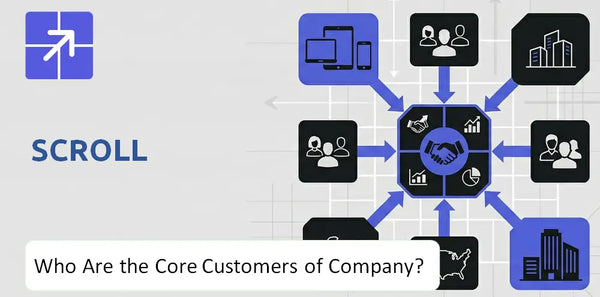
Scroll Corporation's core customers split between retail consumers for catalog and e – commerce and B2B clients for logistics and fintech solutions. This matters because in 2025 Scroll's Solutions segment drove growth as domestic retail shrank, signaling a strategic pivot to higher – margin services.
Focus on enterprise contracts: prioritize expanding Solutions sales to midsize retailers and logistics partners; monitor retention and ARPU to track B2B momentum. See Scroll BCG Matrix Analysis
Who Is Scroll Trying to Win?
Scroll Corporation targets Active Seniors in Japan – women aged 50 – 75 – plus small-to-mid e-commerce operators that use its back-office and fulfillment services; these two groups drive most sales and growth.
 Main customer group: Active Senior shoppers
Women aged 50 – 75 in Japan form the primary cohort for Scroll Company core customers, accounting for roughly 60 – 70% of B2C mail-order and e-commerce revenue in 2025; they buy curated apparel, home goods, and health supplements and show high repeat-purchase rates.
Secondary groups: digital-native merchants
Small and mid-sized e-commerce operators and digital-native brands are Scroll customer segments that fuel growth; in 2025 B2B Solutions grew to contribute about 35 – 40% of new contract value as brands outsoured fulfillment and marketing.
Customer type and market role: mixed B2C and B2B
Scroll mainly serves consumers directly through mail-order and e-commerce while also serving businesses via platform and logistics services; this mixed model lets Scroll monetize both end users and the infrastructure that supports them.
Most important segment by revenue and scale
The Active Senior B2C segment remains the largest by revenue share, but the fastest-growing and strategically vital segment in 2025 is B2B Solutions – contracts with small and medium publishers and merchants lifted overall GMV and reduced CAC via platform stickiness; see How Scroll Company Works and Makes Money for context.
Scroll SWOT Analysis
- Complete SWOT Breakdown
- Fully Customizable
- Editable in Excel & Word
- Professional Formatting
- Investor-Ready Format

What Do Scroll's Customers Care About Most?
Scroll Company core customers care most about product reliability, safety, consistent aesthetics, cost-efficiency, and technical fit; these needs drive purchase and partnership decisions across B2C and B2B segments.

Dependable product quality and safety
Consumers in Scroll Company target market expect reliable sizing, material quality, and safety standards for apparel and health goods; reliability reduces returns and supports trust-based shopping.
Practical buying drivers: price and convenience
B2C buyers favor predictable fit and aesthetic consistency; B2B customers demand cost-efficiency and integration to lower customer acquisition and last – mile costs amid rising logistics expenses.
Emotional and aspirational appeal
Consumers choose Scroll Company for brand trust that signals quality in a crowded digital marketplace; this appeals to millennial and Gen Z readers seeking curated, dependable purchases.
What customers value most
Customers value predictable product performance, clear safety claims, and operational efficiencies – B2B clients also prioritize shared-warehouse savings and data-driven marketing tools that cut acquisition costs.
Loyalty and repeat demand
Reliability in sizing and material quality supports a 18.5 percent repeat purchase rate in apparel; consistent delivery and quality controls sustain retention among paid content subscribers and digital publisher customers.
Why customers choose Scroll Company
Scroll Company acts as a quality filter: consumers trust the brand, while advertisers and media buyers and small and medium publishers gain cost, integration, and last – mile efficiencies – especially after logistics costs in Japan rose by 4.5 percent in 2025.
For more on company positioning and values see Mission, Vision, and Values of Scroll Company
Scroll Business Model Canvas
- One-time Payment
- No Research Needed – Save Hours of Work
- Built by Experts, Trusted by Consultants
- Instant Download, Ready to Use
- 100% Editable, Fully Customizable

Where Is Demand Strongest for Scroll?
Demand is strongest in digital transition services, concentrated in urban and suburban Japan where aging demographics drive both catalog retention and mobile adoption; Beauty, Health, and Solutions segments show the fastest growth.
Main market: Urban and suburban Japan
Urban and suburban prefectures with dense elderly populations (Tokyo, Kanagawa, Osaka) generate the bulk of Scroll Company core customers because they combine catalog loyalty with rising mobile engagement, making these regions the Scroll Company target market epicenter.
Secondary demand: Beauty, Health, and third – party logistics
Beauty and Health verticals and startups outsourcing fulfillment drive meaningful demand outside core mail-order buyers; small and medium publishers and digital publisher customers also form growing segments for paid content subscribers and advertisers and media buyers.
Where Scroll Company is strongest
Scroll Company is strongest in reach and revenue mix from legacy mail-order plus rapid digital adoption: the traditional catalog channel remains a steady cash source while mobile-first interfaces are expanding paid content subscribers and advertiser demand among older cohorts.
Where demand is growing fastest (2025 – FY ending Mar 2026)
The Solutions segment is projected to exceed 28% of total operating income in the fiscal year ending March 2026, driven by third – party logistics from startups lacking physical infrastructure; mobile transaction volume among seniors rose 12% year – over – year, signaling successful digital migration and stronger demand for digital publisher customers and conversion-focused marketers.
Ownership and Control of Scroll Company
Scroll Marketing Mix
- Complete Marketing Mix Analysis
- Effortlessly Communicate Your Business Strategy
- Investor-Ready Format
- 100% Editable and Customizable
- Clear and Structured Layout

How Does Scroll Keep Its Audience Growing?
Scroll Corporation grows its audience by life-stage marketing, cross-selling insurance and travel to its retail database, and investing in AI personalization and B2B cross-border services to broaden reach and boost retention.
How Scroll Corporation Expands Its Customer Base
Scroll Company targets adjacent segments by adding insurance and travel offers to its core retail customers and by expanding B2B cross-border e-commerce support, attracting small and medium publishers, news organizations, and enterprise media buyers. AI-driven personalization on e-commerce and paid content boosts conversion among millennial and Gen Z readers while capturing long-tail digital publisher customers and content creators.
Customer Retention Drivers
Retention hinges on life-stage marketing, product bundling, and tailored messaging; female core customers held a retention rate near 74 percent in 2025. Improved personalization reduces churn, and logistics reliability supports repeat purchases as traditional mail-order declines.
Loyalty, Repeat Demand, and Customer Depth
Cross-selling insurance and travel increases customer lifetime value and ecosystem stickiness; repeat purchase cadence is reinforced by personalized offers and seamless fulfillment. Loyalty among Scroll Company target market segments grows through renewals and bundled subscriptions for paid content subscribers and advertisers and media buyers accessing engaged audiences.
Strongest Customer-Base Growth Lever
The chief growth lever is AI-driven personalization combined with logistics dominance: investing to become a high-utility service provider is forecast to lift operating margin to 6.2 percent by late 2026 while offsetting Japan's declining mail-order volume. See Competitive Landscape of Scroll Company for context: Competitive Landscape of Scroll Company
Scroll Boston Consulting Group Matrix
- Built by Experts, Trusted by Consultants
- Structured for Consultants, Students, and Founders
- 100% Editable in Microsoft Word & Excel
- Instant Digital Download – Use Immediately
- Compatible with Mac & PC – Fully Unlocked

Related Blogs
- What Is the History of Scroll Company and How Did It Evolve?
- What Is the Competitive Landscape of Scroll Company and How Does It Compete?
- What Is the Growth Outlook of Scroll Company and Where Is It Heading?
- How Does Scroll Company Work and What Drives Its Business Model?
- How Does Scroll Company Reach Customers and Turn Demand into Sales?
- What Do the Mission, Vision, and Core Values of Scroll Company Reveal?
- Who Owns Scroll Company Today and Who Holds Control?
Frequently Asked Questions
Scroll's main customers are Active Senior shoppers in Japan, especially women aged 50-75. They make up the primary B2C audience and buy curated apparel, home goods, and health supplements, with strong repeat-purchase behavior. The company also serves small and mid-sized e-commerce operators through its B2B services.
Disclaimer
All information, articles, and product details provided on this website are for general informational and educational purposes only. We do not claim any ownership over, nor do we intend to infringe upon, any trademarks, copyrights, logos, brand names, or other intellectual property mentioned or depicted on this site. Such intellectual property remains the property of its respective owners, and any references here are made solely for identification or informational purposes, without implying any affiliation, endorsement, or partnership.
We make no representations or warranties, express or implied, regarding the accuracy, completeness, or suitability of any content or products presented. Nothing on this website should be construed as legal, tax, investment, financial, medical, or other professional advice. In addition, no part of this site - including articles or product references - constitutes a solicitation, recommendation, endorsement, advertisement, or offer to buy or sell any securities, franchises, or other financial instruments, particularly in jurisdictions where such activity would be unlawful.
All content is of a general nature and may not address the specific circumstances of any individual or entity. It is not a substitute for professional advice or services. Any actions you take based on the information provided here are strictly at your own risk. You accept full responsibility for any decisions or outcomes arising from your use of this website and agree to release us from any liability in connection with your use of, or reliance upon, the content or products found herein.