
Who are SK Telecom's core customers among South Korea's consumers and enterprises?
Identifying SK Telecom's core customers shows how it shifts from telco services to AI platforms; its ~47% market share in 2025 signals dominance among retail mobile users and large enterprises investing in AI infrastructure.
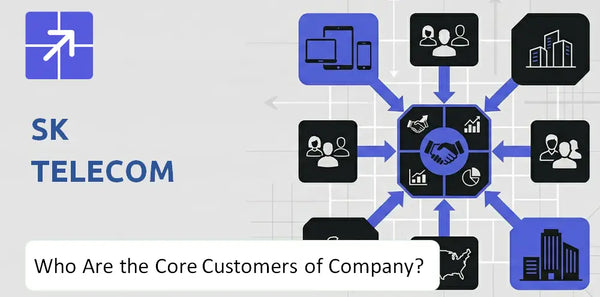
Retail subscribers and enterprise IT units drive revenue: retail yields steady ARPU while enterprises fund 2025 capex in AI data centers. See product analysis: SK Telecom BCG Matrix Analysis
Who Is SK Telecom Trying to Win?
SK Telecom tries to win high-ARPU 5G retail subscribers, large B2B clients and AI-native consumers; these groups drive premium revenue and strategic services across mobile, private 5G, IoT and AI platforms.
 Main customer group: High-ARPU 5G retail subscribers
SK Telecom targets the 16.5 million 5G users within its 31 million mobile connections because they deliver the largest ARPU and demand premium network reliability, driving a large share of the 17.8 trillion KRW 2025 revenue.
Secondary groups: MVNO and budget-conscious users
SK Telecom keeps price-sensitive segments via MVNO sub-brands to protect market share among mobile subscribers South Korea while preserving premium positioning for core customers.
Customer type and market role: Mixed consumer and enterprise focus
SK Telecom serves both consumers and enterprises: retail postpaid/prepaid subscribers plus enterprise and B2B customers such as government agencies and large corporations needing private 5G, IoT integration and cloud services.
Most important segment: Premium tier 5G and enterprise B2B
The premium 5G cohort and enterprise clients (private 5G, IoT customers and industries, cloud customers) are most important by revenue and strategic relevance, accounting for the bulk of service ARPU and driving investments in AI-native features like the A. personal assistant platform; see Ownership and Control of SK Telecom Company for related context: Ownership and Control of SK Telecom Company
SK Telecom SWOT Analysis
- Complete SWOT Breakdown
- Fully Customizable
- Editable in Excel & Word
- Professional Formatting
- Investor-Ready Format

What Do SK Telecom's Customers Care About Most?
Retail and enterprise SK Telecom target customers prioritize reliable networks, AI-enhanced utilities, and seamless ecosystem integration for daily life and operations; purchase drivers are network stability, AI features, security, and cost-efficiency. These motivations drive demand across SK Telecom core customers spanning mobile subscribers South Korea and enterprise and B2B customers.

Network stability and AI-enhanced utility
Retail users want uninterrupted 5G service plus AI features such as automated call recording, real-time translation, and personalized content curation from the A. platform to simplify daily tasks and media consumption.
Practical buying drivers: price, bundled convenience, and performance
Consumers choose SK Telecom for integrated mobile plans, the T-Membership loyalty benefits, and bundled SK Broadband services that reduce friction and deliver measurable value per month.
Emotional and aspirational appeal
Young urban millennials and 5G early adopters value being seen as tech-forward; enterprise buyers prize innovation status from adopting AI-on-the-edge and industry-specific LLMs.
What customers value most
Retailers and households prioritize seamless ecosystem outcomes – stable connectivity plus services that save time; enterprises prioritize scalability, reduced latency, energy efficiency, and strong data security from AIDC and edge AI.
Loyalty and repeat demand
Churn holds at approximately 0.7 percent in 2025 because T-Membership perks, bundled SK Broadband integration, and reliable AI services raise switching costs and encourage long-term retention.
Why customers choose SK Telecom
Customers pick SK Telecom for its market-leading 5G network, integrated lifestyle ecosystem, proprietary AI models for industry use, and enterprise-grade AIDC scalability that cut latency and energy costs.
For context on company evolution and strategic positioning see History and Background of SK Telecom Company.
SK Telecom Business Model Canvas
- One-time Payment
- No Research Needed – Save Hours of Work
- Built by Experts, Trusted by Consultants
- Instant Download, Ready to Use
- 100% Editable, Fully Customizable

Where Is Demand Strongest for SK Telecom?
Demand is concentrated in the Seoul Metropolitan Area where per-user data use and 5G-Advanced density are highest; strongest growth in 2025 – 2026 is shifting to industrial corridors in Incheon and Gyeonggi driven by smart factory and IoT adoption.
Main Market: Seoul Metropolitan Area
Seoul Metro holds the largest share of SK Telecom target customers, with peak data consumption and dense 5G-Advanced coverage; urban consumers and 5G early adopters drive mobile ARPU and device-led usage.
Secondary Markets: Incheon and Gyeonggi Industrial Corridors
Incheon and Gyeonggi show the fastest growth for enterprise and B2B customers: smart factory deployments, logistics IoT, and private 5G projects underpin rising demand from SK Telecom IoT customers and industries.
Where SK Telecom Is Strongest: Urban Consumer and Cloud Reach
SK Telecom core customers cluster among young urban millennials and high-usage households in metro areas; Cloud and AIDC adoption lifted data center utilization by near 30 percent year-over-year in 2025 as enterprise clients seek localized AI infrastructure.
Fastest Growing Demand: Cloud, AIDC, and Export Channels
Demand is growing fastest in Cloud and AIDC channels and via the Global Telco AI Alliance, which opened export routes for SK Telecom telecom solutions to Southeast Asia and Europe; expect continued lift in enterprise cloud contracts and corporate partnerships and clients through 2026.
Related reading: Growth Outlook of SK Telecom Company
SK Telecom Marketing Mix
- Complete Marketing Mix Analysis
- Effortlessly Communicate Your Business Strategy
- Investor-Ready Format
- 100% Editable and Customizable
- Clear and Structured Layout

How Does SK Telecom Keep Its Audience Growing?
SK Telecom keeps its audience growing by migrating 4G users to 5G/5G – Advanced, expanding AI and cloud services to enterprises, and bundling third – party subscriptions to raise switching costs and reach adjacent customer segments.
How SK Telecom Expands Its Customer Base
SK Telecom targets 5G early adopters and mobile subscribers South Korea by upselling 4G to 5G/5G – Advanced plans and adding 5G home and IoT customers; enterprise and B2B customers grow via AI infrastructure and cloud services, winning multi – year contracts that broaden SK Telecom target customers into adjacent industries.
Customer Retention Drivers
Loyalty stems from the T – Universe subscription ecosystem bundling partners like Amazon and Starbucks, postpaid mobile plans with device upgrade paths, and service SLAs for enterprise clients; these raise switching costs and keep churn below industry averages.
Loyalty, Repeat Demand, and Customer Depth
T – Universe plus device and plan pipelines drive repeat demand; migrating the remaining 4G base to higher – margin 5G tiers deepens ARPU per user. For enterprise clients, recurring AI and cloud management contracts create long customer lifecycles and cross – sell opportunities.
The Strongest Customer – Base Growth Lever in 2025/2026
The biggest lever is 5G migration combined with AI services: professional judgment projects stable 3 percent telco revenue growth in 2026 while AI – related businesses contribute over 20 percent of operating profit; a projected dividend payout ratio of 75 percent reinforces SK Telecom as a high – yield defensive asset for its tech – savvy core customers.
SK Telecom core customers include young urban millennials using SK Telecom, 5G home customers, IoT customers and industries, and enterprise clients buying telecom solutions and cloud services; see Competitive Landscape of SK Telecom Company for context: Competitive Landscape of SK Telecom Company
SK Telecom Boston Consulting Group Matrix
- Built by Experts, Trusted by Consultants
- Structured for Consultants, Students, and Founders
- 100% Editable in Microsoft Word & Excel
- Instant Digital Download – Use Immediately
- Compatible with Mac & PC – Fully Unlocked

Related Blogs
- What Is the History of SK Telecom Company and How Did It Evolve?
- What Is the Competitive Landscape of SK Telecom Company and How Does It Compete?
- What Is the Growth Outlook of SK Telecom Company and Where Is It Heading?
- How Does SK Telecom Company Work and What Drives Its Business Model?
- How Does SK Telecom Company Reach Customers and Turn Demand into Sales?
- What Do the Mission, Vision, and Core Values of SK Telecom Company Reveal?
- Who Owns SK Telecom Company Today and Who Holds Control?
Frequently Asked Questions
SK Telecom's core target customers are high-ARPU 5G retail subscribers, large B2B clients, and AI-native consumers. The company also serves MVNO and budget-conscious users, but its main focus is on premium mobile users and enterprise customers that drive revenue through mobile, private 5G, IoT, cloud, and AI services.
Disclaimer
All information, articles, and product details provided on this website are for general informational and educational purposes only. We do not claim any ownership over, nor do we intend to infringe upon, any trademarks, copyrights, logos, brand names, or other intellectual property mentioned or depicted on this site. Such intellectual property remains the property of its respective owners, and any references here are made solely for identification or informational purposes, without implying any affiliation, endorsement, or partnership.
We make no representations or warranties, express or implied, regarding the accuracy, completeness, or suitability of any content or products presented. Nothing on this website should be construed as legal, tax, investment, financial, medical, or other professional advice. In addition, no part of this site - including articles or product references - constitutes a solicitation, recommendation, endorsement, advertisement, or offer to buy or sell any securities, franchises, or other financial instruments, particularly in jurisdictions where such activity would be unlawful.
All content is of a general nature and may not address the specific circumstances of any individual or entity. It is not a substitute for professional advice or services. Any actions you take based on the information provided here are strictly at your own risk. You accept full responsibility for any decisions or outcomes arising from your use of this website and agree to release us from any liability in connection with your use of, or reliance upon, the content or products found herein.