
How does SK Telecom convert its sales and marketing model into sustained subscriber and enterprise revenue growth?
SK Telecom shifts from pure connectivity to AI and cloud, using a 31,000,000 subscriber base and channel partnerships to sell high-margin digital services. This matters as SK Telecom reported strong 2025 capex toward AI platforms and maintained industry-leading EBITDA margins, signaling scalable monetization.
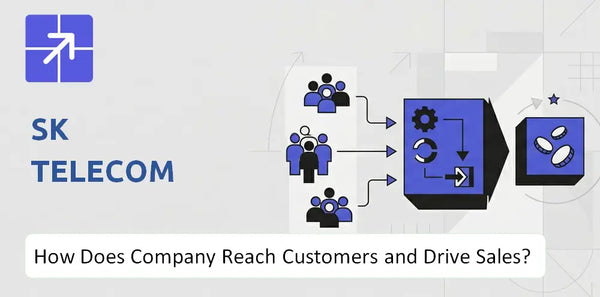
Prioritize cross-sell via enterprise sales teams and retail channels, and push bundled AI-cloud offers to existing mobile customers; see SK Telecom BCG Matrix Analysis for product positioning and portfolio moves.
Who Does SK Telecom Want to Sell To?
SK Telecom wants to sell mainly to South Korean consumers – the 31.5 million mobile subscribers where it holds a 47.5 percent market share – focusing on high-value 5G users and Gen Z with AI-integrated personal services, plus enterprise clients (manufacturing, finance, public) needing sovereign AI and edge computing. It also courts international telco partners via the Global Telco AI Alliance to offer non-hyperscaler AI infrastructure.
 Main consumer segment: high-value 5G and Gen Z users
SK Telecom marketing targets the domestic base of 31.5 million subscribers, prioritizing 5G adopters who drive ARPU and Gen Z who adopt AI-integrated personal assistant services; this group yields faster upsell to premium plans and digital services.
Additional target segments: enterprise and public sector
SK Telecom sales strategy pursues B2B clients in manufacturing, finance, and government for sovereign AI, edge computing, and customized Large Language Models, aiming for multi-year contracts and higher-margin platform revenues.
Market positioning: leading domestic telco and global AI partner
SK Telecom positions itself as the dominant South Korean operator with strong 5G penetration and as a strategic technology partner for other operators via the Global Telco AI Alliance, offering alternatives to US hyperscalers.
Why the positioning works: tech depth, data scale, and sovereign AI
The message centers on sovereign AI, edge computing, and localized LLMs – differentiators supported by 47.5 percent domestic share, strong 5G adoption, and partnerships that enable SK Telecom customer acquisition through targeted advertising and omnichannel retail tactics.
How SK Telecom Company Works and Makes Money
SK Telecom SWOT Analysis
- Complete SWOT Breakdown
- Fully Customizable
- Editable in Excel & Word
- Professional Formatting
- Investor-Ready Format

How Does SK Telecom Get in Front of Customers?
SK Telecom gets in front of customers through a hybrid omnichannel approach: Korea's largest retail footprint plus the T-Direct Shop and A. (A-dot) AI platform for digital-first acquisition. It combines retail conversion, app-driven cross-sell, and enterprise consultative sales to build awareness, generate demand, and convert subscribers.

Flagship Retail and T-Direct Shop Drive Volume
SK Telecom marketing leans on the domestic retail network – the largest in Korea – to capture walk-in traffic and service conversions, while T-Direct Shop provides a digital storefront for quick plan activation and device sales, improving omnichannel retail SK Telecom conversion rates.
AI Platform as a Digital Growth Engine
SK Telecom sales strategy routes demand through the A. (A-dot) AI platform, which surpassed 5,000,000 subscribers by early 2026; generative AI features increase engagement and serve personalized cross-sell prompts inside the mobile app ecosystem.
Direct Enterprise Sales and Partner Ecosystem
For B2B, SK Telecom customer acquisition uses a direct consultative sales force plus channel partners; global collaborations with Anthropic and AWS enable co-branded AI and cloud solutions, aiding enterprise deal flow and higher ARPU (average revenue per user).
Digital Marketing and Platform Distribution
Digital marketing SK Telecom relies on search, paid media, social, content, and push notifications via the mobile app; platform distribution and in-app prompts on A. drive acquisition and retention, with data-driven marketing campaigns for 5G services improving targeting efficiency.
Demand Generation: Campaigns and Promotions
SK Telecom runs time-limited promotions, device subsidies, bundle offers, and influencer campaigns to spur activations; seasonal campaigns tied to device launches and 5G service promotions convert high-intent traffic into paying subscribers.
Customer Acquisition Efficiency and Metrics
Public filings and 2025 disclosures show customer lifecycle focus and investments in CRM to reduce churn; combining retail conversion and A. engagement has improved cost-per-acquisition versus prior years while supporting sustained postpaid subscriber growth.
Key Reach Advantage: Scale + AI Personalization
The most important reach advantage is scale – extensive retail presence – paired with A. AI personalization, enabling targeted offers at scale and seamless online-to-offline SK Telecom mobile app customer acquisition strategies that drive conversions across channels.
See additional context in this company profile: History and Background of SK Telecom Company
SK Telecom Business Model Canvas
- One-time Payment
- No Research Needed – Save Hours of Work
- Built by Experts, Trusted by Consultants
- Instant Download, Ready to Use
- 100% Editable, Fully Customizable

How Does SK Telecom Turn Attention Into Sales?
SK Telecom turns attention into sales by migrating users to higher-ARPU 5G plans and locking customers into converged bundles and loyalty programs that lower churn and raise lifetime value. Enterprise uptake of Data Center and AI-as-a-Service contracts converts interest into recurring, higher-margin revenue.
Core sales model: bundle-led subscriptions and enterprise contracts
SK Telecom sells via retail stores, direct enterprise sales, and digital channels. Consumer revenue is subscription-led (mobile, IPTV, broadband bundles); enterprise growth is driven by long-term DC and AIaaS contracts and partner-led integration deals.
Pricing and monetization logic: ARPU migration and bundle premiums
Pricing mixes recurring monthly fees, usage-based data add-ons, and tiered bundle discounts. The company pushes higher-priced 5G plans to raise ARPU while monetizing cloud/AI through multi-year contracts and consumption billing.
Conversion and purchase drivers: loyalty, convergence, and 5G performance
T-Membership rewards and converged offers with SK Broadband's IPTV reduce friction and increase perceived value, keeping monthly churn under 1 percent. 5G coverage – about 80 percent penetration in the subscriber base by early 2026 – boosts data monetization and upsell effectiveness.
Repeat revenue and customer expansion: retention and non-telco diversification
Cross-sell into IPTV, fixed broadband, and value-added digital services expands ARPU per household. Non-telco segments (Data Center, AIaaS) now contribute over 20 percent of total revenue, creating recurring, higher-margin streams and lowering overall volatility.
SK Telecom combines omnichannel retail, targeted digital marketing, and CRM-driven personalization to convert leads into subscribers; see related market segmentation in Target Customers and Market of SK Telecom Company.
SK Telecom Marketing Mix
- Complete Marketing Mix Analysis
- Effortlessly Communicate Your Business Strategy
- Investor-Ready Format
- 100% Editable and Customizable
- Clear and Structured Layout

How Strong Does SK Telecom's Commercial Engine Look Going Forward?
SK Telecom's commercial engine looks resilient, driven by a mature mobile cash flow and high-growth Data Center and Cloud segments; strengths include a disciplined capital allocation and an AI-first push, while risks center on competition and execution of cloud expansion. Key support or weakness will come from cloud/DC growth rates, telco margins, and success converting AI infrastructure demand into paid services.
Primary support for future demand
Brand strength and telco monopoly supply stable cash and distribution; Data Center and Cloud grew double-digit in 2025, underpinning sales. SK Telecom marketing and SK Telecom sales strategy center on AI-led enterprise offerings that raise average revenue per user in B2B and B2C.
Channel and marketing effectiveness
Omnichannel retail SK Telecom plus digital marketing SK Telecom deliver broad reach: retail stores, mobile app funnels, and targeted advertising drive acquisition and conversion. CRM and data-driven campaigns for 5G and cloud show improved conversion; retail-to-online (O2O) conversion optimization reduced acquisition cost in 2025.
Risks to commercial performance
Cloud incumbents and hyperscalers could pressure margins and pricing strategy to convert demand into subscriptions; execution risk for scaling data centers may raise CapEx beyond forecasts. Subscriber churn from aggressive promos and slower AI monetization would weaken SK Telecom customer acquisition ROI.
Overall sales and marketing outlook for 2025/2026
Outlook is strong and adaptable: mobile provides stability while Data Center and Cloud supply upside; management projects near 2.0 trillion KRW operating profit in 2026, and maintains a 50 percent dividend payout ratio alongside elevated R&D and AI capex. The mix positions SK Telecom as a defensive-growth hybrid with steady cash flow and diversification tailwinds.
See related governance context in Ownership and Control of SK Telecom Company
SK Telecom Boston Consulting Group Matrix
- Built by Experts, Trusted by Consultants
- Structured for Consultants, Students, and Founders
- 100% Editable in Microsoft Word & Excel
- Instant Digital Download – Use Immediately
- Compatible with Mac & PC – Fully Unlocked

Related Blogs
- What Is the History of SK Telecom Company and How Did It Evolve?
- What Is the Competitive Landscape of SK Telecom Company and How Does It Compete?
- What Is the Growth Outlook of SK Telecom Company and Where Is It Heading?
- How Does SK Telecom Company Work and What Drives Its Business Model?
- What Do the Mission, Vision, and Core Values of SK Telecom Company Reveal?
- Who Are the Core Customers in SK Telecom Company's Target Market?
- Who Owns SK Telecom Company Today and Who Holds Control?
Frequently Asked Questions
SK Telecom mainly targets South Korean mobile consumers, especially high-value 5G users and Gen Z customers who want AI-integrated personal services. It also sells to enterprise clients in manufacturing, finance, and the public sector, plus international telco partners through the Global Telco AI Alliance.
Disclaimer
All information, articles, and product details provided on this website are for general informational and educational purposes only. We do not claim any ownership over, nor do we intend to infringe upon, any trademarks, copyrights, logos, brand names, or other intellectual property mentioned or depicted on this site. Such intellectual property remains the property of its respective owners, and any references here are made solely for identification or informational purposes, without implying any affiliation, endorsement, or partnership.
We make no representations or warranties, express or implied, regarding the accuracy, completeness, or suitability of any content or products presented. Nothing on this website should be construed as legal, tax, investment, financial, medical, or other professional advice. In addition, no part of this site - including articles or product references - constitutes a solicitation, recommendation, endorsement, advertisement, or offer to buy or sell any securities, franchises, or other financial instruments, particularly in jurisdictions where such activity would be unlawful.
All content is of a general nature and may not address the specific circumstances of any individual or entity. It is not a substitute for professional advice or services. Any actions you take based on the information provided here are strictly at your own risk. You accept full responsibility for any decisions or outcomes arising from your use of this website and agree to release us from any liability in connection with your use of, or reliance upon, the content or products found herein.