
Who are Swatch Group's core customers across entry-level to luxury segments?
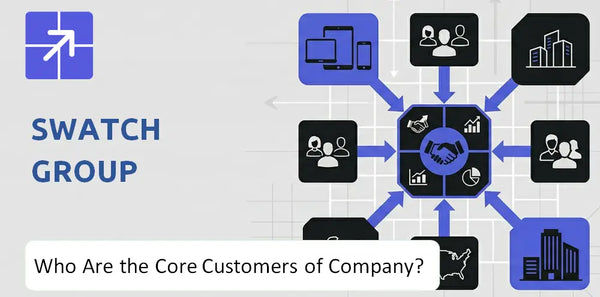
Swatch Group serves mass-market buyers, aspirational mid-tier purchasers, and affluent collectors; this matters because in 2025 the group reported resilient demand across tiers, with mid-price brands driving volume recovery. Swatch Group BCG Matrix Analysis
Focus on converting first-time buyers into repeat purchasers: prioritize accessible aftersales and targeted loyalty programs tied to mid-tier brands, where 2025 growth signals show highest conversion potential.
Who Is Swatch Group Trying to Win?
Swatch Group tries to win four core customer groups: Ultra – High – Net – Worth collectors for prestige brands, Aspirational Professionals for Omega/Longines, younger fashion and first – time Swiss buyers via Tissot/Mido/Swatch, and industrial clients sourcing movements through ETA and Nivarox – FAR.
 Main customer group: Aspirational Professionals
Aspirational professionals – ages 30 – 55, mid – to – high income – drive the largest share of operating profit via Omega and Longines; in 2025 these mid – luxury segments supported a substantial portion of group margin as retail sales mix shifted toward premium mid – range watches.
Secondary groups: UHNW collectors and fashion buyers
Ultra – High – Net – Worth Individuals and serious collectors buy Breguet, Blancpain and Harry Winston for rarity and investment value; younger fashion watch buyers (18 – 35) target Swatch, Tissot and Mido for price, style and trends, expanding total addressable market.
Customer type and market role: mixed consumer and B2B
Swatch Group serves a mixed base: direct consumers across luxury, mid – range and fashion segments, plus business clients – watchmakers and brands – buying ETA movements and Nivarox – FAR components, which accounted for a meaningful share of industrial revenue in recent years.
Most important segment by revenue: Omega/Longines
Omega and Longines represent the most important revenue and profit pool by scale; management commentary and 2025 channel mix show mid – luxury sales and global retail expansion as key drivers of group operating profit and brand equity.
See related analysis on Sales and Marketing Strategy of Swatch Group Company
Swatch Group SWOT Analysis
- Complete SWOT Breakdown
- Fully Customizable
- Editable in Excel & Word
- Professional Formatting
- Investor-Ready Format

What Do Swatch Group's Customers Care About Most?
Swatch Group target customers prioritize technical precision, heritage, and cultural currency: high – end buyers seek Swiss Made certification and advanced movements, middle – market shoppers want attainable luxury between $500 and $2,000, and entry buyers chase hype, Bioceramic drops, and limited editions for collectability.

Technical pedigree and investment value
Luxury watch consumers and professional buyers of Omega and Breguet prioritize Chronometer certifications, anti – magnetic silicon hairsprings, and in – house calibers as proof of resale value and horological legitimacy.
Practical buying drivers: materials and price points
Swatch Group target market for mid – range watches focuses on sapphire crystal, ceramic bezels, and robust movements at accessible pricing; data shows core mid – range sales cluster in the $500 – $2,000 band.
Emotional and aspirational appeal
Fashion watch buyers and collectors value brand heritage and cultural signaling – owning an Omega or Breguet signals status, while Bioceramic Swatch drops serve youthful identity and street – style visibility.
What customers value most
Across segments, customers value authenticity (Swiss Made), measurable technical specs, and design relevance; resale potential and limited – edition scarcity increase willingness to pay.
Loyalty and repeat demand
Retention is driven by brand ecosystems (entry buyers migrating to Tissot or Longines), limited drops that spark secondary – market interest, and authorized service networks that preserve value.
Why customers choose Swatch Group brands
The clearest reason is category depth: from collectible Bioceramic pieces to high – net – worth luxury like Omega, the portfolio matches watch brand demographics across age and income and channels, supporting both retail and online demand; see How Swatch Group Company Works and Makes Money for operational context.
Swatch Group Business Model Canvas
- One-time Payment
- No Research Needed – Save Hours of Work
- Built by Experts, Trusted by Consultants
- Instant Download, Ready to Use
- 100% Editable, Fully Customizable

Where Is Demand Strongest for Swatch Group?
Demand is strongest in the Asia-Pacific region, accounting for over 35% of Swatch Group Company sales as of early 2026, led by Mainland China and Hong Kong; strong activity also appears in North America and Japan where city boutiques and tourism boost purchases.
Asia – Pacific: Primary Demand Hub
Asia – Pacific remains the Swatch Group target market core, delivering more than 35% of group revenue in early 2026 thanks to a stabilized recovery in Mainland China and Hong Kong and continued appetite from luxury watch consumers.
United States and Japan: High – Growth Terrains
The United States is a high-growth territory with double-digit sales increases in 2025 driven by mono-brand boutiques in Tier – 1 cities; Japan surged in 2025 on luxury tourism and favorable currency moves, lifting demand for higher – end brands.
Where Swatch Group Is Strongest
Swatch Group Company is strongest in Direct – to – Consumer retail and brand boutiques, which deliver higher margins and brand control; the DTC and e – commerce mix now represents approximately 42% of total revenue as of 2025.
Fastest – Growing Demand Areas
Demand grew fastest in DTC and online channels in 2025/2026, and in the United States and Japan; collectors and young urban professionals are buying limited editions and mid – range premium pieces, shifting sales away from multi – brand retailers.
See further context on ownership and strategic positioning in this analysis: Ownership and Control of Swatch Group Company
Swatch Group Marketing Mix
- Complete Marketing Mix Analysis
- Effortlessly Communicate Your Business Strategy
- Investor-Ready Format
- 100% Editable and Customizable
- Clear and Structured Layout

How Does Swatch Group Keep Its Audience Growing?
Swatch Group keeps its audience growing by pairing a brand ladder strategy with hit collaborations and digital retail premiumization, attracting younger buyers and feeding them into higher – margin brands while boosting retention through enhanced loyalty and service.
Expanding the Customer Base via Brand Ladder and Collaborations
Swatch Group target customers expand as entry – level brands (Swatch, Flik Flak) and fashion watch buyers draw Gen Z and Millennials via viral collaborations like MoonSwatch; mid – range labels (Tissot, Certina) capture young urban professionals; luxury watch consumers move up to Omega and Breguet. This staged funnel broadens the Swatch Group target market and adjacent segments globally.
Customer Retention Drivers
Retention relies on retail premiumization, authorized – service networks, extended warranties, and omnichannel CRM. Digital integration and post – purchase service reduce churn; in 2025 the group reported improving same – store – sales momentum and higher repeat rates in mature markets.
Loyalty, Repeat Demand, and Customer Depth
Loyalty grows via product ecosystems, limited editions, and trade – up pathways – MoonSwatch converted many first – time buyers into Omega prospects. Repeat purchase frequency rose as the group leaned into direct retail and digital services; management projects repeat purchase lifts under its 2025/2026 retail premiumization push.
Strongest Growth Lever in 2025/2026
The key lever is brand laddering combined with product innovation – scalable manufacturing lets Swatch Group keep prices competitive while capturing the expanding global middle class. Management projects revenue growth of 5 to 7 percent for 2026 as digital integration and retail premiumization raise margins and customer lifetime value; see Competitive Landscape of Swatch Group Company for context: Competitive Landscape of Swatch Group Company.
Swatch Group Boston Consulting Group Matrix
- Built by Experts, Trusted by Consultants
- Structured for Consultants, Students, and Founders
- 100% Editable in Microsoft Word & Excel
- Instant Digital Download – Use Immediately
- Compatible with Mac & PC – Fully Unlocked

Related Blogs
- What Is the History of Swatch Group Company and How Did It Evolve?
- What Is the Competitive Landscape of Swatch Group Company and How Does It Compete?
- What Is the Growth Outlook of Swatch Group Company and Where Is It Heading?
- How Does Swatch Group Company Work and What Drives Its Business Model?
- How Does Swatch Group Company Reach Customers and Turn Demand into Sales?
- What Do the Mission, Vision, and Core Values of Swatch Group Company Reveal?
- Who Owns Swatch Group Company Today and Who Holds Control?
Frequently Asked Questions
Swatch Group's core customers are Aspirational Professionals, Ultra-High-Net-Worth collectors, younger fashion and first-time Swiss watch buyers, and industrial clients. The article says Omega and Longines attract the main profit-driving mid-luxury audience, while Breguet, Blancpain, Harry Winston, Swatch, Tissot, Mido, ETA, and Nivarox-FAR serve the other groups.
Disclaimer
All information, articles, and product details provided on this website are for general informational and educational purposes only. We do not claim any ownership over, nor do we intend to infringe upon, any trademarks, copyrights, logos, brand names, or other intellectual property mentioned or depicted on this site. Such intellectual property remains the property of its respective owners, and any references here are made solely for identification or informational purposes, without implying any affiliation, endorsement, or partnership.
We make no representations or warranties, express or implied, regarding the accuracy, completeness, or suitability of any content or products presented. Nothing on this website should be construed as legal, tax, investment, financial, medical, or other professional advice. In addition, no part of this site - including articles or product references - constitutes a solicitation, recommendation, endorsement, advertisement, or offer to buy or sell any securities, franchises, or other financial instruments, particularly in jurisdictions where such activity would be unlawful.
All content is of a general nature and may not address the specific circumstances of any individual or entity. It is not a substitute for professional advice or services. Any actions you take based on the information provided here are strictly at your own risk. You accept full responsibility for any decisions or outcomes arising from your use of this website and agree to release us from any liability in connection with your use of, or reliance upon, the content or products found herein.