
How does Swatch Group reach customers and convert demand through its sales and marketing model?
The Swatch Group sells across price tiers via owned boutiques, wholesale partners, and e-commerce, pairing brand marketing with in-house production to control margins and inventory. This matters as 2025 revenue mix shifts toward direct retail, supported by recent retail expansion in Asia.
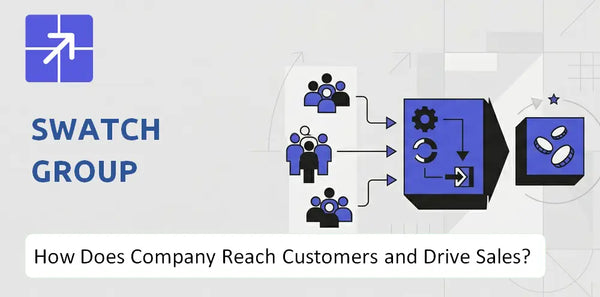
The Group leans on targeted brand campaigns, channel-specific assortments, and CRM to speed conversions; focus on omni-channel stock visibility cuts checkout friction. See Swatch Group BCG Matrix Analysis
Who Does Swatch Group Want to Sell To?
The Swatch Group wants to sell to three clear segments: ultra-high-net-worth collectors through prestige maisons, the global professional and aspirational middle-upper class via heritage brands, and mass-market plus Gen Z buyers with accessible lines. The firm uses price-point segmentation and targeted marketing to convert brand interest into purchases across channels.
 Primary audience: Luxury collectors and HNW individuals
Swatch Group marketing chases ultra-high-net-worth individuals with Breguet, Blancpain and Glashütte Original, where average unit prices exceed USD 20,000 and top pieces sell above USD 100,000. These buyers drive high-margin sales and brand halo; certified complications and limited editions are key conversion levers.
Core revenue: Professionals and aspirational buyers
Omega and Longines target the global professional class and aspirational buyers, with typical price points from USD 1,000 to USD 8,000. Swatch Group sales strategy focuses here: heritage storytelling, METAS/chronometer certifications, and sponsorships (Olympics, sports ambassadors) to drive trust and premium ASPs.
Mass and youth: Accessible, trend-driven buyers
Swatch and Tissot target Gen Z and mass-market consumers at price points from USD 60 to USD 1,000, using limited drops, collaborations, social media campaigns, and affordable mechanical options to boost volume and lifetime value.
Market positioning across segments
Swatch Group distribution channels balance direct retail, e-commerce, authorized dealers, and wholesale partners to cover tiers. The group positions brands by price, heritage, and technical credibility to avoid internal cannibalization while maximizing global reach.
Why this segmentation works
Price-point segmentation (USD 60 to >USD 100,000) insulates Swatch Group revenue from local downturns; in 2025 the group reported net sales of approximately CHF 9.8 billion, diversified across regions and channels. Targeted customer acquisition, omnichannel retail strategy, and brand-portfolio marketing approach turn demand into sales.
Channel mix and customer reach
Swatch Group omnichannel strategy for watches uses mono-brand boutiques, e-commerce (direct-to-consumer sales tactics), department-store concessions, and authorized dealers; roughly 30 – 40% of sales come through single-brand boutiques and online for premium brands, while mass-market brands rely more on wholesale and retail partnerships.
Read more on Ownership and Control of Swatch Group Company: Ownership and Control of Swatch Group Company
Swatch Group SWOT Analysis
- Complete SWOT Breakdown
- Fully Customizable
- Editable in Excel & Word
- Professional Formatting
- Investor-Ready Format

How Does Swatch Group Get in Front of Customers?
Swatch Group gets in front of customers through a hybrid distribution mix that shifted heavily to direct-to-consumer in 2025, combining a global mono-brand boutique expansion, selective wholesale partners, high-profile sponsorships, and viral collaborations to drive awareness, traffic, and conversions.

Mono-brand boutiques as the primary acquisition channel
Swatch Group expanded its mono-brand boutiques to over 1,600 locations in 2025 to control pricing, the in-store experience, and direct customer data capture; boutiques act as the main funnel for high-margin sales and brand storytelling.
Digital marketing and platform-driven reach
Swatch Group marketing leans on paid social, search, brand content, email CRM, and apps; in 2025 e-commerce growth outpaced retail footfall with digital sales rising mid-single digits year-over-year and targeted campaigns re-engaging younger cohorts.
Omnichannel sales and selective wholesale access
Swatch Group distribution channels remain hybrid: direct e-commerce, mono-brand boutiques, authorized dealers and selected department store concessions; wholesale is kept selective to protect pricing and brand equity while enabling reach in markets with limited boutique density.
Demand generation via sponsorships and collaborations
High-profile sports sponsorships (for example Omega as Olympic Official Timekeeper) and viral collaborations such as MoonSwatch and Bioceramic Scuba Fifty Fathoms drive top-of-funnel awareness, spike store traffic, and re-engage younger buyers who favor experiences over devices.
Customer acquisition efficiency and conversion
Direct-to-consumer focus improves margins and lifetime value; 2025 boutique expansion and tighter online funnels lifted conversion and reduced reliance on third-party retail markdowns, improving gross margin mix vs prior years.
Most important reach advantage: brand portfolio and marquee events
Swatch Group brand portfolio marketing approach and marquee sponsorships deliver scale and credibility: flagship brands provide halo effects that amplify traffic across mono-brand boutiques and digital channels, enabling efficient scaling in 2025.
For historical context and brand evolution, see History and Background of Swatch Group Company
Swatch Group Business Model Canvas
- One-time Payment
- No Research Needed – Save Hours of Work
- Built by Experts, Trusted by Consultants
- Instant Download, Ready to Use
- 100% Editable, Fully Customizable

How Does Swatch Group Turn Attention Into Sales?
Swatch Group turns attention into sales by pairing scarcity-driven desirability for prestige brands with drop culture and experiential retail for mass-market lines, then capturing margin through vertical integration and after-sales services.
Core sales model: Omnichannel direct-led retail and wholesale
Swatch Group sells via brand boutiques, ecommerce, authorized dealers, and wholesale partners. Direct-to-consumer and retail concession channels are growing to reach an expected 45 percent DTC mix in 2025, shifting sales toward higher-margin, owned channels.
Pricing and monetization logic: Premium scarcity and tiered pricing
Prestige labels use limited runs and waiting lists to preserve secondary-market value and high price points, while mass-market brands use timed drops, accessible price tiers, and bundle offers. Revenue streams include one-time watch sales plus recurring after-sales service fees and spare parts.
Conversion and purchase drivers: Scarcity, experience, and trust
Limited production and waiting lists create urgency for prestige buyers; drop culture and in-store experiences convert foot traffic into immediate transactions for mass segments. Vertical integration improves availability, boosting conversion rates at point of sale.
Repeat revenue and customer expansion: After-sales and service network
Swatch Group's global after-sales service network drives retention and recurring high-margin income from repairs, maintenance, and parts; services contributed an estimated mid-single-digit percentage of group revenue in 2025, reinforcing LTV.
Conversion tactics mix psychology and accessibility: limited – edition scarcity keeps resale premiums high, while experiential retail and timed drops create immediate purchase triggers; the group's manufacturing control widens gross margins and supports the Growth Outlook of Swatch Group Company.
Swatch Group Marketing Mix
- Complete Marketing Mix Analysis
- Effortlessly Communicate Your Business Strategy
- Investor-Ready Format
- 100% Editable and Customizable
- Clear and Structured Layout

How Strong Does Swatch Group's Commercial Engine Look Going Forward?
The Swatch Group's commercial engine entering 2026 appears resilient, supported by strong brand demand and a debt-free balance sheet, but faces pressure from a cooling Chinese luxury market and Swiss franc swings. Main drivers: product momentum (Bioceramic, Omega), healthy cash of over 2.2 billion CHF, and a strategic pivot to accessible collectibles; risks include smartwatch competition and FX volatility.
What Supports Future Demand
Brand depth across price tiers, record-high Omega sales in 2025, and the popularity of Bioceramic lines sustain demand; Swatch Group marketing and Swatch Group sales strategy focus on collectible drops and limited editions that drive repeat purchases and secondary-market buzz.
Channel and Marketing Effectiveness
Omnichannel strength – retail boutiques, authorized dealers, and growing e-commerce – maintains conversion; Swatch Group distribution channels and targeted digital campaigns raise acquisition efficiency, while in-store experiences and point-of-sale events lift average transaction values.
Risks to Commercial Performance
Chinese luxury slowdown and Swiss franc volatility threaten margins and tourist spending; lower-end segments face smartwatch substitution, and inventory/supply chain tightness could constrain timely product drops, affecting Swatch Group retail strategy and wholesale versus retail channels.
The Overall Sales and Marketing Outlook
Outlook for 2025/2026 is stable-growth: operating margins recovered to ~18.5 percent in 2025, revenue guidance shows projected growth of 4 to 6 percent assuming Southeast Asian and US demand steadies; the sales and marketing setup is adaptable but sensitive to FX and regional luxury trends.
Key financial supports: debt-free balance sheet, cash > 2.2 billion CHF, and margin recovery to ~18.5% in 2025; projected revenue rise of 4 – 6% for 2026 contingent on stabilization. See Competitive Landscape of Swatch Group Company for context: Competitive Landscape of Swatch Group Company
Swatch Group Boston Consulting Group Matrix
- Built by Experts, Trusted by Consultants
- Structured for Consultants, Students, and Founders
- 100% Editable in Microsoft Word & Excel
- Instant Digital Download – Use Immediately
- Compatible with Mac & PC – Fully Unlocked

Related Blogs
- What Is the History of Swatch Group Company and How Did It Evolve?
- What Is the Competitive Landscape of Swatch Group Company and How Does It Compete?
- What Is the Growth Outlook of Swatch Group Company and Where Is It Heading?
- How Does Swatch Group Company Work and What Drives Its Business Model?
- What Do the Mission, Vision, and Core Values of Swatch Group Company Reveal?
- Who Are the Core Customers in Swatch Group Company's Target Market?
- Who Owns Swatch Group Company Today and Who Holds Control?
Frequently Asked Questions
Swatch Group targets three main customer groups: ultra-high-net-worth collectors, professional and aspirational buyers, and mass-market or Gen Z shoppers. It uses different brands and price points to match each segment, from prestige maisons to accessible lines, so demand can be converted into sales across channels.
Disclaimer
All information, articles, and product details provided on this website are for general informational and educational purposes only. We do not claim any ownership over, nor do we intend to infringe upon, any trademarks, copyrights, logos, brand names, or other intellectual property mentioned or depicted on this site. Such intellectual property remains the property of its respective owners, and any references here are made solely for identification or informational purposes, without implying any affiliation, endorsement, or partnership.
We make no representations or warranties, express or implied, regarding the accuracy, completeness, or suitability of any content or products presented. Nothing on this website should be construed as legal, tax, investment, financial, medical, or other professional advice. In addition, no part of this site - including articles or product references - constitutes a solicitation, recommendation, endorsement, advertisement, or offer to buy or sell any securities, franchises, or other financial instruments, particularly in jurisdictions where such activity would be unlawful.
All content is of a general nature and may not address the specific circumstances of any individual or entity. It is not a substitute for professional advice or services. Any actions you take based on the information provided here are strictly at your own risk. You accept full responsibility for any decisions or outcomes arising from your use of this website and agree to release us from any liability in connection with your use of, or reliance upon, the content or products found herein.