
Who are TomTom Company's core customers in automotive and enterprise mapping?
TomTom's core customers are automakers, mobility platforms, and enterprises needing location intelligence; their shift to subscriptions raised ARR and enterprise contracts by 2025, signaling steadier recurring revenue. This matters for valuation as B2B contract tenure predicts cash flow stability.
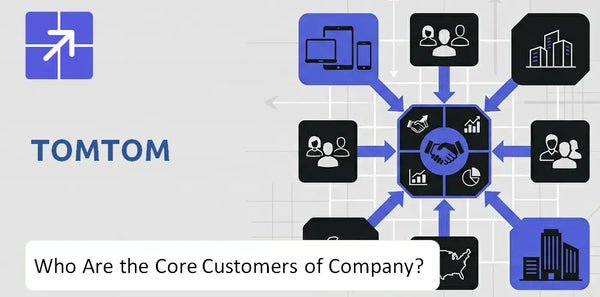
Also note TomTom's Orbis map and traffic feeds embed into ADAS and fleet systems; buyers value low-latency updates and scalable SLAs, so longer contracts reduce churn risk. See TomTom BCG Matrix Analysis
Who Is TomTom Trying to Win?
TomTom targets high-precision location-intelligence buyers: Global Automotive OEMs for in – vehicle navigation and ADAS, enterprise platforms and logistics firms embedding TomTom APIs, and a smaller consumer base for navigation devices and apps.
 Main customer group: Global Automotive OEMs
TomTom focuses on automotive manufacturers such as Stellantis, the Renault – Nissan – Mitsubishi Alliance, and Hyundai that need high-definition maps and ADAS software; these OEMs drive long – term contracts and recurring map – update revenue critical to TomTom target market strategy.
Secondary groups: Enterprise platforms and logistics
Enterprise customers include tech platforms and logistics providers like Uber and Microsoft that license TomTom maps and APIs for routing, traffic, and geospatial services; logistics and transportation companies using TomTom see route optimization and telematics benefits that reduce costs and improve ETA reliability.
Customer type and market role: Mostly B2B with a consumer tail
TomTom primarily serves businesses – automotive OEMs and enterprise developers – while maintaining a consumer segment; in FY2025 B2B software and licensing accounted for the bulk of revenue versus consumer hardware.
Most important segment by revenue: Automotive and SDV
The Software – Defined Vehicle (SDV) and automotive OEM segment is most important: in FY2025 TomTom reported a continued shift toward software and licensing, with consumer products representing less than 15% of total revenue as the company prioritizes OEM and enterprise contracts; see Mission, Vision, and Values of TomTom Company for corporate context.
TomTom SWOT Analysis
- Complete SWOT Breakdown
- Fully Customizable
- Editable in Excel & Word
- Professional Formatting
- Investor-Ready Format

What Do TomTom's Customers Care About Most?
TomTom target market cares most about fresh, precise map and traffic data, easy integration into existing systems, and control over data sovereignty; buyers want regulatory-compliant mapping for advanced driver assistance and low-latency routing that reduces operating costs.

Accurate, up-to-date mapping for safety and autonomy
Automotive OEM customers TomTom demand highly accurate, regulatory-compliant map data to support Level 2 and Level 3 autonomous features and advanced driver assistance systems; TomTom supplies HD and ADAS-grade maps with frequent updates to meet safety certification cycles.
Practical buying drivers: integration, latency, and cost
Fleet management customers for TomTom and logistics and transportation companies using TomTom choose based on ease of integration (APIs and SDKs), low-latency traffic for route optimization, and predictable pricing that lowers last-mile delivery costs.
Emotional and aspirational appeal: independence from closed ecosystems
Enterprise location based services customers of TomTom often prefer a neutral specialist to avoid vendor lock-in; retaining control of proprietary data and user experience signals technical independence and strategic differentiation.
What customers value most: freshness, precision, and control
TomTom core customers value map freshness (frequent map and traffic updates), routing precision (reducing fuel and time), and technological sovereignty – key for automotive manufacturers partnering with TomTom maps and commercial fleet managers choosing TomTom fleet management.
Loyalty and repeat demand drivers
Reliable OTA updates, stable SLAs for traffic feeds, and integration consistency drive retention among transportation companies evaluating TomTom telematics ROI; long-term contracts with enterprise clients and OEM partnerships sustain recurring revenue.
Why customers choose TomTom
TomTom wins because it balances high-quality map products and neutral data policy – offering precise real time traffic and map data with open integration paths – making it a favored supplier for logistics companies, automotive OEMs, and public sector mapping projects; see Sales and Marketing Strategy of TomTom Company for more context Sales and Marketing Strategy of TomTom Company.
TomTom Business Model Canvas
- One-time Payment
- No Research Needed – Save Hours of Work
- Built by Experts, Trusted by Consultants
- Instant Download, Ready to Use
- 100% Editable, Fully Customizable

Where Is Demand Strongest for TomTom?
Demand is strongest in Europe and North America, concentrated in automotive software and cloud-based logistics; fleet management and enterprise location services show the most active adoption.
Main Market: Europe and North America
Europe remains the largest revenue contributor for TomTom target market, driven by automotive OEMs and urban mobility projects; North America shows strong demand from cloud-based logistics and enterprise location-based services.
Secondary Markets: Global Tech Firms and Logistics
Global tech firms adopting the TomTom Orbis Maps platform and logistics and transportation companies using TomTom for routing represent growing secondary markets, with sizeable uptake among ecommerce delivery companies and transportation firms.
Where TomTom Is Strongest
TomTom is strongest in automotive OEM customers TomTom and fleet management customers for TomTom, where recurring software and data licenses make up a large share of revenue; by 2025 mapping and licensing segment still drives the majority of map-data sales.
Where Demand Is Growing Fastest (2025 – 2026)
Growth is accelerating in Software-Defined Vehicle (SDV) subscriptions and enterprise location-based services: adoption of TomTom Orbis increased materially in 2025, and demand in fleet telematics rose as commercial fleet managers choosing TomTom seek to cut fuel use and CO2; see Growth Outlook of TomTom Company for context.
TomTom Marketing Mix
- Complete Marketing Mix Analysis
- Effortlessly Communicate Your Business Strategy
- Investor-Ready Format
- 100% Editable and Customizable
- Clear and Structured Layout

How Does TomTom Keep Its Audience Growing?
TomTom grows its audience by scaling Orbis mapmaking to lower map-maintenance costs, pricing competitively for enterprise and automotive OEM customers, and locking in clients via embedded navigation stacks and a >€2.5 billion automotive backlog in early 2026, which secures predictable revenue as contracted models hit production.
Expanding Reach via Standardized Map Platform
Orbis standardizes geospatial data so TomTom serves TomTom target market segments faster and cheaper, attracting fleet management customers for TomTom and logistics and transportation companies using TomTom with lower TCO (total cost of ownership) for maps and more consistent map updates.
Customer Retention Drivers
High switching costs from deeply embedded navigation stacks keep automotive OEM customers TomTom and enterprise location based services customers of TomTom sticky; mandatory adoption of advanced safety technologies in 2025 – 2026 raises churn barriers for navigation suppliers.
Loyalty, Repeat Demand, and Ecosystem Depth
Renewals and multi-year licensing from commercial fleet managers choosing TomTom fleet management and automotive manufacturers partnering with TomTom maps drive recurring revenue; embedded stacks and API integrations boost repeat demand and upsell of real-time traffic and map data services.
Strongest Growth Lever in 2025 – 2026
The primary lever is Orbis-driven cost efficiency combined with the >€2.5 billion automotive backlog, enabling aggressive enterprise pricing and predictable auto revenues; this is the main reason TomTom core customers – automotive OEMs, logistics firms, and fleet operators – stay and expand usage. Read more on operational monetization How TomTom Company Works and Makes Money.
TomTom Boston Consulting Group Matrix
- Built by Experts, Trusted by Consultants
- Structured for Consultants, Students, and Founders
- 100% Editable in Microsoft Word & Excel
- Instant Digital Download – Use Immediately
- Compatible with Mac & PC – Fully Unlocked

Related Blogs
- What Is the History of TomTom Company and How Did It Evolve?
- What Is the Competitive Landscape of TomTom Company and How Does It Compete?
- What Is the Growth Outlook of TomTom Company and Where Is It Heading?
- How Does TomTom Company Work and What Drives Its Business Model?
- How Does TomTom Company Reach Customers and Turn Demand into Sales?
- What Do the Mission, Vision, and Core Values of TomTom Company Reveal?
- Who Owns TomTom Company Today and Who Holds Control?
Frequently Asked Questions
TomTom's core customers are mainly global automotive OEMs, followed by enterprise platforms and logistics firms. The company also serves a smaller consumer segment, but its target market is mostly B2B. Automotive and software-defined vehicle customers are the most important revenue segment in the blog content.
Disclaimer
All information, articles, and product details provided on this website are for general informational and educational purposes only. We do not claim any ownership over, nor do we intend to infringe upon, any trademarks, copyrights, logos, brand names, or other intellectual property mentioned or depicted on this site. Such intellectual property remains the property of its respective owners, and any references here are made solely for identification or informational purposes, without implying any affiliation, endorsement, or partnership.
We make no representations or warranties, express or implied, regarding the accuracy, completeness, or suitability of any content or products presented. Nothing on this website should be construed as legal, tax, investment, financial, medical, or other professional advice. In addition, no part of this site - including articles or product references - constitutes a solicitation, recommendation, endorsement, advertisement, or offer to buy or sell any securities, franchises, or other financial instruments, particularly in jurisdictions where such activity would be unlawful.
All content is of a general nature and may not address the specific circumstances of any individual or entity. It is not a substitute for professional advice or services. Any actions you take based on the information provided here are strictly at your own risk. You accept full responsibility for any decisions or outcomes arising from your use of this website and agree to release us from any liability in connection with your use of, or reliance upon, the content or products found herein.