
How does TomTom generate recurring revenue by selling location data and services to automakers and enterprises?
TomTom shifted from device sales to a SaaS and data-licensing model, monetizing maps, traffic, and ADAS datasets via multi-year automotive and enterprise contracts. This matters as TomTom in 2025 is the leading independent alternative to Big Tech for location services, supporting AV and logistics deployments.
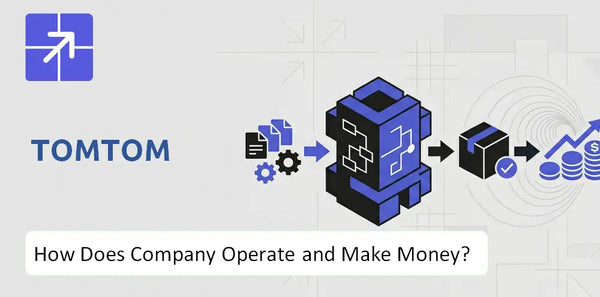
Focus on contract scale and data refresh cadence; long-term OEM deals and frequent map updates drive margin expansion and retention. See product analysis: TomTom BCG Matrix Analysis
What Does TomTom Actually Sell?
TomTom sells high-precision location technology: digital maps, navigation software, and real-time traffic data. Customers pay for licensed map content, navigation stacks for vehicles, and API/SDK access plus live data feeds and subscriptions that enable location-aware apps and ADAS functions.
 Core offerings: Maps, Navigation, Traffic
TomTom Orbis Maps is the 2025 flagship: a collaborative global map combining proprietary telemetry with open-source inputs to standardize location data. The company sells digital maps licensing, in-dash navigation stacks for OEMs, ADAS map layers, and real-time traffic feeds and SDKs for developers.
Main buyers: Automakers, enterprises, developers
Automotive OEMs and Tier-1 suppliers buy integrated navigation and map stacks and map licensing for connected cars; enterprises (logistics, rideshare, cloud providers) subscribe to APIs and traffic feeds; app developers license SDKs or subscribe to TomTom GO Navigation services.
Customer value: control, accuracy, integration
Customers get high-precision maps, deterministic routing for ADAS, and live traffic that reduces ETA variance; OEMs keep data control via independent licensing rather than ceding telemetry to hyperscalers. TomTom's APIs lower integration time for enterprise location services.
Why it stands out: independence and modular licensing
TomTom's selling point is independence: map licensing and SDKs let customers retain user-data ownership and avoid Google lock-in. Orbis Maps and modular navigation stacks simplify OEM integration and support AV development; licensing and subscription tiers align with TomTom revenue streams and mapping services pricing models.
See detailed market positioning and financial context in this analysis: Growth Outlook of TomTom Company
TomTom SWOT Analysis
- Complete SWOT Breakdown
- Fully Customizable
- Editable in Excel & Word
- Professional Formatting
- Investor-Ready Format

How Does TomTom Run Its Business Day to Day?
TomTom runs day-to-day as a data-first mapping and navigation operator: automated pipelines ingest billions of probes, connected-vehicle signals, and satellite inputs to update maps and traffic in real time, while commercial teams manage long-cycle OEM and enterprise integrations. Core systems include AI-driven mapmaking, live-traffic engines, cloud APIs, and sales/engineering squads that deliver licensed SDKs and data feeds.

Operating model: data ingestion to licensed features
Daily operations center on a massive data-processing engine that consumes billions of data points per day from GPS probes, connected devices, and satellite imagery. TomTom focuses internal resources on high-value proprietary layers like live traffic and lane-level navigation while using standardized base maps through cooperation with peers.
Product delivery: APIs, SDKs, and embedded systems
Customers access TomTom mapping services via cloud APIs, on-device SDKs, and OEM-embedded software; large automakers license map and traffic bundles under multi-year contracts while enterprises subscribe to telematics and fleet-management services.
Development: automated mapmaking and AI pipelines
Most map updates are automated: AI and ML pipelines detect road changes and traffic shifts from probe data and satellite imagery, reducing manual editing. R&D teams maintain lane-level models and safety-critical datasets used by autonomous-vehicle partners.
Sales channels: OEMs, enterprises, and developer platforms
Revenue flows through long-cycle OEM deals for in-car systems, enterprise sales for telematics and fleet software, and pay-as-you-go or subscription APIs for developers. Contract sizes vary from tens of millions with automakers to smaller recurring API subscriptions.
Key assets and partnerships: data, cloud, and standards
Critical assets include global map databases, live-traffic engines, and cloud infrastructure; strategic partnerships – such as co-founding the Overture Maps Foundation – shift basic map maintenance to open standards, letting TomTom monetize differentiated features.
What makes it work: scale, automation, and contract depth
Scale of probe data (billions daily) plus automated AI mapmaking yields low marginal cost per update and high freshness, while deep OEM integrations and multi-year licensing create predictable revenue and high switching costs for automakers.
Daily KPIs tracked include map freshness (hours to update), probe volume (billions/day), API latency and uptime (target >99.9%), and new OEM contract value; in 2025 TomTom reported significant enterprise contract renewals that reinforced recurring licensing revenue. Read more company background at History and Background of TomTom Company
TomTom Business Model Canvas
- One-time Payment
- No Research Needed – Save Hours of Work
- Built by Experts, Trusted by Consultants
- Instant Download, Ready to Use
- 100% Editable, Fully Customizable

How Does Revenue Flow Through TomTom?
Revenue flows mainly from licensing and subscriptions: automaker design wins yield per-vehicle licenses over multi-year production runs, while enterprise customers pay for APIs and data licenses; demand converts to cash via long-term contracts and usage billing.
Automotive licensing: per-vehicle design wins
The Automotive segment drives the TomTom business model through design wins that convert into per-vehicle licensing fees across typical 5 to 7-year production cycles, creating predictable revenue streams and contract visibility.
Enterprise: APIs, data and telematics
Enterprise customers generate recurring income via usage-based API calls or annual flat-fee licenses for map and traffic datasets; telematics and fleet-management services add steady, contract-backed revenue.
Pricing & monetization: subscriptions, licenses, usage
TomTom monetizes through per-vehicle licensing for OEMs, subscriptions for consumer and software-defined vehicle (SDV) features, and API usage fees; enterprise deals often use annual or per-call billing models.
Primary revenue drivers: SDV, Orbis, backlog
Revenue growth is led by software-defined vehicle contracts and expansion of the Orbis ecosystem; as of early 2026 TomTom holds an order backlog exceeding €1.1 billion, and gross margins remain near 80%, highlighting high profitability.
See related market and customer detail in Target Customers and Market of TomTom Company
TomTom Marketing Mix
- Complete Marketing Mix Analysis
- Effortlessly Communicate Your Business Strategy
- Investor-Ready Format
- 100% Editable and Customizable
- Clear and Structured Layout

What Makes TomTom's Model Sustainable or Fragile?
TomTom's model is sustained by high switching costs for automakers and shared base-map costs via the Overture Maps Foundation, lowering capex and supporting recurring licensing revenue; it is fragile because Google Automotive Services offers a free integrated alternative and TomTom's per-unit revenue tracks global vehicle production and EV cycles.
High switching costs and strategic cooperation
TomTom business model relies on embedded OEM integrations and long-term contracts that raise switching costs for automakers, preserving recurring licensing and service fees. Sharing base-map investment through the Overture Maps Foundation reduces TomTom's capital burden and improves margin stability.
Proprietary mapping assets and premium positioning
TomTom mapping services combine high-resolution base maps, traffic feeds, and telematics (fleet management) to offer differentiated products for privacy-conscious and premium segments. In 2025 TomTom reported continued revenue from licensing and subscriptions that underscore its niche value versus basic free navigation.
Concentration on OEMs and vehicle volumes
TomTom revenue streams are highly correlated with global vehicle production; any OEM shift to Google Automotive Services or a slowdown in EV/auto output directly reduces per-unit licensing income. Concentration risk also exists in a limited number of large OEM contracts and regional exposure.
Resilience assessment for 2025/2026
My professional judgment: TomTom is a stabilized, specialized player with a defensible niche in privacy-focused and premium automotive segments, but growth is capped by Google's free ecosystem and OEM consolidation. Expect modest top-line growth, margin pressure if vehicle volumes decline, and reliance on licensing plus telematics to sustain EBITDA.
For deeper context on competition and OEM deals see Competitive Landscape of TomTom Company
TomTom Boston Consulting Group Matrix
- Built by Experts, Trusted by Consultants
- Structured for Consultants, Students, and Founders
- 100% Editable in Microsoft Word & Excel
- Instant Digital Download – Use Immediately
- Compatible with Mac & PC – Fully Unlocked

Related Blogs
- What Is the History of TomTom Company and How Did It Evolve?
- What Is the Competitive Landscape of TomTom Company and How Does It Compete?
- What Is the Growth Outlook of TomTom Company and Where Is It Heading?
- How Does TomTom Company Reach Customers and Turn Demand into Sales?
- What Do the Mission, Vision, and Core Values of TomTom Company Reveal?
- Who Are the Core Customers in TomTom Company's Target Market?
- Who Owns TomTom Company Today and Who Holds Control?
Frequently Asked Questions
TomTom sells high-precision location technology. Its core offerings include digital maps, navigation software, real-time traffic data, and API or SDK access. Customers use these products for in-dash navigation, ADAS functions, connected-car services, and location-aware apps that need licensed map content and live data feeds.
Disclaimer
All information, articles, and product details provided on this website are for general informational and educational purposes only. We do not claim any ownership over, nor do we intend to infringe upon, any trademarks, copyrights, logos, brand names, or other intellectual property mentioned or depicted on this site. Such intellectual property remains the property of its respective owners, and any references here are made solely for identification or informational purposes, without implying any affiliation, endorsement, or partnership.
We make no representations or warranties, express or implied, regarding the accuracy, completeness, or suitability of any content or products presented. Nothing on this website should be construed as legal, tax, investment, financial, medical, or other professional advice. In addition, no part of this site - including articles or product references - constitutes a solicitation, recommendation, endorsement, advertisement, or offer to buy or sell any securities, franchises, or other financial instruments, particularly in jurisdictions where such activity would be unlawful.
All content is of a general nature and may not address the specific circumstances of any individual or entity. It is not a substitute for professional advice or services. Any actions you take based on the information provided here are strictly at your own risk. You accept full responsibility for any decisions or outcomes arising from your use of this website and agree to release us from any liability in connection with your use of, or reliance upon, the content or products found herein.