
Who are Udemy Company's core customers among enterprise L&D and individual tech learners?
Udemy Company targets enterprise learning-and-development teams and individual technical learners; this matters because in 2025 Udemy shifted toward recurring corporate subscriptions, with enterprise ARR growth signaling higher-margin revenue and productization of content.
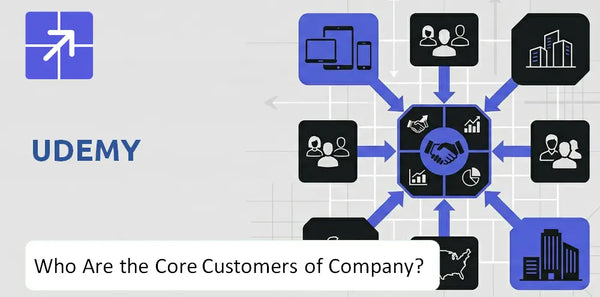
Enterprises buy platform-wide licenses for upskilling, while developers and IT pros buy role-specific courses; combine this with Udemy's 2025 push into SaaS features to drive retention and expansion. See Udemy BCG Matrix Analysis
Who Is Udemy Trying to Win?
Udemy tries to win large enterprise learning buyers and self-directed individual learners while also attracting and retaining high-quality instructors. The company's core focus is Udemy Business accounts at enterprise clients and a massive base of pro-sumers who buy single courses or subscriptions.
 Main customer group: Enterprise learning buyers
Udemy targets Chief Learning Officers and HR executives at over 16,500 enterprise customers as of early 2025, including more than 50 percent of the Fortune 100; this Udemy Business segment drives recurring revenue through land-and-expand deals and larger contract values.
Secondary groups: Individual learners and prosumers
Udemy serves a pool of over 70 million Udemy learners who use the platform for professional upskilling, certification prep, or hobby learning; these online course consumers supply scale and marketplace demand for Udemy Business content and subscriptions.
Customer type and market role: Mixed B2B and B2C marketplace
Udemy operates a mixed market serving both institutions and consumers: Udemy corporate customers for enterprise training and individual learners buying single courses or subscriptions; this hybrid model relies on content creators to supply breadth.
Most important segment: Udemy Business (enterprise)
Udemy Business is the core growth engine by revenue and strategic importance – enterprise deals with high retention and expansion. The marketplace also depends on over 75,000 instructors who monetize across roughly 250,000 courses to meet enterprise and consumer demand; see Growth Outlook of Udemy Company for context: Growth Outlook of Udemy Company
Udemy SWOT Analysis
- Complete SWOT Breakdown
- Fully Customizable
- Editable in Excel & Word
- Professional Formatting
- Investor-Ready Format

What Do Udemy's Customers Care About Most?
Udemy's customers prioritize rapid, practical skill gains and affordable, up-to-date content; enterprises focus on reducing Time to Skill while individual learners seek immediate career outcomes and localized courses in their language.

Speed of skill acquisition (Time to Skill)
Enterprise buyers want training that closes skill gaps fast; in 2025 many evaluate the Udemy Intelligent Skills Platform that maps employee skills to future needs, shortening reskilling cycles by measurable months versus legacy programs.
Practical buying drivers: cost, outcomes, update cadence
Customers pick Udemy for lower per-learner cost and fast curriculum refreshes; enterprises compare time-to-certification, and individuals look for courses that help pass cloud or vendor exams quickly and affordably.
Emotional and aspirational appeal: career progress
Learners seek confidence and upward mobility – passing a certification or shipping a project delivers status and job leverage; enterprises want workforce readiness and reduced hiring gaps.
What customers value most: relevance and localization
Both segments value course relevance; Udemy offers content in over 75 languages, which increases adoption in emerging markets and matches regional learning preferences better than many competitors.
Loyalty and repeat demand: measurable ROI and refresh rates
Retention hinges on visible ROI – enterprises track skills impact via the Intelligent Skills Platform; individuals return for sequential upskilling (cert paths, new languages); recurring purchases and subscriptions rise when outcomes are proven.
Why customers choose Udemy
Udemy target market wins through a large catalog, frequent content updates, and accessible pricing – making it a top option for online course consumers, professional upskilling learners, and Udemy corporate customers who need scalable training.
See the platform's positioning in broader context: Competitive Landscape of Udemy Company
Udemy Business Model Canvas
- One-time Payment
- No Research Needed – Save Hours of Work
- Built by Experts, Trusted by Consultants
- Instant Download, Ready to Use
- 100% Editable, Fully Customizable

Where Is Demand Strongest for Udemy?
Demand is strongest outside the US, with international sales making up about 58 percent of Udemy revenue in fiscal 2025, concentrated in EMEA and APAC where digital-transformation spending is accelerating.
Primary Market: International EMEA and APAC
Udemy target market concentration is highest in EMEA and APAC because corporate digital upskilling budgets and consumer mobile adoption are rising; these regions drove the fastest revenue growth in 2025.
Secondary Markets: North America and LatAm Verticals
North America remains important for enterprise deals and subscription customers, while LatAm shows strong growth among online course consumers and professional upskilling learners via mobile-first access.
Where Udemy Is Strongest: Tech, Professional Services, Manufacturing
Demand is strongest in technology, professional services, and manufacturing verticals where skill gaps are largest; certification prep for AWS, Azure, and Google Cloud are top-volume drivers and sustain repeat traffic.
Fastest-Growing Demand Areas in 2025 – 2026
EMEA and APAC corporate customers and mobile-first consumer segments are growing fastest in 2025 – 2026; organic search and direct brand recognition continue to fuel high traffic for professionals seeking certification courses on Udemy. Read more on Sales and Marketing Strategy of Udemy Company
Udemy Marketing Mix
- Complete Marketing Mix Analysis
- Effortlessly Communicate Your Business Strategy
- Investor-Ready Format
- 100% Editable and Customizable
- Clear and Structured Layout

How Does Udemy Keep Its Audience Growing?
Udemy keeps its audience growing by using its consumer marketplace to test trending topics, then scaling successful content into Udemy Business while adding AI-driven personalization and guided learning paths to boost engagement and retention.
How Udemy Expands Its Customer Base
Udemy sources demand from millions of online course consumers and lifelong learners on the consumer marketplace, converts high-interest topics into enterprise-ready offerings, and targets adjacent segments – SMBs, professional upskilling learners, and students – via tailored marketing and channel partnerships.
Customer Retention Drivers
Retention rests on data-driven curation, AI personalization, and learning paths that raise time-on-platform; Udemy reports Net Dollar Retention for large enterprise clients of about 105 – 110%, reflecting expansion and low churn among Udemy corporate customers.
Loyalty, Repeat Demand, and Customer Depth
Udemy Business renewals and seat expansions drive repeat demand; enterprise subscriptions convert single-course buyers into recurring revenue, and customer success teams plus analytics increase license utilization and upsell into new departments.
Strongest Customer-Base Growth Lever in 2025/2026
The top lever is deep AI-powered personalization and structured learning paths that increase engagement and lower churn; management projects enterprise subscriptions will exceed 65% of total revenue by 2026 as Udemy shifts to more predictable, scalable B2B ARR-driven sales.
See further corporate context in this analysis on Ownership and Control of Udemy Company.
Udemy Boston Consulting Group Matrix
- Built by Experts, Trusted by Consultants
- Structured for Consultants, Students, and Founders
- 100% Editable in Microsoft Word & Excel
- Instant Digital Download – Use Immediately
- Compatible with Mac & PC – Fully Unlocked

Related Blogs
- What Is the History of Udemy Company and How Did It Evolve?
- What Is the Competitive Landscape of Udemy Company and How Does It Compete?
- What Is the Growth Outlook of Udemy Company and Where Is It Heading?
- How Does Udemy Company Work and What Drives Its Business Model?
- How Does Udemy Company Reach Customers and Turn Demand into Sales?
- What Do the Mission, Vision, and Core Values of Udemy Company Reveal?
- Who Owns Udemy Company Today and Who Holds Control?
Frequently Asked Questions
Udemy's core customers are enterprise learning buyers and self-directed individual learners. The company mainly focuses on Udemy Business accounts at enterprise clients, while also serving a large base of prosumers who buy single courses or subscriptions. In addition, Udemy relies on instructors to supply the marketplace with content.
Disclaimer
All information, articles, and product details provided on this website are for general informational and educational purposes only. We do not claim any ownership over, nor do we intend to infringe upon, any trademarks, copyrights, logos, brand names, or other intellectual property mentioned or depicted on this site. Such intellectual property remains the property of its respective owners, and any references here are made solely for identification or informational purposes, without implying any affiliation, endorsement, or partnership.
We make no representations or warranties, express or implied, regarding the accuracy, completeness, or suitability of any content or products presented. Nothing on this website should be construed as legal, tax, investment, financial, medical, or other professional advice. In addition, no part of this site - including articles or product references - constitutes a solicitation, recommendation, endorsement, advertisement, or offer to buy or sell any securities, franchises, or other financial instruments, particularly in jurisdictions where such activity would be unlawful.
All content is of a general nature and may not address the specific circumstances of any individual or entity. It is not a substitute for professional advice or services. Any actions you take based on the information provided here are strictly at your own risk. You accept full responsibility for any decisions or outcomes arising from your use of this website and agree to release us from any liability in connection with your use of, or reliance upon, the content or products found herein.