
How does Udemy's sales and marketing model convert marketplace traffic into recurring Udemy Business contracts?
Udemy blends an organic consumer marketplace with a direct enterprise salesforce to lower acquisition costs while upselling organizations to Udemy Business. This matters as investors value recurring revenue; by 2025 Udemy Business drove margin stability and higher ARR growth signals.
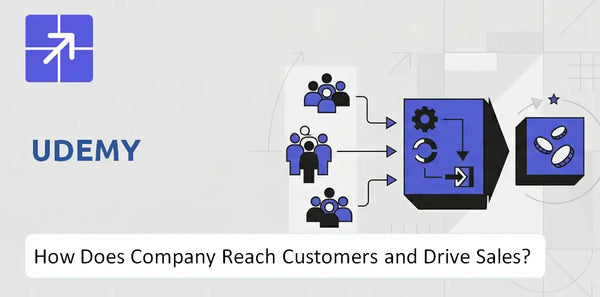
Focus sellers on trial-to-seat conversion and use marketplace demand data to prioritize enterprise outreach; tie incentives to net retention and contract length. See product analysis: Udemy BCG Matrix Analysis
Who Does Udemy Want to Sell To?
Udemy sells to two core groups: individual lifelong learners – professionals in tech, business, and creative fields seeking tactical skills – and enterprise learning buyers, led by Chief Learning Officers looking to upskill workforces at scale. The company wins through a large consumer marketplace funnel and a fast-growing B2B offering that embeds into corporate L&D stacks.
 Main customer: enterprise L&D leaders
Udemy Business targets Fortune 500s, mid-market firms, and government agencies undergoing digital transformation or AI adoption, where decentralized, rapid training is essential. As of early 2026 Udemy has over 16,500 enterprise customers worldwide, making B2B the primary growth lever within its Udemy marketing strategy.
Secondary: individual professionals and lifelong learners
The consumer segment focuses on professionals seeking certifications and tactical skills in technology, business, and creative fields; this long-tail marketplace fuels Udemy customer acquisition via SEO, email, promotions, and paid advertising. Consumer monetization and course sales funnel tactics keep acquisition costs lower per learner over time.
Market positioning: practical, skills-first learning at scale
Udemy positions itself as the pragmatic online course marketplace for immediate workplace skills rather than academic credentials, emphasizing breadth of courses, instructor variety, and enterprise admin tools. This positioning supports both individual course discovery and enterprise procurement in L&D budgets.
Why this positioning resonates
Organizations prioritizing speed – AI integration and digital transformation – value decentralized upskilling, where time-to-skill matters more than traditional degrees. Udemy's mix of instructor-supplied content, analytics, and integrations reduces rollout time, improving conversion of procurement interest into purchases via targeted Udemy for Business partnerships and corporate sales motions; see Ownership and Control of Udemy Company for context: Ownership and Control of Udemy Company
Udemy SWOT Analysis
- Complete SWOT Breakdown
- Fully Customizable
- Editable in Excel & Word
- Professional Formatting
- Investor-Ready Format

How Does Udemy Get in Front of Customers?
Udemy gets in front of customers via a consumer marketplace flywheel, aggressive SEO and performance marketing, plus a global direct sales force and platform partnerships to capture both individual learners and enterprise buyers.

Marketplace Flywheel as Main Acquisition Engine
The consumer marketplace functions as a massive lead generator: ≈75 million monthly visitors supply organic demand signals that feed course curation and instructor incentives, powering Udemy marketing strategy and Udemy customer acquisition at scale.
Search and Performance Marketing Drive Online Reach
Udemy leans on SEO, paid search, social ads, email, and app-store optimization to capture intent – its Udemy SEO tactics for course discovery and Udemy paid advertising and PPC strategies funnel organic and paid traffic into the digital course sales funnel.
Direct Sales and Strategic Partnerships for Distribution
For Udemy for Business, Udemy uses a global direct sales force plus platform partnerships (examples: AWS, SAP) to reach enterprise buyers; partnerships also aid distribution into corporate LMS ecosystems and channel sales.
Promotions and Content-led Demand Generation
Demand is driven via site-wide promotions, limited-time discounts, instructor promotions, content marketing, and email campaigns – Udemy email marketing campaigns for course sales and discounting tactics convert large volumes of site visitors into buyers.
Customer Acquisition Efficiency and Unit Economics
High organic traffic lowers marginal acquisition cost; combined with targeted PPC and email retention, Udemy reports improving monetization per visitor – market signals and A/B tests refine pricing and course placement to raise conversion rates.
Localized Content and Reach Advantage in Growth Markets
By 2025 Udemy expanded localized collections in over 15 languages, lowering barriers in APAC and EMEA and tapping regional demand – this localization plus the marketplace flywheel is the most important reach advantage in 2025/2026.
For additional context and financial framing see the Growth Outlook of Udemy Company
Udemy Business Model Canvas
- One-time Payment
- No Research Needed – Save Hours of Work
- Built by Experts, Trusted by Consultants
- Instant Download, Ready to Use
- 100% Editable, Fully Customizable

How Does Udemy Turn Attention Into Sales?
Udemy turns attention into sales through a mix of transactional consumer purchases and subscription contracts for enterprises, using pricing incentives, social proof, and analytics to move users from discovery to purchase quickly.
Core Sales Model
Udemy combines self-serve transactional sales for individual learners with seat-based, multi-year subscriptions for Udemy Business enterprise clients, plus a growing Personal Subscription plan to lift lifetime value.
Pricing and Monetization Logic
Consumer revenue uses dynamic pricing, frequent discounts, and limited – time offers to convert clicks into purchases; enterprise revenue is recurring, contract – based, and priced per seat with multi – year terms to stabilize ARR.
Conversion and Purchase Drivers
Conversion relies on social proof – millions of learner ratings and reviews – to build trust, plus targeted email marketing, PPC, and SEO to capture intent; Skill Insights dashboards show HR leaders measurable ROI, accelerating enterprise buys.
Repeat Revenue and Customer Expansion
Retention and expansion drive net dollar retention; enterprise NDR stabilized at 108 percent in early 2026 through seat expansion into new departments and international subsidiaries, while Personal Subscription aims to increase customer lifetime value on the consumer side.
Key mechanics: dynamic pricing and promotions convert website visitors into buyers quickly; social proof and course ratings boost trust and click – to – purchase rates; Skill Insights and account management push renewals and expansion in Udemy Business, improving Net Dollar Retention to 108 percent as of early 2026. Read more context in Mission, Vision, and Values of Udemy Company
Udemy Marketing Mix
- Complete Marketing Mix Analysis
- Effortlessly Communicate Your Business Strategy
- Investor-Ready Format
- 100% Editable and Customizable
- Clear and Structured Layout

How Strong Does Udemy's Commercial Engine Look Going Forward?
Udemy's commercial engine looks resilient through 2026, supported by a stronger enterprise mix and AI-enabled content creation, but it needs disciplined execution to fend off competition and content commoditization. Key supports: high gross margins, predictable enterprise ARR, and scalable acquisition channels; key weaknesses: competitive pressure and rapid AI-driven shift in content economics.
What Supports Future Demand
Udemy Business contributing nearly 65 percent of revenue and a predictable $580,000,000 ARR provides stable recurring demand and higher enterprise ARPU, while a 63 percent gross margin supports reinvestment in Udemy marketing strategy and product improvements that aid Udemy customer acquisition.
Channel and Marketing Effectiveness
Organic channels – SEO, email, and marketplace discovery – plus paid advertising and PPC maintain efficient new-student acquisition; data-driven personalization and mobile app user acquisition strategies keep conversion rates healthy, supporting digital course sales funnel optimization.
Risks to Commercial Performance
Coursera and LinkedIn Learning present intense competition for enterprise and individual learners; generative AI risks commoditizing entry-level technical courses, pressuring Udemy monetization and instructor economics unless the Udemy Intelligent Skills Platform and AI-assisted course creation maintain a meaningful moat.
The Overall Sales and Marketing Outlook
Outlook for 2025/2026 is resilient with expected annual revenue growth of 12 – 14 percent, GAAP profitability through 2026, and a strong enterprise base; continued success depends on execution across Udemy affiliate program driving course purchases, pricing strategy and revenue optimization, and defending discovery via Udemy SEO tactics for course discovery.
History and Background of Udemy Company
Udemy Boston Consulting Group Matrix
- Built by Experts, Trusted by Consultants
- Structured for Consultants, Students, and Founders
- 100% Editable in Microsoft Word & Excel
- Instant Digital Download – Use Immediately
- Compatible with Mac & PC – Fully Unlocked

Related Blogs
- What Is the History of Udemy Company and How Did It Evolve?
- What Is the Competitive Landscape of Udemy Company and How Does It Compete?
- What Is the Growth Outlook of Udemy Company and Where Is It Heading?
- How Does Udemy Company Work and What Drives Its Business Model?
- What Do the Mission, Vision, and Core Values of Udemy Company Reveal?
- Who Are the Core Customers in Udemy Company's Target Market?
- Who Owns Udemy Company Today and Who Holds Control?
Frequently Asked Questions
Udemy sells to two main groups: individual lifelong learners and enterprise learning buyers. The company focuses on professionals in tech, business, and creative fields, while Udemy Business targets L&D leaders at Fortune 500s, mid-market firms, and government agencies that need fast, practical upskilling at scale.
Disclaimer
All information, articles, and product details provided on this website are for general informational and educational purposes only. We do not claim any ownership over, nor do we intend to infringe upon, any trademarks, copyrights, logos, brand names, or other intellectual property mentioned or depicted on this site. Such intellectual property remains the property of its respective owners, and any references here are made solely for identification or informational purposes, without implying any affiliation, endorsement, or partnership.
We make no representations or warranties, express or implied, regarding the accuracy, completeness, or suitability of any content or products presented. Nothing on this website should be construed as legal, tax, investment, financial, medical, or other professional advice. In addition, no part of this site - including articles or product references - constitutes a solicitation, recommendation, endorsement, advertisement, or offer to buy or sell any securities, franchises, or other financial instruments, particularly in jurisdictions where such activity would be unlawful.
All content is of a general nature and may not address the specific circumstances of any individual or entity. It is not a substitute for professional advice or services. Any actions you take based on the information provided here are strictly at your own risk. You accept full responsibility for any decisions or outcomes arising from your use of this website and agree to release us from any liability in connection with your use of, or reliance upon, the content or products found herein.