
How does Air T, Inc. generate steady cash from flight services while funding aerospace parts and equipment growth?
Air T, Inc. runs utility-like cargo and flight services to produce predictable cash, then deploys that capital into higher-margin aerospace equipment and engine parts. This matters as 2025 revenue mix showed stable logistics contracts amid growing parts demand and tighter supply chains.
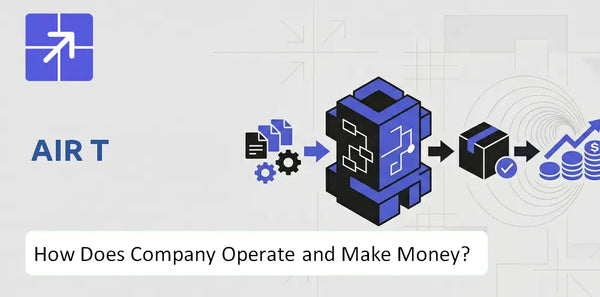
Focus on tightening operations: improve utilization and contract tenure to protect cash flow while scaling parts sales; see Air T BCG Matrix Analysis.
What Does Air T Actually Sell?
Air T, Inc. sells outsourced flight operations and maintenance for express carriers, specialized aviation ground support equipment, and a portfolio of commercial jet engines and replacement parts focused on narrow-body types; customers pay for operational uptime, equipment reliability, and lower-cost spare engines and components.
 Core Offerings: Flight Ops, Ground Equipment, Engines
Air T Company business model centers on three revenue streams: outsourced flight operations and maintenance managing ~85 aircraft for express delivery clients, sales of aviation ground support equipment (de-icers, scissor lifts, overhead cranes), and sales/leasing of commercial jet engines plus high-demand replacement parts for CFM56 and V2500 types.
Who Buys It: Airlines, Lessors, Airports, Logistics Firms
Buyers include express delivery carriers contracting fleet and crew services, airlines and airport ground handlers purchasing de-icing and lift equipment, and airlines or lessors sourcing used/leasing engines and spare modules; see Target Customers and Market of Air T Company for market fit and segmentation.
Customer Value: Uptime, Cost Savings, Asset Liquidity
Customers get improved aircraft availability via outsourced operations, lower capital cost alternatives to new engines, and durable ground-support tools that reduce turnaround times; Contrail focuses on the most liquid narrow-body engines to cut lead times and cash outlays for parts.
Differentiators: Specialized Fleet Scale and Liquid Engine Focus
Air T Company operations stand out by combining scale in managed aircraft (~85 units), integrated MRO and logistics, and a parts-and-engine platform targeting high-demand CFM56 and V2500 inventory – enabling faster delivery, predictable pricing, and strong B2B partnerships.
Air T SWOT Analysis
- Complete SWOT Breakdown
- Fully Customizable
- Editable in Excel & Word
- Professional Formatting
- Investor-Ready Format

How Does Air T Run Its Business Day to Day?
Air T, Inc. runs daily via decentralized subsidiaries: an overnight air cargo dry-lease operation, a ground-support manufacturing arm, and an aviation parts trading/leasing desk; delivery flows are crew- and compliance-led for flights, backlogged build schedules for de-icers, and inventory-to-global-market flows for parts. Key systems are flight operations & maintenance (FOM) software, ERP-driven supply-chain planning, and a trading/leasing platform that drives asset rotation and near-term cash conversion.

Operating model: decentralized, specialized subsidiaries
Each subsidiary runs semi-autonomously: overnight air cargo uses a dry-lease model where customers supply aircraft while Air T, Inc. supplies crews, maintenance, and regulatory oversight to guarantee dispatch reliability. Manufacturing focuses on long-cycle contracts; parts trading acts as a market-facing liquidity engine. This structure reduces capital aircraft exposure while concentrating operational expertise.
Product & service delivery: crewed operations, built-to-order hardware, global parts distribution
Customers access cargo services via contract dry-leases and scheduled overnight slots; manufacturing customers place purchase orders that feed a multi-million dollar backlog; parts buyers use the trading desk and leasing offerings to source spares. Contracts lock pricing and availability, while the trading desk auctions or negotiates components into a market tight from new-delivery delays.
Production, sourcing & development: backlog-driven manufacturing and outsourced supply chains
De-icer production runs from supplier-sourced subsystems, with lead times creating a 12 – 18 month backlog and multi-million dollar WIP (work-in-progress). Engineering manages certification and iterative product updates; vendors supply valves, heat elements, and control electronics under long-term purchase agreements to stabilize margins and throughput.
Sales channels & distribution: B2B contracts, trading desk, and aftermarket networks
Main channels are direct B2B contracts with airlines and logistics firms, a parts trading/leasing desk serving MROs and lessors, and distributor relationships for ground-support gear. Customer acquisition leans on contract renewals, RFQs, and industry trade networks; pricing mixes fixed contracts and spot-market sales for components.
Key assets, systems & partnerships: crew pools, ERP, MRO networks
Critical assets include pilot and maintenance crew pools, engine and component inventories, and manufacturing lines. Systems include flight operations & maintenance (FOM) software, ERP for supply-chain planning, and a trading/leasing platform. Strategic partnerships with lessees, MRO shops, and tier-1 suppliers underpin operational scale and regulatory compliance.
What makes it work: asset-light risk transfer and market arbitrage
The dry-lease crew-and-maintenance model shifts aircraft ownership risk to customers while retaining margin on operations and compliance, improving ROIC (return on invested capital). The parts desk captures arbitrage from delivery delays; de-icer manufacturing secures long-term revenue via backlog – together delivering diversified, resilient Air T Company revenue streams.
For operational context and company philosophy see Mission, Vision, and Values of Air T Company
Air T Business Model Canvas
- One-time Payment
- No Research Needed – Save Hours of Work
- Built by Experts, Trusted by Consultants
- Instant Download, Ready to Use
- 100% Editable, Fully Customizable

How Does Revenue Flow Through Air T?
Revenue flows into Air T, Inc. from three core streams: cargo service fees, ground equipment sales and parts, and commercial jet engine leases and parts sales; demand converts to revenue via contracts, unit sales, and recurring lease payments.
Main revenue: Commercial jet engine leasing and parts
Monthly lease payments and high-margin harvested parts sales drove the largest share of profit in 2025 – 2026, accounting for the most operating leverage across Air T Company operations and boosting consolidated revenue above $280,000,000.
Additional revenue: Ground equipment and aftermarket parts
Sales of ground units – often priced over $500,000 per unit – produce lumpy but significant revenue, while growing high-margin aftermarket parts and service contracts improve gross margins and recurring cash flow.
Pricing and monetization model: Contracts, sales, and asset leases
Cargo operations use cost-plus contracts (reimbursed operating costs plus a fixed administrative fee), ground equipment sells units and attaches service agreements, and engines monetize via leases and parts sales – mixing fixed fees, capital sales, and recurring payments.
What drives revenue most: Asset mix and aftermarket margins
The engine segment's monthly lease streams and harvested-parts margins provide the strongest revenue and profit driver; equipment and parts supply the majority of operating leverage, while cargo cost-plus contracts stabilize cash flow against fuel volatility. See more on structure in Ownership and Control of Air T Company.
Air T Marketing Mix
- Complete Marketing Mix Analysis
- Effortlessly Communicate Your Business Strategy
- Investor-Ready Format
- 100% Editable and Customizable
- Clear and Structured Layout

What Makes Air T's Model Sustainable or Fragile?
Air T, Inc.'s model is sustainable where long-term contracts, high barriers to entry in de-icer and engine parts, and a FedEx-aligned revenue base create steady cash flow, but it is fragile due to extreme customer concentration in cargo, capital-intensive engine buys, and sensitivity to interest rates and debt levels.
Structural tailwinds from fleet aging and supply shortages
Demand for engines, parts, and de-icer systems rises as global narrow-body deliveries lag; airlines keep older airframes, increasing aftermarket spend. In 2025 the narrow-body delivery shortfall and multi-year OEM backlogs support elevated parts demand and higher pricing power.
Key assets and strategic partnerships
Air T Company business model benefits from a long-standing FedEx partnership and specialized manufacturing for de-icer systems, creating high switching costs. Proprietary inventory, repair capabilities, and distribution networks underpin Air T Company operations and parts margin expansion.
Dependencies, concentration, and capital intensity
Revenue is highly concentrated in cargo customers; over 60% of legacy revenue derives from this segment, amplifying demand shocks. Engine acquisitions are capital-heavy and leverage-sensitive, so rising interest rates increase financing costs and compress returns.
Durability assessment as of 2025/2026
As of early 2026 professional judgment finds the model resilient: legacy cargo cash flow funds high-growth parts and equipment divisions, creating a counter-cyclical mix. Debt management remains a key risk; if interest rates rise further or FedEx reduces purchases, fragility increases.
For context on customer strategy and sales channels see Sales and Marketing Strategy of Air T Company.
Air T Boston Consulting Group Matrix
- Built by Experts, Trusted by Consultants
- Structured for Consultants, Students, and Founders
- 100% Editable in Microsoft Word & Excel
- Instant Digital Download – Use Immediately
- Compatible with Mac & PC – Fully Unlocked

Related Blogs
- What Is the History of Air T Company and How Did It Evolve?
- What Is the Competitive Landscape of Air T Company and How Does It Compete?
- What Is the Growth Outlook of Air T Company and Where Is It Heading?
- How Does Air T Company Reach Customers and Turn Demand into Sales?
- What Do the Mission, Vision, and Core Values of Air T Company Reveal?
- Who Are the Core Customers in Air T Company's Target Market?
- Who Owns Air T Company Today and Who Holds Control?
Frequently Asked Questions
Air T sells outsourced flight operations and maintenance, aviation ground support equipment, and commercial jet engines plus replacement parts. Its customers pay for operational uptime, equipment reliability, and lower-cost spare engines and components. The business is built around serving express carriers, airlines, airports, lessors, and logistics firms.
Disclaimer
All information, articles, and product details provided on this website are for general informational and educational purposes only. We do not claim any ownership over, nor do we intend to infringe upon, any trademarks, copyrights, logos, brand names, or other intellectual property mentioned or depicted on this site. Such intellectual property remains the property of its respective owners, and any references here are made solely for identification or informational purposes, without implying any affiliation, endorsement, or partnership.
We make no representations or warranties, express or implied, regarding the accuracy, completeness, or suitability of any content or products presented. Nothing on this website should be construed as legal, tax, investment, financial, medical, or other professional advice. In addition, no part of this site - including articles or product references - constitutes a solicitation, recommendation, endorsement, advertisement, or offer to buy or sell any securities, franchises, or other financial instruments, particularly in jurisdictions where such activity would be unlawful.
All content is of a general nature and may not address the specific circumstances of any individual or entity. It is not a substitute for professional advice or services. Any actions you take based on the information provided here are strictly at your own risk. You accept full responsibility for any decisions or outcomes arising from your use of this website and agree to release us from any liability in connection with your use of, or reliance upon, the content or products found herein.