
How does Bakkt Company connect institutional clients to crypto markets and monetize its infrastructure?
Bakkt Company sells institutional-grade custody, settlement, and trading rails that let banks, brokers, and merchants offer crypto services securely. This matters as 2025 saw rising institutional custody flows and Bakkt's 2025 pivot to B2B2C infrastructure boosting contract volumes. Bakkt BCG Matrix Analysis
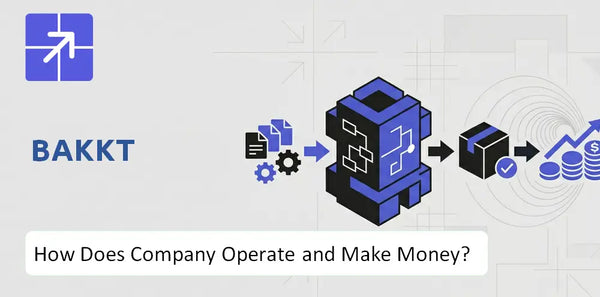
Bakkt's revenue drivers are custody fees, transaction fees, and SaaS contracts with financial partners; focus on uptime and compliance raises switching costs and drives recurring revenue.
What Does Bakkt Actually Sell?
Bakkt sells white-label digital asset infrastructure and secure custody solutions via an API-first platform that powers crypto trading, custody, clearing, and settlement for third-party fintechs, banks, and merchants. Customers pay for regulated, turnkey backend services that remove technical and legal burdens and enable monetization of their user bases.
 Core platform and infrastructure
Bakkt offers an API-based crypto platform that handles trade execution, clearing, settlement, and custody; it also provides white-label integrations and tokenization tooling. Revenue comes from custody fees, transaction fees on trades and settlements, and platform licensing.
Main buyers and partners
Primary customers are fintechs, neobanks, traditional banks, payment processors, and large merchants seeking Bakkt custody services and payment solutions to add crypto features without building bespoke systems. Institutional clients use Bakkt institutional custody solutions and clearing rails.
Customer value and outcomes
Customers gain a regulated, SOC-compliant custody service with insurance coverage, lower time-to-market for crypto products, and predictable fee schedules; this enables new revenue streams – Bakkt reported platform growth in 2025 with active third – party integrations increasing by a notable percent year-over-year.
Differentiators and competitive edges
Bakkt stands out by combining regulated custody, clearing/settlement rails, and white-label APIs tailored to enterprise compliance – so partners avoid building custody vaults and settlement engines. See History and Background of Bakkt Company for context on licensing and market moves: History and Background of Bakkt Company
Bakkt SWOT Analysis
- Complete SWOT Breakdown
- Fully Customizable
- Editable in Excel & Word
- Professional Formatting
- Investor-Ready Format

How Does Bakkt Run Its Business Day to Day?
Bakkt runs daily by matching high-frequency customer orders through a low-latency trading engine, settling trades into a regulated custody layer while enforcing AML/KYC and partner SLAs. Core systems are a matching engine, custody ledger, AML/KYC monitor, and partner APIs that together deliver trade execution, settlement, and secure storage.

Operating model: execution, custody, compliance
Bakkt operates a tightly integrated execution-to-custody workflow: a low-latency trading engine routes orders to internal liquidity pools and external market makers, the custody ledger records ownership, and a compliance stack enforces AML/KYC as required by the New York BitLicense. Daily ops focus on throughput, settlement finality, and regulatory reporting.
Product delivery: access and settlement
Institutional and fintech partners access Bakkt via APIs and FIX connections to place trades and move funds; retail flows arrive through partner platforms. Trades are executed in seconds and then settled into Bakkt custody; reconciliation and reporting run continuously to meet partner SLAs and audit requirements.
Production and development: secure asset engineering
Development centers on secure custody software, settlement rails, and market connectivity. Bakkt builds cold and hot wallet operations, integrates HSMs (hardware security modules), and continuously updates AML/KYC rule engines; R&D teams maintain market adapters for liquidity partners and futures clearing interfaces.
Sales channels: partner-led distribution
Bakkt sells through institutional sales, white-label fintech integrations, and strategic partnerships with broker-dealers and platforms such as Webull. These channels drive volume – Bakkt reported handling thousands of institutional trades per hour during peak periods in 2025 – and fees come from custody, transaction, and integration services.
Key assets and partnerships: infrastructure and liquidity
Critical assets are the custody warehouse, trading engine, AML/KYC systems, and partner APIs. Bakkt maintains deep liquidity by connecting to multiple market makers and exchanges; key partnerships with platforms and banks provide distribution and order flow. See Ownership and Control of Bakkt Company for governance context: Ownership and Control of Bakkt Company
What makes the model work: trust, scale, and compliance
Bakkt scales by automating settlement and custody while keeping compliance front-and-center; its New York BitLicense and AML/KYC tooling lower onboarding friction for banks. Operationally, high-throughput matching plus deep liquidity relationships deliver competitive pricing and predictable spreads, which drives partner retention and recurring custody revenue.
Bakkt Business Model Canvas
- One-time Payment
- No Research Needed – Save Hours of Work
- Built by Experts, Trusted by Consultants
- Instant Download, Ready to Use
- 100% Editable, Fully Customizable

How Does Revenue Flow Through Bakkt?
Revenue at Bakkt flows from transaction fees, custody charges, and recurring institutional services; demand converts to revenue when partner-driven trades and assets under custody generate per-trade commissions and percentage-based custody fees.
Transaction fees: core revenue engine
Bakkt earns most from transaction-based fees on retail and partner-originated crypto trades; in fiscal 2025 transaction revenue stayed the largest line, driven by trading volume and market volatility and accounting for a majority of total revenue.
Custody and institutional services
Bakkt custody services generate recurring income via fees tied to Assets Under Custody (AUC); institutional clients also pay subscriptions for analytics, reporting, and white – label integrations that smooth revenue across quarters.
Pricing and monetization model
Bakkt monetizes through per-trade commissions, spreads, percentage custody fees, and subscription/service contracts; once fixed platform costs are covered, incremental trades carry high gross margins, while custody yields steady, lower – volatility income.
Key revenue drivers and sensitivity
Revenue hinges on partner network scale, daily active trading users, and AUC; volatility raises transaction revenue but increases forecasting risk, while growth in institutional custody lifts recurring revenue and stabilizes margins. Read more on distribution and go – to – market in the Sales and Marketing Strategy of Bakkt Company
Bakkt Marketing Mix
- Complete Marketing Mix Analysis
- Effortlessly Communicate Your Business Strategy
- Investor-Ready Format
- 100% Editable and Customizable
- Clear and Structured Layout

What Makes Bakkt's Model Sustainable or Fragile?
Bakkt's model is sustainable where its high-compliance infrastructure and embedded B2B integrations create a strong regulatory moat and high switching costs, but fragile because revenue is highly cyclical with crypto markets and margins compress under scale. Key strengths are regulatory licensing and bank partnerships; key risks are market-driven volume declines and competition from deeper-pocketed players.
Regulatory moat and embedded integrations
Bakkt's licensed, compliant infrastructure lets it serve banks and merchants that demand regulated custody and payments; this reduces churn because banks face high onboarding and compliance costs to switch. In 2025 Bakkt reported a shift to B2B revenue with transactional volumes stabilizing after prior consumer spend cuts.
Key assets and capabilities
Bakkt custody services, its cleared Bitcoin futures linkage, and API-first payment solutions form a stack attractive to institutional clients; the company's custody platform and partnerships with banks bolster enterprise adoption. In 2025 Bakkt reduced consumer marketing and focused on lean B2B operations to conserve cash and deepen integrations.
Dependencies and concentration risks
Revenue depends on crypto market activity (spot and futures volumes) and a small number of large B2B integrations; prolonged low volatility or one large partner leaving would materially depress fees. Margin pressure arises as transaction fees compress and competition from larger platforms and exchanges intensifies.
Durability assessment for 2025 – 2026
As of 2025 professional judgment views Bakkt as a stabilized infrastructure provider that must prove consistent GAAP profitability in 2026 by expanding bank wallet integrations and fee-based custody and payments revenue. The model is exposed to cyclical volume shocks but supported by regulatory licensing and high switching costs; success hinges on scale and deeper bank footprint.
For context on competition and positioning see Competitive Landscape of Bakkt Company.
Bakkt Boston Consulting Group Matrix
- Built by Experts, Trusted by Consultants
- Structured for Consultants, Students, and Founders
- 100% Editable in Microsoft Word & Excel
- Instant Digital Download – Use Immediately
- Compatible with Mac & PC – Fully Unlocked

Related Blogs
- What Is the History of Bakkt Company and How Did It Evolve?
- What Is the Competitive Landscape of Bakkt Company and How Does It Compete?
- What Is the Growth Outlook of Bakkt Company and Where Is It Heading?
- How Does Bakkt Company Reach Customers and Turn Demand into Sales?
- What Do the Mission, Vision, and Core Values of Bakkt Company Reveal?
- Who Are the Core Customers in Bakkt Company's Target Market?
- Who Owns Bakkt Company Today and Who Holds Control?
Frequently Asked Questions
Bakkt sells white-label digital asset infrastructure and secure custody solutions through an API-first platform. Its services support crypto trading, custody, clearing, and settlement for fintechs, banks, payment processors, and merchants. Customers pay for regulated backend services that reduce technical and legal burdens.
Disclaimer
All information, articles, and product details provided on this website are for general informational and educational purposes only. We do not claim any ownership over, nor do we intend to infringe upon, any trademarks, copyrights, logos, brand names, or other intellectual property mentioned or depicted on this site. Such intellectual property remains the property of its respective owners, and any references here are made solely for identification or informational purposes, without implying any affiliation, endorsement, or partnership.
We make no representations or warranties, express or implied, regarding the accuracy, completeness, or suitability of any content or products presented. Nothing on this website should be construed as legal, tax, investment, financial, medical, or other professional advice. In addition, no part of this site - including articles or product references - constitutes a solicitation, recommendation, endorsement, advertisement, or offer to buy or sell any securities, franchises, or other financial instruments, particularly in jurisdictions where such activity would be unlawful.
All content is of a general nature and may not address the specific circumstances of any individual or entity. It is not a substitute for professional advice or services. Any actions you take based on the information provided here are strictly at your own risk. You accept full responsibility for any decisions or outcomes arising from your use of this website and agree to release us from any liability in connection with your use of, or reliance upon, the content or products found herein.