
How does Bakkt's B2B2C sales and marketing model convert partner relationships into scalable revenue?
Bakkt focuses on institutional and enterprise partnerships to distribute digital-asset services, lowering retail acquisition costs and improving regulatory trust. By March 2026, Bakkt emphasized B2B2C deals – partner onboarding growth drove transaction volume gains and custody mandates from fintechs.
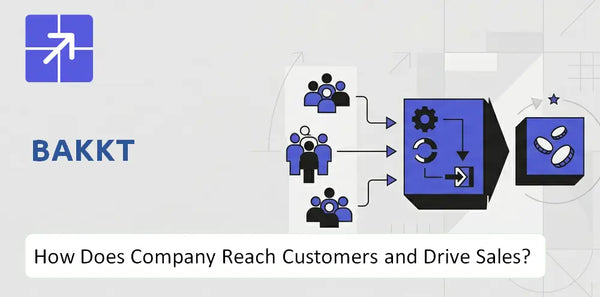
Bakkt pushes partner-led integrations and revenue sharing to unlock customer access; track partner activation rates and average transaction value as early signals. See product-level strategic positioning in Bakkt BCG Matrix Analysis.
Who Does Bakkt Want to Sell To?
Bakkt targets three high-value customer tiers: Tier 1 financial institutions and wealth managers, fintechs and regional banks seeking crypto-as-a-service, and large enterprise merchants and loyalty providers that want to tokenize rewards. The go-to-market focuses on selling institutional-grade custody, pre-integrated APIs, and loyalty tokenization to win aggregated pools of capital and millions of end-users.
 Primary target: Institutional financial firms
Bakkt customer acquisition centers on Tier 1 banks and wealth management firms that need compliant, institutional-grade custody and secure execution. By 2025 Bakkt prioritized high-volume partners after signing custody and settlement integrations with major custodians, aiming to capture $billions in AUM flows through B2B channels.
Secondary segments: Fintechs and regional banks
Bakkt sells APIs and white-label crypto-as-a-service to fintech innovators and regional banks, enabling fast payment and crypto features. Its Bakkt API integration for payment processing and developer tooling reduces time-to-market, converting fintech pilots into production partnerships that reach millions of retail users indirectly.
Enterprise merchants and loyalty providers
Bakkt payment and loyalty solutions target large merchants and loyalty program providers to tokenize rewards and drive spend. Case studies show enterprise integrations can lift redemption rates and increase transaction frequency, helping partners monetize loyalty balances and drive sales volume.
Market positioning: Institutional, API-first, enterprise
Bakkt go-to-market strategy positions the company as an institutional-grade, API-first provider of custody, settlement, and loyalty tokenization. The B2B focus shifts resources from low-margin retail acquisition to high-value partner onboarding, improving average contract values and channel efficiency.
Why this positioning wins
Institutional client acquisition and onboarding, plus Bakkt partnerships and integrations, offer differentiated trust and scale – key for institutions and merchants. The message: compliant custody, plug-and-play APIs, and loyalty tokenization convert crypto demand into enterprise sales and large, recurring revenue streams; see Mission, Vision, and Values of Bakkt Company for context.
What this means for sales channels
Bakkt sales channels focus on enterprise sales, partner-led distribution, and API developer outreach. Measuring Bakkt conversion rates and sales ROI centers on contract value, onboarding time, and aggregated end-user reach – metrics that matter more than single retail app downloads.
Bakkt SWOT Analysis
- Complete SWOT Breakdown
- Fully Customizable
- Editable in Excel & Word
- Professional Formatting
- Investor-Ready Format

How Does Bakkt Get in Front of Customers?
Bakkt reaches customers primarily through partnership-led distribution, embedding payment and loyalty services into banks, card networks, and merchant platforms while a specialist direct sales team handles institutional clients. Awareness is built via deep integrations, co-marketing with partners, and targeted enterprise sales that convert demand where money is already managed.

Embedded distribution via payment and bank partners
Bakkt customer acquisition centers on integrations with global payment networks and core banking processors – placing its services inside card rails and bank apps so users encounter Bakkt where they manage funds. This channel drives scalable awareness and reduces friction in onboarding.
Minimal mass digital marketing, focused digital placements
Bakkt uses partner co-marketing, platform distribution, and selective paid and content placements rather than broad consumer advertising; app integrations and partner email lists amplify reach while preserving capital efficiency.
Sales-led access to institutions and intermediaries
A direct sales force targets banks, processors, and large merchants with compliance and security expertise; by early 2026 Bakkt was the regulated backend for over 50 major financial intermediaries, capturing demand at the source of traditional financial traffic.
Demand generation through partner programs and pilots
Bakkt runs joint pilots, incentive programs, and merchant promotions via partners to prove ROI and accelerate adoption – pilot-to-scale conversion is driven by transaction uplift and loyalty redemptions tied to partner KPIs.
Efficient acquisition via embedded touchpoints
By embedding at POS, in banking apps, and on card statements, Bakkt lowers customer acquisition cost and improves activation rates; enterprise deals bundle integration fees with transaction revenue, improving payback periods.
Reach advantage: regulation and integration depth
Bakkt's regulated custody and deep API integration with payment rails is the strongest reach advantage in 2025/2026 – partners prefer a compliant backend, so Bakkt secures distribution by being the embedded, trusted provider; see Ownership and Control of Bakkt Company for context.
Bakkt Business Model Canvas
- One-time Payment
- No Research Needed – Save Hours of Work
- Built by Experts, Trusted by Consultants
- Instant Download, Ready to Use
- 100% Editable, Fully Customizable

How Does Bakkt Turn Attention Into Sales?
Bakkt turns attention into sales by converting platform activity into predictable cash flow through transaction spreads, recurring custody and platform fees, and institutional contracts that lock in long-term revenue.
Core Sales Model: Multi-stream, Platform-led Sales
Bakkt uses a mix of self-serve retail rails, merchant integrations, and direct institutional sales to capture demand. Retail and merchant channels run on API integrations and partner-led onboarding while institutional clients sign multi-year contracts for custody and trading services.
Pricing and Monetization Logic: Transaction + Recurring Fees
Revenue comes from transaction spreads and per-trade fees, plus recurring custody, platform access, and service fees. Pricing mixes usage-based commissions for trading with subscription-style custody and enterprise service contracts.
Conversion and Purchase Drivers: Trust, Liquidity, and Efficiency
Bakkt converts interest using SOC 2 Type II security, bankruptcy-remote custody, and improved liquidity management. These elements reduce slippage, lower execution costs, and increase capture of large-block trades – driving conversion for institutional and merchant customers.
Repeat Revenue and Customer Expansion: Retention via Services
Recurring custody and platform fees create predictable cash flow and expand lifetime value through upsells to trading, settlement, and payment products. As institutions scale, Bakkt cross-sells liquidity tools and loyalty/payment integrations to deepen account revenue.
Key performance facts: after rolling out enhanced liquidity management tools, Bakkt reported a 35 percent increase in institutional conversion efficiency by early 2026, lowering slippage on large-block trades and increasing capture rates. Institutional onboarding emphasizes SOC 2 Type II and bankruptcy-remote custody to convert pilot interest into multi-year contracts; custody fees now represent a growing share of recurring revenue. For retail and merchant acquisition, Bakkt combines API integrations for payment processing, loyalty program ties to POS systems, and targeted marketing campaigns to improve Bakkt customer acquisition and Bakkt go-to-market strategy. See market targets in this research on Target Customers and Market of Bakkt Company
Bakkt Marketing Mix
- Complete Marketing Mix Analysis
- Effortlessly Communicate Your Business Strategy
- Investor-Ready Format
- 100% Editable and Customizable
- Clear and Structured Layout

How Strong Does Bakkt's Commercial Engine Look Going Forward?
Bakkt's commercial engine looks materially stronger going into 2026, supported by a leaner cost base, narrowing 2025 net losses, and growing recurring custody fees that reduce revenue cyclicality; main supports are regulatory moat and institutional traction, while market volatility and customer adoption pace could weaken sales and marketing outcomes.
Regulatory positioning and recurring fee mix support future demand
Bakkt's regulatory approvals and custody capabilities drive trust with institutions, helping Bakkt customer acquisition and Bakkt institutional client acquisition and onboarding; 2025 results show custody and institutional fees contributing a larger share of revenue versus volatile trading income.
Channel depth and targeted go-to-market support conversion
Bakkt go-to-market strategy combines direct B2B sales, partner integrations, and API-led payment processing to reach merchants and retail users; reported merchant integrations and loyalty pilots in 2025 expanded Bakkt sales channels and Bakkt partnerships and integrations, improving funnel conversion rates.
Market volatility and adoption lag are key risks to commercial performance
Crypto market swings remain a systemic risk that can depress transaction volumes and marketing ROI; slower merchant onboarding or weak Bakkt payment and loyalty solutions uptake would limit revenue diversification and slow path to positive adjusted EBITDA.
Sales and marketing outlook: cautiously optimistic and adaptable
Given 2025 financials showing narrowed net loss and a clear trajectory toward positive adjusted EBITDA, the sales and marketing outlook for 2026 appears adaptable: investment focused on enterprise sales, API integration for payment processing, and loyalty program integrations should raise merchant conversion and transaction volumes.
Key metrics to watch: custody fee growth, merchant onboarding rate, monthly active transacting users, and adjusted EBITDA trend; see Competitive Landscape of Bakkt Company for context on competitors and partnership opportunities: Competitive Landscape of Bakkt Company
Bakkt Boston Consulting Group Matrix
- Built by Experts, Trusted by Consultants
- Structured for Consultants, Students, and Founders
- 100% Editable in Microsoft Word & Excel
- Instant Digital Download – Use Immediately
- Compatible with Mac & PC – Fully Unlocked

Related Blogs
- What Is the History of Bakkt Company and How Did It Evolve?
- What Is the Competitive Landscape of Bakkt Company and How Does It Compete?
- What Is the Growth Outlook of Bakkt Company and Where Is It Heading?
- How Does Bakkt Company Work and What Drives Its Business Model?
- What Do the Mission, Vision, and Core Values of Bakkt Company Reveal?
- Who Are the Core Customers in Bakkt Company's Target Market?
- Who Owns Bakkt Company Today and Who Holds Control?
Frequently Asked Questions
Bakkt primarily targets Tier 1 financial institutions and wealth managers. It also sells to fintechs and regional banks looking for crypto-as-a-service, plus large enterprise merchants and loyalty providers that want to tokenize rewards. The focus is on high-value B2B relationships rather than broad retail acquisition.
Disclaimer
All information, articles, and product details provided on this website are for general informational and educational purposes only. We do not claim any ownership over, nor do we intend to infringe upon, any trademarks, copyrights, logos, brand names, or other intellectual property mentioned or depicted on this site. Such intellectual property remains the property of its respective owners, and any references here are made solely for identification or informational purposes, without implying any affiliation, endorsement, or partnership.
We make no representations or warranties, express or implied, regarding the accuracy, completeness, or suitability of any content or products presented. Nothing on this website should be construed as legal, tax, investment, financial, medical, or other professional advice. In addition, no part of this site - including articles or product references - constitutes a solicitation, recommendation, endorsement, advertisement, or offer to buy or sell any securities, franchises, or other financial instruments, particularly in jurisdictions where such activity would be unlawful.
All content is of a general nature and may not address the specific circumstances of any individual or entity. It is not a substitute for professional advice or services. Any actions you take based on the information provided here are strictly at your own risk. You accept full responsibility for any decisions or outcomes arising from your use of this website and agree to release us from any liability in connection with your use of, or reliance upon, the content or products found herein.