
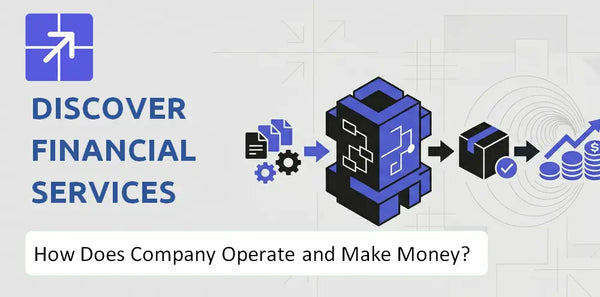
How does Discover Financial Services capture value by running both a consumer bank and a payments network?
Discover Financial Services runs a closed-loop model: it issues credit, services accounts, and processes transactions on its own network, keeping interest, interchange, and data insights. This matters because in 2025 Discover reported higher net interest margins versus peers, driven by loan yields and network fees.
Investors should watch loan growth and merchant acceptance rates; rising merchant fees or card loan balances lift margins – see Discover Financial Services BCG Matrix Analysis.
What Does Discover Financial Services Actually Sell?
Discover Financial Services sells access to credit, deposit funding, and payment-processing infrastructure. Customers pay for credit cards, personal and home-equity loans, deposit accounts, and network services that enable digital payments and merchant acceptance.
 Core Products: Credit, Loans, Deposits, Network Services
Discover Card credit cards form the largest product line, driving interest income from a loan portfolio that exceeded $110 billion in early 2026. Discover Bank offers high-yield savings and CDs as low-cost funding; consumer loans include personal, home-equity, and private student loans to prime borrowers. Discover Global Network provides payment rails via Discover, PULSE, and Diners Club.
Who Buys It: Consumers, Merchants, Financial Partners
Consumers buy credit products and deposit accounts for liquidity, rewards, and savings. Merchants and acquirers purchase network payment processing and routing services to accept Discover and partner-branded payments. Banks and fintechs partner for network access and co-branded card programs.
Customer Value: Credit Access, Yielded Deposits, Seamless Payments
Cardholders get revolving credit, cashback (e.g., Cashback Match), and digital banking features via Discover Bank and mobile apps; depositors receive competitive rates on savings and CDs. Merchants gain global acceptance, reduced friction, and settlement services through Discover Network payment processing.
Differentiators: Integrated Bank + Network Model
Discover Financial Services combines issuer and network roles, which lets it capture both interest income and interchange/merchant-fee revenue – so Discover Card revenue streams include interest versus fee income. Its integrated funding strategy uses deposit products to lower borrowing costs compared with peers that rely on wholesale funding. Read more in History and Background of Discover Financial Services Company.
Discover Financial Services SWOT Analysis
- Complete SWOT Breakdown
- Fully Customizable
- Editable in Excel & Word
- Professional Formatting
- Investor-Ready Format

How Does Discover Financial Services Run Its Business Day to Day?
Discover Financial Services runs day-to-day on a digital-first, closed-loop banking model: it issues Discover Card credit, funds loans from its balance sheet and deposits at Discover Bank, and processes transactions on proprietary rails. Daily work centers on credit underwriting for a $135,000,000,000 loan book, transaction processing for millions of payments, and post-merger integration tasks tied to the Capital One agreement.

Operating model: closed-loop digital bank and network
Discover Financial Services combines card issuance, lending, and payment processing on a single platform so it captures interchange, interest income, and fee revenue directly. Centralized tech hubs and shared service centers run risk models, transaction engines, and customer service without retail branches.
Product delivery: digital-first customer access
Customers apply via mobile and web, receive instant approvals from automated underwriting, and use Discover Card across merchants; deposits flow into Discover Bank via online onboarding. Digital channels handle servicing, statements, payments, and rewards management.
Production & development: data-driven product build
Product teams deploy data science and agile development to design credit products, rewards, and deposit features; core systems are built in-house and integrated with fintech partners. Ongoing model retraining adjusts credit policies to macro conditions.
Sales & distribution: direct and partner channels
Primary acquisition channels are digital marketing, direct mail, and partner co-brand programs; merchant acceptance expands via network onboarding and partnerships with fintechs and processors. Card issuance and deposit products sell directly through Discover Bank portals.
Key assets & partnerships: proprietary network and deposits
Key assets include the Discover Network payment rails, credit analytics stacks, a $135,000,000,000 loan portfolio, and deposit funding via Discover Bank. Partnerships with merchants, payment processors, and fintechs support scale and acceptance.
Practical enablers: risk models, automation, and integration
Efficiency comes from automated credit underwriting, real-time transaction processing, and centralized compliance. In 2025 – 2026 daily operations also focus heavily on regulatory and technical harmonization after the Capital One merger to align compliance standards and network interoperability; see Mission, Vision, and Values of Discover Financial Services Company.
Discover Financial Services Business Model Canvas
- One-time Payment
- No Research Needed – Save Hours of Work
- Built by Experts, Trusted by Consultants
- Instant Download, Ready to Use
- 100% Editable, Fully Customizable

How Does Revenue Flow Through Discover Financial Services?
Revenue at Discover Financial Services flows mainly from interest on loans and credit card balances plus fee-based income; consumer demand for credit and card transactions converts into interest spreads and interchange fees that hit the income statement.
Main revenue: interest income
Interest income – largely from credit card receivables and private student and personal loans – accounts for roughly 80 percent of Discover Financial Services total revenue in fiscal 2025, driven by an average net interest margin near 11.0 percent.
Additional revenue: non – interest fees
Non-interest income comes from interchange and discount revenue, card fees, and banking service fees; owning the Discover Network rails lets Discover Card retain a larger share of merchant transaction dollars versus issuers that pay Visa or Mastercard.
Pricing and monetization model
Discover monetizes via interest spreads (loan yields minus deposit costs), interchange/discount revenue on card transactions, late and annual fees, and deposit-driven funding – combining margin on loans with transaction-based commissions.
What drives revenue most
Key drivers are credit card loan growth, average cardmember balances and yields, interchange volumes, and deposit funding costs; in 2025 higher yields and strong card spend lifted net interest income while interchange benefited from owned network economics. Read the linked piece on marketing and growth strategies for context: Sales and Marketing Strategy of Discover Financial Services Company
Discover Financial Services Marketing Mix
- Complete Marketing Mix Analysis
- Effortlessly Communicate Your Business Strategy
- Investor-Ready Format
- 100% Editable and Customizable
- Clear and Structured Layout

What Makes Discover Financial Services's Model Sustainable or Fragile?
Discover Financial Services' model is sustainable through vertical integration and strong brand loyalty but fragile from concentration in unsecured consumer credit and sensitivity to unemployment and defaults. Key risks include net charge-off volatility and regulatory scrutiny; scale limits drove the proposed Capital One merger to shore up competitiveness and realize projected synergies.
Structural Strength: Vertical integration and brand loyalty
Discover Financial Services benefits from owning card issuance, payment network, and deposit funding, which compresses costs and preserves margin. Discover Card recognition and cross-sell into Discover Bank deposits sustain customer lifetime value and retention.
Key Assets and Capabilities: Network, deposits, underwriting
Discover Network payment processing and merchant relationships generate interchange revenue while Discover deposit products provide low-cost funding; disciplined underwriting and data-driven credit models support underwriting consistency. See customer segmentation in Target Customers and Market of Discover Financial Services Company.
Dependencies and Constraints: Concentration in unsecured consumer credit
The business heavily depends on card and private-label unsecured lending; net charge-off rates around 4.9 percent as of early 2026 raise reserve needs. Performance ties closely to the unemployment rate, consumer credit trends, and interest-rate sensitivity affecting loan yields and prepayment behavior.
Durability in 2025 – 2026: Transitionally stable but conditional
Professional judgment views the model as transitionally stable in 2026 provided disciplined loss reserves and successful execution of the proposed merger with Capital One to capture $2.7 billion in projected synergies. Heightened regulatory scrutiny of historical compliance and risk management practices remains an execution risk that could erode value if unresolved.
Discover Financial Services Boston Consulting Group Matrix
- Built by Experts, Trusted by Consultants
- Structured for Consultants, Students, and Founders
- 100% Editable in Microsoft Word & Excel
- Instant Digital Download – Use Immediately
- Compatible with Mac & PC – Fully Unlocked

Related Blogs
- What Is the History of Discover Financial Services Company and How Did It Evolve?
- What Is the Competitive Landscape of Discover Financial Services Company and How Does It Compete?
- What Is the Growth Outlook of Discover Financial Services Company and Where Is It Heading?
- How Does Discover Financial Services Company Reach Customers and Turn Demand into Sales?
- What Do the Mission, Vision, and Core Values of Discover Financial Services Company Reveal?
- Who Are the Core Customers in Discover Financial Services Company's Target Market?
- Who Owns Discover Financial Services Company Today and Who Holds Control?
Frequently Asked Questions
Discover Financial Services sells access to credit, deposit funding, and payment-processing infrastructure. Its core offerings include credit cards, personal and home-equity loans, deposit accounts, and network services that support digital payments and merchant acceptance. The company serves consumers, merchants, banks, and fintech partners through these products and services.
Disclaimer
All information, articles, and product details provided on this website are for general informational and educational purposes only. We do not claim any ownership over, nor do we intend to infringe upon, any trademarks, copyrights, logos, brand names, or other intellectual property mentioned or depicted on this site. Such intellectual property remains the property of its respective owners, and any references here are made solely for identification or informational purposes, without implying any affiliation, endorsement, or partnership.
We make no representations or warranties, express or implied, regarding the accuracy, completeness, or suitability of any content or products presented. Nothing on this website should be construed as legal, tax, investment, financial, medical, or other professional advice. In addition, no part of this site - including articles or product references - constitutes a solicitation, recommendation, endorsement, advertisement, or offer to buy or sell any securities, franchises, or other financial instruments, particularly in jurisdictions where such activity would be unlawful.
All content is of a general nature and may not address the specific circumstances of any individual or entity. It is not a substitute for professional advice or services. Any actions you take based on the information provided here are strictly at your own risk. You accept full responsibility for any decisions or outcomes arising from your use of this website and agree to release us from any liability in connection with your use of, or reliance upon, the content or products found herein.