
How does Discover Financial Services convert marketing reach into card sales through its sales and marketing model?
Discover Financial Services uses a closed-loop, vertically integrated model to drive originations and merchant volume, capturing interest and interchange margins. This matters as 2025 integration milestones with Capital One shift acquisition channels and could change customer acquisition cost dynamics.
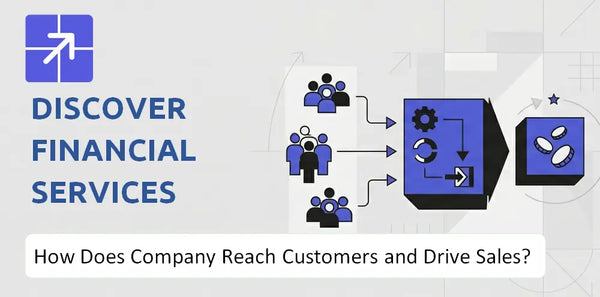
Focus digital spend on high-return channels and tie rewards to activation to lift conversion; recent 2025 portfolio yield and merchant acceptance trends support this move. See Discover Financial Services BCG Matrix Analysis
Who Does Discover Financial Services Want to Sell To?
Discover Financial Services targets US middle-market consumers, focusing on prime and near-prime credit profiles (FICO 670 – 780), the emerging affluent, students, and high-spend transactors; the firm converts early-life lending (private student loans) into durable card and personal-loan relationships while shifting toward transactors to boost fee income and network volume.
 Main target: Prime and Near-Prime Consumers
Discover Financial Services prioritizes consumers with FICO scores between 670 and 780, who deliver lower default rates and higher lifetime value through balanced revolving and transactional behavior.
Secondary targets: Emerging Affluent and Students
Discover secures leadership in private student loans to capture the emerging affluent early; students convert into credit card and personal loan customers, creating a high-conversion pipeline that feeds long-term customer value.
Market positioning: Rewards-focused Transactors
By 2025 Discover shifted emphasis to transactors – high-spend customers who prioritize rewards and service over carrying balances – to drive network volume and interchange revenue rather than interest income.
Why this positioning works
Transactors generate steady, high-velocity transaction fees and lower credit loss, helping balance risk while fueling merchant-fee income; as of Q1 2026, transactors contribute a growing share of Discover's $105,000,000,000 total credit card receivables, reflecting the strategic shift.
Discover Financial customer acquisition mixes private student-lending leadership, rewards-driven offers, digital onboarding, and data-driven personalization to move customers from early products into higher-value cards and loans; see Competitive Landscape of Discover Financial Services Company for related context: Competitive Landscape of Discover Financial Services Company
Discover Financial Services SWOT Analysis
- Complete SWOT Breakdown
- Fully Customizable
- Editable in Excel & Word
- Professional Formatting
- Investor-Ready Format

How Does Discover Financial Services Get in Front of Customers?
Discover Financial Services reaches customers mainly through a high-velocity digital-first funnel plus precision direct mail and merchant visibility via its Discover Global Network; digital channels drove over 75% of new account originations in 2025, while network ubiquity at checkout reinforces demand at point of sale.

Digital-First Acquisition
Discover Financial Services prioritizes online acquisition – search, paid media, affiliates, and social – focusing creatives on the Cashback Match value proposition to convert intent into applications quickly.
SEO, Affiliates and Social Reach
SEO and affiliate partnerships drive top-of-funnel traffic; targeted social ads and content nurture users into the Discover mobile app and web application flow to shorten time-to-approval.
Network Distribution and Merchant Acceptance
Discover Global Network, including PULSE and Diners Club International, expands acceptance to over 70 million merchant locations globally (as of 2026), putting the brand at checkout and increasing spontaneous signups.
Demand Generation Campaigns
Promotions like Cashback Match, seasonal offers, and targeted direct mail raise conversion; digital promotions and referral/affiliate incentives further accelerate signups during peak shopping periods.
Acquisition Efficiency and Metrics
In 2025 Discover sourced > 75% of new accounts from digital channels, indicating strong cost-per-acquisition efficiency from search and affiliate funnels versus legacy offline channels.
Most Important Reach Advantage
The combined effect of digital-first marketing and the Discover Global Network's merchant ubiquity is the strongest reach advantage, delivering continual brand exposure at checkout and online, which turns awareness into sales.
For governance context and ownership details related to Discover Financial Services see Ownership and Control of Discover Financial Services Company
Discover Financial Services Business Model Canvas
- One-time Payment
- No Research Needed – Save Hours of Work
- Built by Experts, Trusted by Consultants
- Instant Download, Ready to Use
- 100% Editable, Fully Customizable

How Does Discover Financial Services Turn Attention Into Sales?
Discover Financial Services turns attention into sales through instant digital approvals and in-app cross-selling, converting clicks into activated accounts and multi-product relationships via data-driven offers and high-touch US-based service.
Instant decisioning and frictionless onboarding
Discover centers on a self-serve, digital-first sales model where prospective customers apply online or in-app and receive credit decisions in seconds via instant decisioning technology. This lowers drop-off and increases activation rates for credit cards and deposit accounts.
Pricing and interest-income monetization
Revenue comes from interest on card balances, interchange fees, and deposit spreads; fees and loan origination income add variability. Discover prices card APRs, personal loan rates, and deposit yields to balance activation with lifetime margin.
Conversion drivers: trust, speed, and personalization
High conversion relies on fast approvals, a 4.9-star mobile app experience, rewards messaging, and targeted offers driven by behavioral and credit-data analytics that match product fit and timing.
Repeat revenue via ecosystem lock-in and cross-sell
Discover uses in-app triggers to upsell personal loans, home equity, and high-yield savings; this ecosystem lock-in grew multi-product households by 12% in the last year and raises customer lifetime value above acquisition cost.
Operational detail: instant decisioning drives approvals in seconds, lifting activation and reducing acquisition cost per activated account; targeted offers use transaction and credit data to present next-best products; US-based customer service improves retention and supports higher lifetime value relative to marketing spend. See related background: History and Background of Discover Financial Services Company
Discover Financial Services Marketing Mix
- Complete Marketing Mix Analysis
- Effortlessly Communicate Your Business Strategy
- Investor-Ready Format
- 100% Editable and Customizable
- Clear and Structured Layout

How Strong Does Discover Financial Services's Commercial Engine Look Going Forward?
Discover Financial Services enters mid-2026 with a scaled, high-margin commercial engine supported by strong NIM, improving efficiency post-merger, and disciplined credit underwriting; key strengths and risks will determine whether demand converts to sustained sales growth.
Drivers that Support Future Demand
Brand recognition, broad card acceptance, and an expanding global network (volume up 8% YoY in 2025) underpin Discover Financial customer acquisition and Discover demand generation strategies, while reward programs and personalization raise conversion and retention.
Channel and Marketing Effectiveness
Digital banking customer engagement via mobile app onboarding, targeted CPM ads, and CRM-driven offers appear effective: Discover mobile app acquisition and onboarding tactics plus referral and affiliate programs lower cost per acquisition versus legacy mail and call channels.
Risks to Commercial Performance
Elevated net charge-offs normalized near 3.4% and macro shocks could raise loss rates; integration execution risk from the Capital One merger and regulatory scrutiny around interchange and fair-lending could pressure margins and customer acquisition costs.
Overall Sales and Marketing Outlook for 2025/2026
The outlook is strong and adaptable: projected post-merger efficiency ratio compresses toward 38% by end-2026, NIM stabilizes around 11.1%, and CET1 remains a prudent buffer, making Discover Financial Services a high-margin sales engine transitioning into a global payments player; see further context in Growth Outlook of Discover Financial Services Company
Discover Financial Services Boston Consulting Group Matrix
- Built by Experts, Trusted by Consultants
- Structured for Consultants, Students, and Founders
- 100% Editable in Microsoft Word & Excel
- Instant Digital Download – Use Immediately
- Compatible with Mac & PC – Fully Unlocked

Related Blogs
- What Is the History of Discover Financial Services Company and How Did It Evolve?
- What Is the Competitive Landscape of Discover Financial Services Company and How Does It Compete?
- What Is the Growth Outlook of Discover Financial Services Company and Where Is It Heading?
- How Does Discover Financial Services Company Work and What Drives Its Business Model?
- What Do the Mission, Vision, and Core Values of Discover Financial Services Company Reveal?
- Who Are the Core Customers in Discover Financial Services Company's Target Market?
- Who Owns Discover Financial Services Company Today and Who Holds Control?
Frequently Asked Questions
Discover Financial Services targets US middle-market consumers, especially prime and near-prime credit profiles with FICO scores between 670 and 780. It also focuses on the emerging affluent, students, and high-spend transactors, using those segments to build long-term card and loan relationships.
Disclaimer
All information, articles, and product details provided on this website are for general informational and educational purposes only. We do not claim any ownership over, nor do we intend to infringe upon, any trademarks, copyrights, logos, brand names, or other intellectual property mentioned or depicted on this site. Such intellectual property remains the property of its respective owners, and any references here are made solely for identification or informational purposes, without implying any affiliation, endorsement, or partnership.
We make no representations or warranties, express or implied, regarding the accuracy, completeness, or suitability of any content or products presented. Nothing on this website should be construed as legal, tax, investment, financial, medical, or other professional advice. In addition, no part of this site - including articles or product references - constitutes a solicitation, recommendation, endorsement, advertisement, or offer to buy or sell any securities, franchises, or other financial instruments, particularly in jurisdictions where such activity would be unlawful.
All content is of a general nature and may not address the specific circumstances of any individual or entity. It is not a substitute for professional advice or services. Any actions you take based on the information provided here are strictly at your own risk. You accept full responsibility for any decisions or outcomes arising from your use of this website and agree to release us from any liability in connection with your use of, or reliance upon, the content or products found herein.