
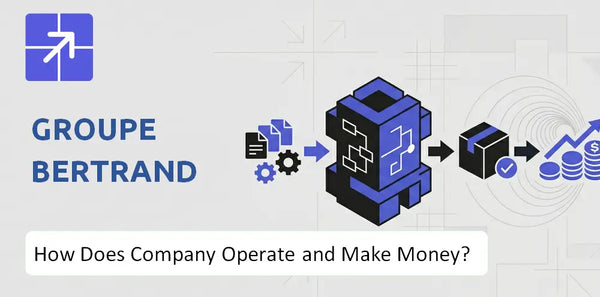
How does Groupe Bertrand operate as a holding that runs both master franchises and luxury restaurants?
Groupe Bertrand combines master franchising for fast-food chains with ownership of upscale dining and bars, capturing volume and premium margins. This matters because its 2025 revenue mix signals exposure to consumer spending cycles and franchise royalties. See recent shifts in same-store sales and portfolio rebalancing.
Focus on margins: franchise royalties scale with volume, while owned luxury outlets boost average unit economics; monitor 2025 like-for-like sales and occupancy trends for forward guidance. Groupe Bertrand BCG Matrix Analysis
What Does Groupe Bertrand Actually Sell?
Groupe Bertrand sells three tiers of hospitality: high-volume quick-service via its Burger King master franchise in France, mid-market casual dining through brands like Au Bureau and Hippopotamus, and premium heritage dining via Angelina and Brasserie Lipp; it also sells franchise rights and operational support to third-party operators.
 Core product lines and channels
Groupe Bertrand offers quick-service restaurants (QSR) as its primary volume driver, casual dining chains, and luxury heritage venues; revenue comes from direct sales, franchising fees, and royalties across physical restaurants plus growing online ordering and delivery channels.
Main customer groups
Customers include mass-market QSR diners, families and social groups for casual dining, and high-net-worth or culturally-focused patrons for heritage venues; franchisees and real-estate partners are B2B buyers of brand and operational packages.
Customer value proposition
Customers pay for speed and consistency at Burger King outlets, social atmosphere and predictable mid-price menus at Au Bureau/Hippopotamus, and cultural prestige plus premium culinary experience at Angelina and Brasserie Lipp; franchisees pay for a proven Groupe Bertrand franchising model and growth playbook.
Differentiators and buying ease
Groupe Bertrand stands out by combining scale in QSR (master franchise for Burger King France), a diversified portfolio across price points, and legacy brands that command pricing power; centralized operations, digital ordering, and real-estate expertise simplify expansion for franchisees. See Growth Outlook of Groupe Bertrand Company
Groupe Bertrand SWOT Analysis
- Complete SWOT Breakdown
- Fully Customizable
- Editable in Excel & Word
- Professional Formatting
- Investor-Ready Format

How Does Groupe Bertrand Run Its Business Day to Day?
Groupe Bertrand runs daily via a hybrid model: direct management for premium brasseries and franchise oversight for scale segments, with centralized procurement, logistics, and a digital-first order flow that routes in-store, app, and delivery orders through unified POS and fulfillment systems.

Operating model: hybrid direct and franchise management
Groupe Bertrand combines directly managed luxury brasseries with franchise networks (including Burger King and Au Bureau). Central teams set standards while local managers run day-to-day service, staffing, and quality control.
Product and service delivery: omnichannel guest flow
Customers access menus via dine-in, mobile apps, in-store digital kiosks, and integrated delivery platforms; by 2026 over 45 percent of quick-service revenue is processed through mobile or digital interfaces, reducing queue time and smoothing peak shifts.
Production, sourcing, and menu development
Centralized procurement negotiates commodity contracts across the 1,100-plus locations to control food costs in an inflationary 2025 environment. Premium concepts keep artisanal sourcing and tighter supplier SLAs; QSR concepts standardize ingredients for speed and consistency.
Sales channels and distribution: multi-route reach
Main channels include company-managed dining rooms, franchise stores, direct online ordering, aggregator delivery apps, and corporate catering; integrated POS funnels sales data into central analytics for pricing and promotions.
Key assets, systems, and partnerships
Critical assets are the centralized procurement/logistics engine, unified POS and mobile app stack, and franchise support teams. Strategic partnerships include national distributors and delivery aggregators to scale distribution and lower unit costs.
What makes the model work in practice
Scale purchasing power lowers COGS, digital ordering shifts 45 percent+ of quick-service sales off the counter, and clear KPI regimes for franchisees ensure consistency. Centralized logistics plus local operational autonomy balance efficiency and guest experience.
For historical context and brand evolution see History and Background of Groupe Bertrand Company.
Groupe Bertrand Business Model Canvas
- One-time Payment
- No Research Needed – Save Hours of Work
- Built by Experts, Trusted by Consultants
- Instant Download, Ready to Use
- 100% Editable, Fully Customizable

How Does Revenue Flow Through Groupe Bertrand?
Revenue flows through Groupe Bertrand via direct restaurant sales, franchise fees and royalties, and branded retail; customer demand converts to cash at point of sale, recurring franchise streams, and higher-margin luxury retail and licensing.
Main cash engine: company-owned restaurant sales
Company-owned restaurants generate the largest, highest-velocity cash inflow by capturing full meal margins at point of sale; in 2025 system-wide sales are projected to exceed 3.5 billion Euros, with Burger King outlets supplying the biggest share of operating cash used to service debt and fund acquisitions.
Recurring high-margin franchise revenue
Franchising strategy Groupe Bertrand provides steady, scalable income via initial entry fees and ongoing royalties – typically 4 to 8 percent of gross sales – plus franchisee contribution to marketing funds and operational support fees.
Pricing and monetization: layered models per segment
Groupe Bertrand business model monetizes demand through retail sales in restaurants, franchise commissions, licensing of branded products (eg Angelina-branded chocolates), and premium pricing in luxury venues where average transaction values are materially higher.
Key revenue drivers: volume, AUV, and brand mix
Top drivers are transaction volume at fast – casual chains, Average Unit Volume (AUV) in luxury restaurants, franchise network expansion, and retail/licensing sales; digital ordering and location selection increase throughput and margins. See Sales and Marketing Strategy of Groupe Bertrand Company for channel tactics: Sales and Marketing Strategy of Groupe Bertrand Company
Groupe Bertrand Marketing Mix
- Complete Marketing Mix Analysis
- Effortlessly Communicate Your Business Strategy
- Investor-Ready Format
- 100% Editable and Customizable
- Clear and Structured Layout

What Makes Groupe Bertrand's Model Sustainable or Fragile?
Groupe Bertrand's model is sustained by diversified formats – fast food, casual and luxury dining – where quick-service cash flows cushion cyclical segments, but it is fragile due to high French labor costs, heavy debt from acquisitions, and sensitivity to interest rates and consumer dining trends.
Core structural advantage: diversified cash engines
Groupe Bertrand benefits from a mix of quick-service brands (high-frequency, low-ticket) and higher-margin casual and luxury venues; quick-service provides steady cash generation that funds expansion and buffers volatility in fine dining. This diversification underpins the Groupe Bertrand business model and helps stabilize restaurant revenue streams across economic cycles.
Key assets, scale, and partnerships
The group's scale in France, franchising partners for Burger King and acquired brands like Quick, proprietary hospitality management systems, and centralized procurement drive unit economics. Brand portfolio breadth and site network create a moat versus new entrants and support the Groupe Bertrand franchising model explained for rapid roll-out.
Primary dependencies and constraints
Operations depend on French labor rules and high wage levels; labor cost increases (social charges and minimum wage) compress margins. The group's aggressive acquisitions increased leverage; rising interest rates in 2024 – 2025 raise financing costs and amplify sensitivity to slower same-store sales. Supply-chain shocks and changing consumer dining habits are additional constraints.
Durability assessment for 2025/2026
Professional judgment: cautious optimism. Digital ordering, delivery partnerships, and menu optimization improve unit margins and operational efficiency, while dominant quick-service share in France and ongoing franchising strategy Groupe Bertrand lower execution risk. Still, high leverage and exposure to French employment costs make the model exposed if macro or dining demand weakens. See Target Customers and Market of Groupe Bertrand Company for customer segmentation and market context.
Groupe Bertrand Boston Consulting Group Matrix
- Built by Experts, Trusted by Consultants
- Structured for Consultants, Students, and Founders
- 100% Editable in Microsoft Word & Excel
- Instant Digital Download – Use Immediately
- Compatible with Mac & PC – Fully Unlocked

Related Blogs
- What Is the History of Groupe Bertrand Company and How Did It Evolve?
- What Is the Competitive Landscape of Groupe Bertrand Company and How Does It Compete?
- What Is the Growth Outlook of Groupe Bertrand Company and Where Is It Heading?
- How Does Groupe Bertrand Company Reach Customers and Turn Demand into Sales?
- What Do the Mission, Vision, and Core Values of Groupe Bertrand Company Reveal?
- Who Are the Core Customers in Groupe Bertrand Company's Target Market?
- Who Owns Groupe Bertrand Company Today and Who Holds Control?
Frequently Asked Questions
Groupe Bertrand sells three tiers of hospitality: high-volume quick-service through Burger King in France, mid-market casual dining through Au Bureau and Hippopotamus, and premium heritage dining through Angelina and Brasserie Lipp. It also sells franchise rights and operational support to third-party operators, with revenue coming from direct sales, fees, and royalties.
Disclaimer
All information, articles, and product details provided on this website are for general informational and educational purposes only. We do not claim any ownership over, nor do we intend to infringe upon, any trademarks, copyrights, logos, brand names, or other intellectual property mentioned or depicted on this site. Such intellectual property remains the property of its respective owners, and any references here are made solely for identification or informational purposes, without implying any affiliation, endorsement, or partnership.
We make no representations or warranties, express or implied, regarding the accuracy, completeness, or suitability of any content or products presented. Nothing on this website should be construed as legal, tax, investment, financial, medical, or other professional advice. In addition, no part of this site - including articles or product references - constitutes a solicitation, recommendation, endorsement, advertisement, or offer to buy or sell any securities, franchises, or other financial instruments, particularly in jurisdictions where such activity would be unlawful.
All content is of a general nature and may not address the specific circumstances of any individual or entity. It is not a substitute for professional advice or services. Any actions you take based on the information provided here are strictly at your own risk. You accept full responsibility for any decisions or outcomes arising from your use of this website and agree to release us from any liability in connection with your use of, or reliance upon, the content or products found herein.