
How does Infosys convert client IT needs into scalable services and revenue?
Infosys sells consulting, application development, cloud and AI services to enterprises, scaling talent and platforms to lower client costs and speed digital change. This matters as Infosys led global IT services moves in 2025, showing rising AI deal sizes and steady revenue from digital transformation.
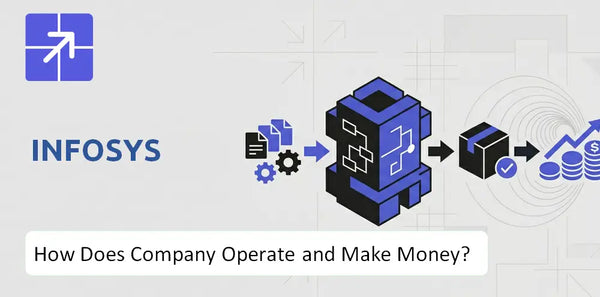
Clients buy outcome-focused contracts, managed services, and platforms; Infosys boosts margins via automation, offshore delivery, and IP. See practical detail in Infosys BCG Matrix Analysis.
What Does Infosys Actually Sell?
Infosys sells specialized intellectual labor and technological execution: strategy, engineering, and managed services for digital transformation. Clients pay for outcomes – modernized applications, cloud migration, AI integration, and ongoing platform operations – rather than standalone hardware.
 Core offerings: Digital Transformation as a Service
Infosys business model centers on services and platforms: consulting, application development, systems integration, managed IT, cloud services via Cobalt, banking software Finacle, and generative AI through Topaz. Revenue mixes time-and-materials contracts, fixed-price programs, and outcome-based deals; in FY2025 Infosys reported consolidated revenue of US$18.3 billion.
Who buys it: enterprise clients across sectors
Buyers are global enterprises – banks using Finacle, retailers automating supply chains, manufacturers adopting cloud security, and public-sector agencies modernizing IT. Top client industries: financial services, manufacturing, retail, energy, and healthcare; top geographies: North America and Europe account for roughly 65 percent of revenues in FY2025.
Value delivered: speed, risk reduction, and talent at scale
Customers get faster product cycles, lower operating risk, and access to skilled teams without building in-house capability. Typical outcomes: 30 – 50 percent faster release cycles, reduced legacy costs from cloud migrations, and measurable automation-led savings reported in client case studies.
Why it stands out: platforms, delivery model, and IP
Infosys delivery model and global delivery centers combine onshore consulting with offshore engineering, leveraging Cobalt cloud suite and Topaz AI tools to speed deployments. The firm's asset-led services and industry IP reduce time-to-value, supporting the role of consulting in Infosys growth strategy and contributing to a FY2025 operating margin near 18 percent. For strategic context see Growth Outlook of Infosys Company
Infosys SWOT Analysis
- Complete SWOT Breakdown
- Fully Customizable
- Editable in Excel & Word
- Professional Formatting
- Investor-Ready Format

How Does Infosys Run Its Business Day to Day?
Infosys runs day-to-day through a Global Delivery Model: onsite consultants in client markets handle strategy and relationships while offshore delivery centers in India perform coding, testing, and operations; core systems track utilization, projects, and continuous reskilling to shift staff into AI and cybersecurity roles.

Hub-and-Spoke Operating Model
The Infosys business model centers on a hub-and-spoke Global Delivery Model that routes high-value client engagement to onsite leads and bulk delivery to offshore centers; project flow uses Agile and DevOps pipelines, time-tracking, and billing systems to manage work and cash conversion.
Client Engagement and Service Delivery
Clients access Infosys services via account teams and digital marketplaces; services are sold as time-and-materials, fixed-price programs, or managed services with cloud, AI, and cybersecurity packages driving higher-margin engagements.
Development and Resource Sourcing
Work is developed in large delivery centers across India and satellite centers globally; recruitment at campuses and vendor partnerships supply engineers, while internal reskilling rotates thousands through training – 2025 programs prioritized AI and cybersecurity to raise billable skill mix.
Sales Channels and Distribution
Sales run through industry-focused account teams, strategic alliances with cloud vendors, and direct digital engagement; repeat contracts and multi-year managed services create predictable recurring revenue streams across North America and Europe.
Key Assets, Systems, and Partnerships
Core assets include over 315,000 employees, global delivery centers, proprietary automation platforms, and alliances with cloud providers; ERPs, time-billing, and talent platforms link utilization to invoicing and capacity planning.
What Makes the Model Work in Practice
Efficiency comes from arbitraging labor costs offshore while keeping client trust via onsite consultants; daily focus on utilization rate drives revenue per employee, and 2025 reskilling efforts aim to increase high-value service mix and margin expansion.
More detail on the firm's evolution and strategy appears in this article History and Background of Infosys Company
Infosys Business Model Canvas
- One-time Payment
- No Research Needed – Save Hours of Work
- Built by Experts, Trusted by Consultants
- Instant Download, Ready to Use
- 100% Editable, Fully Customizable

How Does Revenue Flow Through Infosys?
Revenue at Infosys flows from client contracts that convert demand for digital, consulting, and IT services into billed work and recurring fees; the mix of fixed-price and time-and-materials deals, plus large multi-year agreements and vertical concentration, determines cash and margin profiles.
Fixed-price engagements: high-margin project wins
Fixed-price contracts generate the largest share of revenue – more than 50 percent – because Infosys captures upside when automation and its delivery platforms lower costs versus estimates, boosting margins when projects finish efficiently.
Time-and-materials and managed services
Time-and-materials billing captures actual hours from consultants and engineers and underpins steady cash flow for ongoing support and managed services; this stream favors utilization and mix management to protect margins.
Pricing and monetization: blended models
Infosys monetizes demand via fixed bids, hourly rates, subscription-style managed services, and outcome-based pricing; licensing and platform fees for cloud and AI offerings add recurring revenue and higher-margin revenue over time.
Primary revenue drivers: verticals, large deals, geography
Financial Services and Retail together account for nearly half of sales, multi-year Large Deals often exceed USD 1 billion and raise visibility, and North America remains dominant – about 58 percent of the >USD 19 billion FY2025 revenue base – making these three levers the core revenue drivers. See Target Customers and Market of Infosys Company for client mix and market positioning: Target Customers and Market of Infosys Company
Infosys Marketing Mix
- Complete Marketing Mix Analysis
- Effortlessly Communicate Your Business Strategy
- Investor-Ready Format
- 100% Editable and Customizable
- Clear and Structured Layout

What Makes Infosys's Model Sustainable or Fragile?
Infosys business model is sustainable where high switching costs and embedded delivery platforms create sticky revenues, yet fragile because labor arbitrage and AI-driven automation threaten billable hours and margins. Structural strengths include deep client integration and recurring contracts; risks center on AI cannibalization, visa rules, and Indian wage inflation.
Client lock-in and recurring revenue
Once Infosys is embedded in a client's core IT estate, migration costs and operational risk make exits hard, producing a sticky revenue base that supports predictable cash flow and cross-selling of Infosys services and offerings.
Scale, delivery network, and brand
Infosys delivery model and global delivery centers plus long-standing relationships with hyperscalers and enterprise clients provide scale advantages, enabling competitive pricing and rapid deployment of cloud services and automation.
Dependency on labor arbitrage and visa access
Revenue is sensitive to the number of human hours billed; visa restrictions in key markets and upward wage pressure in India can compress operating margins, amplifying exposure in Infosys revenue streams and organizational structure.
Durability in 2025/2026: defensive but conditional
By fiscal 2025 Infosys maintained operating margins near 20 to 22 percent, but the model looks defensive: sustainable if Infosys charges premium consulting and AI implementation fees to offset declining commoditized maintenance work; fragile if generative AI reduces billable coding hours faster than premium services scale.
Practical implications: prioritize premium consulting, reskill offshore talent for AI-led delivery, and protect margin via pricing for outcomes and IP-led offerings; see Competitive Landscape of Infosys Company for context on rivals and positioning: Competitive Landscape of Infosys Company
Infosys Boston Consulting Group Matrix
- Built by Experts, Trusted by Consultants
- Structured for Consultants, Students, and Founders
- 100% Editable in Microsoft Word & Excel
- Instant Digital Download – Use Immediately
- Compatible with Mac & PC – Fully Unlocked

Related Blogs
- What Is the History of Infosys Company and How Did It Evolve?
- What Is the Competitive Landscape of Infosys Company and How Does It Compete?
- What Is the Growth Outlook of Infosys Company and Where Is It Heading?
- How Does Infosys Company Reach Customers and Turn Demand into Sales?
- What Do the Mission, Vision, and Core Values of Infosys Company Reveal?
- Who Are the Core Customers in Infosys Company's Target Market?
- Who Owns Infosys Company Today and Who Holds Control?
Frequently Asked Questions
Infosys sells specialized intellectual labor and technological execution for digital transformation. Its offerings include consulting, application development, systems integration, managed IT, cloud services, banking software, and generative AI. Clients pay for outcomes such as modernized applications, cloud migration, AI integration, and ongoing platform operations.
Disclaimer
All information, articles, and product details provided on this website are for general informational and educational purposes only. We do not claim any ownership over, nor do we intend to infringe upon, any trademarks, copyrights, logos, brand names, or other intellectual property mentioned or depicted on this site. Such intellectual property remains the property of its respective owners, and any references here are made solely for identification or informational purposes, without implying any affiliation, endorsement, or partnership.
We make no representations or warranties, express or implied, regarding the accuracy, completeness, or suitability of any content or products presented. Nothing on this website should be construed as legal, tax, investment, financial, medical, or other professional advice. In addition, no part of this site - including articles or product references - constitutes a solicitation, recommendation, endorsement, advertisement, or offer to buy or sell any securities, franchises, or other financial instruments, particularly in jurisdictions where such activity would be unlawful.
All content is of a general nature and may not address the specific circumstances of any individual or entity. It is not a substitute for professional advice or services. Any actions you take based on the information provided here are strictly at your own risk. You accept full responsibility for any decisions or outcomes arising from your use of this website and agree to release us from any liability in connection with your use of, or reliance upon, the content or products found herein.