
How does Infosys convert pipeline into revenue through its sales and marketing model?
Infosys sells outcome-focused services via industry sales teams, partners, and account-based marketing; its AI-first messaging helped win multi-year deals in 2025, tightening deal cycles and improving deal sizes. This matters because larger, stickier contracts drive predictable cash flow and margin expansion.
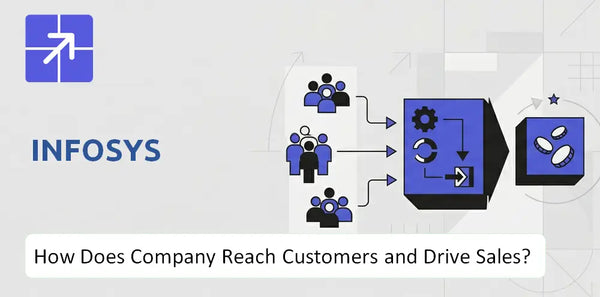
Focus sellers on industry outcomes, tie pricing to value, and scale through partnerships; Infosys reported growing large-transformation deal wins in 2025, signaling stronger go-to-market conversion. See Infosys BCG Matrix Analysis.
Who Does Infosys Want to Sell To?
Infosys targets Global 2000 enterprises, prioritizing large organizations with complex legacy systems and strict compliance needs. It wins C-suite buyers – CIOs, CTOs, Chief Digital Officers – by offering end-to-end managed services, cybersecurity, and cloud migration for high-IT-budget clients.
 Main customer group: Global 2000 enterprise IT leadership
Infosys sells mainly to CIOs, CTOs, and Chief Digital Officers at large enterprises with annual IT spend over $500,000,000. These buyers control strategic transformation programs – cloud, cybersecurity, managed services – that generate high ACV (annual contract value) deals.
Additional targets: sector and growth verticals
Primary sectors are Financial Services, Retail, and Manufacturing, which account for over 50% of Infosys revenue in FY2025; the company intensified focus on Energy, Utilities, and Life Sciences in FY2025 to diversify revenue and capture large cloud and managed-services budgets.
Market positioning: trusted digital transformation partner
Infosys positions itself as a full-stack partner combining consulting, engineering, and large-scale program delivery – appealing to enterprises seeking low-risk migrations and regulatory-compliant architectures. This supports its Infosys go-to-market approach and Infosys marketing strategy focused on enterprise sales conversion.
Why the positioning works: scale, delivery, and sector depth
Clients choose Infosys for scale – > over 300,000 employees and multi-year delivery capability – domain expertise in regulated sectors, and measurable ROI claims. The firm ties consulting to sales to shorten procurement cycles and uses analytics-driven demand generation and account-based marketing to convert pipeline into signed contracts; see History and Background of Infosys Company
Infosys SWOT Analysis
- Complete SWOT Breakdown
- Fully Customizable
- Editable in Excel & Word
- Professional Formatting
- Investor-Ready Format

How Does Infosys Get in Front of Customers?
Infosys gets in front of customers through a dual-track go-to-market approach combining strategic consulting and hyperscaler partnerships, a decentralized industry-aligned sales force, and data-driven thought leadership to generate qualified demand and convert it into enterprise deals.

Hyperscaler partnerships as the primary acquisition channel
Infosys marketing strategy centers on co-selling with AWS, Microsoft Azure, Google Cloud, and NVIDIA; these partnerships unlock ready cloud customer bases and drive large deals through joint solutioning and marketplace listings.
Digital thought leadership and content-led reach
Infosys leverages the Infosys Knowledge Institute to publish data-driven research and white papers, uses SEO, targeted LinkedIn campaigns, and account-based marketing to nurture enterprise buyers and drive inbound leads.
Industry-aligned, decentralized sales distribution
Infosys sales strategy uses vertical-aligned account teams across North America and Europe, enabling relationship selling, proactive RFP participation, and local engagement where about 85 percent of geographic revenue mix is concentrated.
Demand generation via consulting and co-sell programs
Demand generation blends high-level strategic consulting that surfaces transformation mandates with hyperscaler co-sell programs, joint go-to-market campaigns, executive events, and industry forums to accelerate pipeline.
Customer acquisition efficiency and funnel metrics
Infosys appears to maintain efficient deal conversion by cross-selling services to existing cloud customers and consulting clients; in fiscal 2025, services tied to cloud and AI contributed materially to revenue growth and larger average deal sizes.
Most important reach advantage: partner ecosystem and executive credibility
The strongest reach advantage is the combined hyperscaler ecosystem plus executive visibility from the Infosys Knowledge Institute, which delivers credibility at scale and drives enterprise inquiries and co-sell opportunities into the sales funnel.
Read a related analysis: Growth Outlook of Infosys Company
Infosys Business Model Canvas
- One-time Payment
- No Research Needed – Save Hours of Work
- Built by Experts, Trusted by Consultants
- Instant Download, Ready to Use
- 100% Editable, Fully Customizable

How Does Infosys Turn Attention Into Sales?
Infosys turns attention into sales by using a Land and Expand commercial model: short proof-of-concept AI or cloud projects validate value, then expand into multi-year managed services contracts and outcome-linked pricing to lock in long-term revenue.
Core Sales Model: Land and Expand with Platform-led Execution
Infosys sells through account teams and strategic partners, using platform-led propositions (Cobalt for cloud, Topaz for AI) to accelerate direct sales and large contract wins across enterprises.
Pricing and Monetization Logic: Value-based and Outcome-linked
Pricing mixes fixed fees for PoCs, subscription/managed services for multi-year engagements, plus outcome-linked fees; this shifts revenue toward recurring streams and measurable ROI metrics.
Conversion and Purchase Drivers: Proof, Platforms, and Commercial Packaging
Conversion relies on rapid PoC wins using Cobalt and Topaz, quantifiable ROI dashboards, executive sponsorship, and bundling cost-optimization with innovation to justify discretionary spend.
Repeat Revenue or Customer Expansion: High Retention and Account Expansion
Infosys converts initial wins into expanded mandates; top accounts retain above 95 percent, and the company reports Total Contract Value from large deals exceeding $12 billion annually in recent fiscal cycles.
Key mechanics: targeted account-based marketing, solution engineering tied to Cobalt and Topaz, executive-level commercial proposals with outcome metrics, and a pricing shift to value-based models that increase upsell and retention. See How Infosys Company Works and Makes Money for broader context on operations and revenue mix.
Infosys Marketing Mix
- Complete Marketing Mix Analysis
- Effortlessly Communicate Your Business Strategy
- Investor-Ready Format
- 100% Editable and Customizable
- Clear and Structured Layout

How Strong Does Infosys's Commercial Engine Look Going Forward?
Infosys commercial engine looks resilient heading into 2025/2026, driven by large transformation pipelines and an AI-integrated delivery pivot, though macro sensitivity and pricing pressure could dampen discretionary deals.
What Supports Future Demand
Infosys marketing strategy and brand strength, plus a large pipeline of transformation deals, underpin demand; non-discretionary cloud and cybersecurity contracts provide a revenue floor. The Generative AI services leadership and sustained client relationships support high deal conversion rates.
Channel and Marketing Effectiveness
Infosys go-to-market approach combines direct enterprise sales, partner channels, and account-based marketing; digital marketing and CRM automation improve lead nurturing and conversion. Recent investments in sales enablement and analytics raised utilization and shortened sales cycles.
Risks to Commercial Performance
Discretionary IT spend remains sensitive to global macro and client budget cuts; boutique AI firms and legacy rivals exert pricing pressure. Concentration risk in large deals means deal slippage could dent quarterly revenue growth.
The Overall Sales and Marketing Outlook
Outlook is steady and adaptable: management guides for mid-single-digit revenue growth in 2025/2026 with operating margins between 20 and 22 percent due to AI-driven automation and higher utilization. Monitor competitive pricing and deal conversion rates closely.
Key 2025 facts: Infosys reported a strong transformation pipeline with multi-year deals announced across cloud, cybersecurity, and generative AI; professional judgment forecasts mid-single-digit revenue growth and stable margins as AI reduces delivery costs and improves utilization. For further context on ownership and governance, see Ownership and Control of Infosys Company
Infosys Boston Consulting Group Matrix
- Built by Experts, Trusted by Consultants
- Structured for Consultants, Students, and Founders
- 100% Editable in Microsoft Word & Excel
- Instant Digital Download – Use Immediately
- Compatible with Mac & PC – Fully Unlocked

Related Blogs
- What Is the History of Infosys Company and How Did It Evolve?
- What Is the Competitive Landscape of Infosys Company and How Does It Compete?
- What Is the Growth Outlook of Infosys Company and Where Is It Heading?
- How Does Infosys Company Work and What Drives Its Business Model?
- What Do the Mission, Vision, and Core Values of Infosys Company Reveal?
- Who Are the Core Customers in Infosys Company's Target Market?
- Who Owns Infosys Company Today and Who Holds Control?
Frequently Asked Questions
Infosys mainly targets Global 2000 enterprises, especially CIOs, CTOs, and Chief Digital Officers. It focuses on large organizations with complex legacy systems, strict compliance needs, and high IT budgets, selling managed services, cybersecurity, and cloud migration programs that can lead to large annual contract values.
Disclaimer
All information, articles, and product details provided on this website are for general informational and educational purposes only. We do not claim any ownership over, nor do we intend to infringe upon, any trademarks, copyrights, logos, brand names, or other intellectual property mentioned or depicted on this site. Such intellectual property remains the property of its respective owners, and any references here are made solely for identification or informational purposes, without implying any affiliation, endorsement, or partnership.
We make no representations or warranties, express or implied, regarding the accuracy, completeness, or suitability of any content or products presented. Nothing on this website should be construed as legal, tax, investment, financial, medical, or other professional advice. In addition, no part of this site - including articles or product references - constitutes a solicitation, recommendation, endorsement, advertisement, or offer to buy or sell any securities, franchises, or other financial instruments, particularly in jurisdictions where such activity would be unlawful.
All content is of a general nature and may not address the specific circumstances of any individual or entity. It is not a substitute for professional advice or services. Any actions you take based on the information provided here are strictly at your own risk. You accept full responsibility for any decisions or outcomes arising from your use of this website and agree to release us from any liability in connection with your use of, or reliance upon, the content or products found herein.