
How does Pegasystems Company earn recurring revenue by turning enterprise workflows into automated customer decisions?
Pegasystems Company sells cloud-native automation and customer engagement software that shifts firms from manual processes to real-time decisioning. This matters as Pegasystems reported growing cloud ARR in 2025 and investments in AI-driven decisioning, signaling durable subscription economics and higher lifetime value.
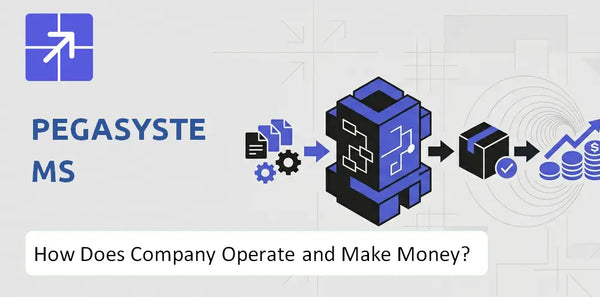
Pegasystems monetizes via subscriptions, professional services, and platform usage; focus on cloud ARR and AI features drives upsell and renewals. See product implications in Pegasystems BCG Matrix Analysis.
What Does Pegasystems Actually Sell?
Pegasystems sells the Pega Platform, a low-code enterprise suite that bundles Pega BPM (business process management), Pega CRM, decisioning (AI) and robotic process automation so customers can build and run complex, production-grade applications with minimal coding. Buyers pay for platform subscriptions, cloud hosting, AI decisioning and professional implementation services.
 Core offering: Pega Platform and Pega Infinity
Pegasystems markets the Pega Platform (Pega BPM, Pega CRM, and Pega Infinity) as an integrated low-code suite. The package combines digital process automation, AI-powered decisioning engines, and robotic process automation in one architecture.
Main buyers: large enterprises and IT leaders
Primary customers are global financial services, healthcare, insurance, telco and government organizations seeking enterprise-grade automation and customer engagement. Procurement typically comes from CIOs, heads of digital transformation, and lines-of-business managers.
Customer value: faster apps, lower operating cost
Customers gain faster application delivery via low-code, reduced manual work through RPA, and higher customer retention via the Pega decisioning engine (next-best-action). Reported implementations often cut processing time and reduce operational costs by 20 – 40% in targeted workflows.
Differentiators: unified stack and AI decisioning
Pegasystems stands out by offering one architecture that ties Pega BPM, Pega CRM, AI decisioning and cloud delivery together, reducing integration drag. Its licensing and cloud subscription model drives recurring revenue while professional services and partner ecosystem support complex rollouts.
Relevant context and further company background are available in this article: History and Background of Pegasystems Company
Pegasystems SWOT Analysis
- Complete SWOT Breakdown
- Fully Customizable
- Editable in Excel & Word
- Professional Formatting
- Investor-Ready Format

How Does Pegasystems Run Its Business Day to Day?
Pegasystems runs day-to-day on a cloud-first delivery model with a centralized business-rules engine (Center Out) that coordinates interactions across web, mobile, and contact centers; product development focuses on embedding generative AI and decisioning into the Pega platform while implementation work is largely executed through partner teams.

Operating model: cloud-first Center Out delivery
Pegasystems uses a cloud-architected Pega platform that centralizes business logic so rules and decisioning apply consistently across channels; internal teams manage platform R&D and product roadmaps while day-to-day deployments are coordinated with partners and customer IT.
Product and service delivery: Pega platform as SaaS and subscription
Customers access the Pega platform via cloud subscriptions and managed services; sales close enterprise agreements (often multi-year) covering Pega licensing, cloud services, and professional services fees, yielding recurring revenue from subscriptions and support.
Production, sourcing, and development: R&D-led, partner-executed deployments
Pegasystems invests heavily in R&D – focusing on Pega BPM (business process management), Pega CRM, low-code tooling, and generative AI – while sourcing most deployment labor from systems integrators; this lets engineering scale capabilities without proportional staff increases.
Sales channels and distribution: hybrid direct plus partner ecosystem
Pegasystems uses a high-touch direct sales force for Global 2000 accounts and a broad partner network (Accenture, Capgemini, EY and others) for implementation and resale; partners handle the bulk of professional services and drive volume-led growth.
Key assets, systems, and partnerships: cloud, decisioning engine, and SI alliances
Key assets include the Pega platform decisioning engine, cloud infrastructure, IP for low-code application composition, and large systems-integrator partnerships; these assets support scale and recurring revenue – in 2025 Pegasystems reported $1.48 billion in revenue with subscription and cloud growing as a share of total sales.
What makes the model work in practice: central rules, partner leverage, and AI
The Center Out engine prevents channel silos, partners provide flexible delivery capacity, and generative AI shortens build cycles so customers launch projects faster; together these elements drive higher retention and predictability in Pega licensing and subscription revenue.
For background on corporate governance and ownership dynamics see Ownership and Control of Pegasystems Company.
Pegasystems Business Model Canvas
- One-time Payment
- No Research Needed – Save Hours of Work
- Built by Experts, Trusted by Consultants
- Instant Download, Ready to Use
- 100% Editable, Fully Customizable

How Does Revenue Flow Through Pegasystems?
Revenue flows mainly through multi-year Pega Cloud subscriptions and module add-ons, turning enterprise demand into recurring Annual Contract Value (ACV). Clients sign multi-year deals, pay recurring fees, and often layer professional services or partner-led implementations that convert demand into steady cash flows.
Subscription revenue from Pega Cloud
The Pega platform earns most revenue from Pega Cloud subscriptions where customers pay recurring fees for access and core modules; this subscription-first shift drove ACV toward $1.4 billion by early 2026 and underpins predictable SaaS cash flows.
Professional services and partner-led delivery
Professional services still generate revenue via implementations, integrations, and customizations, but Pegasystems has shifted delivery to partners to improve margins while maintaining solution adoption and recurring license upsells.
Pricing and monetization model
Pegasystems monetizes with tiered subscription pricing, module-based licensing for Pega CRM and Pega BPM capabilities, and consumption tiers for cloud services; one-time perpetual licenses are largely replaced by SaaS contracts that smooth revenue recognition.
Primary revenue drivers
ACV growth, multi-year contract renewals, and cloud migration drive revenue most; subscription gross margins reached approximately 75 percent, and the company targets free cash flow of $350 million to $400 million annually as recurring revenue scales.
Demand converts to revenue through multi-year contracts, upsells of decisioning, AI, and low-code modules, and partner-delivered services; see related strategic detail in Sales and Marketing Strategy of Pegasystems Company.
Pegasystems Marketing Mix
- Complete Marketing Mix Analysis
- Effortlessly Communicate Your Business Strategy
- Investor-Ready Format
- 100% Editable and Customizable
- Clear and Structured Layout

What Makes Pegasystems's Model Sustainable or Fragile?
Pegasystems' model rests on high switching costs and deep enterprise embedding via the Pega platform, creating durable recurring revenue; however, complexity-driven long sales cycles and competition from Salesforce and ServiceNow create tangible fragility. Success in 2025 hinges on proving Pega GenAI shortens time-to-value and sustains subscription growth versus lower-cost alternatives.
High switching costs form a moat
Once banks or healthcare providers embed Pega BPM and Pega decisioning engine into core workflows, replacing it requires rewiring critical claims, underwriting, or onboarding logic; that creates sticky, recurring revenue and supports subscription and maintenance income.
Fast AI adoption reduces time-to-value
Pega GenAI adoption accelerated in 2024 – 2025, helping shorten pilot-to-production timelines and increasing ROI visibility; this improves sales conversion and amplifies the Pega platform's value proposition versus pure low-code rivals.
Complexity and implementation fatigue
Pegasystems business model depends on deep professional services and long implementations, which lengthen sales cycles and raise total cost of ownership; some clients opt for lighter Pega low-code platform benefits or third-party SaaS to avoid implementation risk.
Resilience outlook for 2025/2026
Financially, Pegasystems transitioned toward a cash-generative subscription engine with 2025 ARR growth momentum; however, market durability depends on proving AI-driven autonomous enterprise outcomes deliver measurable ROI faster than Salesforce or ServiceNow alternatives. See competitive context: Competitive Landscape of Pegasystems Company
Pegasystems Boston Consulting Group Matrix
- Built by Experts, Trusted by Consultants
- Structured for Consultants, Students, and Founders
- 100% Editable in Microsoft Word & Excel
- Instant Digital Download – Use Immediately
- Compatible with Mac & PC – Fully Unlocked

Related Blogs
- What Is the History of Pegasystems Company and How Did It Evolve?
- What Is the Competitive Landscape of Pegasystems Company and How Does It Compete?
- What Is the Growth Outlook of Pegasystems Company and Where Is It Heading?
- How Does Pegasystems Company Reach Customers and Turn Demand into Sales?
- What Do the Mission, Vision, and Core Values of Pegasystems Company Reveal?
- Who Are the Core Customers in Pegasystems Company's Target Market?
- Who Owns Pegasystems Company Today and Who Holds Control?
Frequently Asked Questions
Pegasystems sells the Pega Platform, an integrated low-code enterprise suite. It combines Pega BPM, Pega CRM, AI decisioning, and robotic process automation so customers can build and run complex applications with less coding. Buyers typically pay for platform subscriptions, cloud hosting, AI decisioning, and implementation services.
Disclaimer
All information, articles, and product details provided on this website are for general informational and educational purposes only. We do not claim any ownership over, nor do we intend to infringe upon, any trademarks, copyrights, logos, brand names, or other intellectual property mentioned or depicted on this site. Such intellectual property remains the property of its respective owners, and any references here are made solely for identification or informational purposes, without implying any affiliation, endorsement, or partnership.
We make no representations or warranties, express or implied, regarding the accuracy, completeness, or suitability of any content or products presented. Nothing on this website should be construed as legal, tax, investment, financial, medical, or other professional advice. In addition, no part of this site - including articles or product references - constitutes a solicitation, recommendation, endorsement, advertisement, or offer to buy or sell any securities, franchises, or other financial instruments, particularly in jurisdictions where such activity would be unlawful.
All content is of a general nature and may not address the specific circumstances of any individual or entity. It is not a substitute for professional advice or services. Any actions you take based on the information provided here are strictly at your own risk. You accept full responsibility for any decisions or outcomes arising from your use of this website and agree to release us from any liability in connection with your use of, or reliance upon, the content or products found herein.