
How does Pegasystems convert enterprise demand into sales through its sales and marketing model?
Pegasystems targets large enterprises with a high-touch sales model and cloud subscription pricing, shifting from perpetual licenses to predictable ACV. This matters because in 2025 Pega Cloud drove the majority of new commitments, boosting gross margins and highlighting GenAI as a sales differentiator. Pegasystems BCG Matrix Analysis
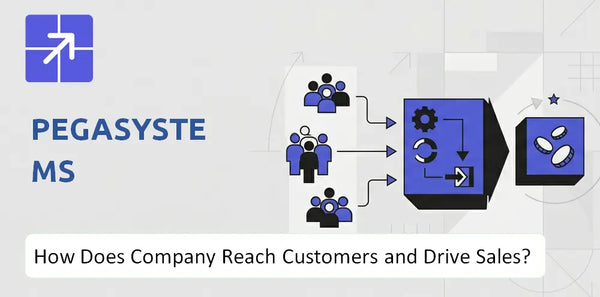
Pegasystems pairs strategic account teams with product-led demos and GenAI use cases to expand ACV and shorten deal cycles; expect continued ACV growth as cloud adoption rises in 2026.
Who Does Pegasystems Want to Sell To?
Pegasystems targets Global 2000 enterprises with high transaction volumes and complex operations, selling to CIOs, CTOs, and COOs in regulated industries that need real-time, AI-driven decisioning and legacy unification. The firm wins by pitching heavy-duty automation over simple low-code tools to reduce costly inefficiencies and speed execution.
 Primary Target: Large, Regulated Enterprises
Pegasystems customer engagement focuses on financial services, healthcare, telecommunications, and government – sectors where scale, compliance, and transaction volumes demand enterprise-grade automation. Target buyers are C-suite tech and operations leaders who prioritize real-time AI decisioning and legacy-system unification to cut operational costs; typical deals exceed $1m ARR in large accounts.
Secondary Segments and Adjacent Buyers
Secondary targets include global insurers, large retailers, and utility providers that need Pega CRM platform capabilities for omnichannel customer care and Pega marketing automation to improve retention. Enterprise IT and line-of-business heads evaluating Pega sales enablement and Pega digital sales use cases are receptive when proofs show >20% reduction in process time or >10% lift in conversion in pilots.
Market Positioning: Heavy-Duty Automation for Complex Operations
Pegasystems positions itself as the platform for enterprises needing full-stack orchestration: Pega customer journey orchestration, decisioning, and case management rather than simple low-code. The messaging emphasizes AI-driven real-time decisions, scalability to handle billions of transactions, and integration with legacy stacks for measurable ROI.
Why This Positioning Resonates
Enterprises buy Pega strategies for turning demand into sales because deployments often show rapid payback – vendors report average project ROI within 12 – 18 months – and case studies of Pega improving sales conversion highlight tighter marketing-to-sales handoffs and personalized customer journeys. See a deeper operational and financial view in How Pegasystems Company Works and Makes Money.
Pegasystems SWOT Analysis
- Complete SWOT Breakdown
- Fully Customizable
- Editable in Excel & Word
- Professional Formatting
- Investor-Ready Format

How Does Pegasystems Get in Front of Customers?
Pegasystems gets in front of enterprise buyers through a hybrid model: direct enterprise sales for strategic accounts and a partner-led motion that drives most pipeline, supplemented by digital channels, flagship events, and AI demos to convert awareness into technical validation quickly.

Partner-led enterprise acquisition
Big Four consultancies and global systems integrators such as Accenture, Capgemini, and Cognizant lead large transformation programs where Pegasystems is embedded, accounting for over 75 percent of the new business pipeline in 2025; this channel supplies high-value, enterprise deals and shortens procurement cycles.
Digital marketing and high-intent channels
Pegasystems uses search, targeted paid media, thought-leadership content, email nurture, and social to capture high-intent buyers, with Pega Blueprint demos promoted as conversion assets; these channels feed qualified leads into the partner and direct sales funnel for technical evaluation.
Sales channels and distribution access
Direct enterprise sales teams handle strategic accounts while global systems integrators and consulting partners provide distribution, implementation, and resale; marketplaces and ISV alliances extend reach into adjacent CRM and automation stacks.
Demand generation tactics
Pegasystems runs campaigns around PegaWorld iNspire events, targeted account-based marketing, thought-leadership webinars, and product-led demos – most notably the generative AI Pega Blueprint tool that visualizes application architectures in minutes to accelerate technical validation.
Customer acquisition efficiency
Partner-led deals yield higher average contract values and lower customer acquisition cost per enterprise; by 2025 partner-led engagements delivered the bulk of pipeline and improved sales velocity, shortening typical software cycles from months to weeks in many proof-of-concept scenarios.
Most important reach advantage
The strategic partner ecosystem is Pegasystems' strongest reach lever in 2025, combining consulting-led demand with Pega Blueprint AI demos to convert awareness into technical wins; this mix drives enterprise scale and supports Pega customer engagement and Pega sales enablement across global accounts.
Read analysis on market positioning and competitors in Competitive Landscape of Pegasystems Company
Pegasystems Business Model Canvas
- One-time Payment
- No Research Needed – Save Hours of Work
- Built by Experts, Trusted by Consultants
- Instant Download, Ready to Use
- 100% Editable, Fully Customizable

How Does Pegasystems Turn Attention Into Sales?
Pegasystems turns attention into sales by delivering quick, measurable value with Pega Express and Pega Blueprint, then expanding usage via subscription-based modules to convert interest into recurring ACV and upsell opportunities.
Core Sales Model: Direct, Subscription, and Partner-Led
Pegasystems combines direct enterprise sales, partner-led deals, and subscription contracts for its Pega CRM platform and Pega customer engagement products. Sales teams target enterprise accounts while partners and system integrators enable scale and industry-specific deployments.
Pricing and Monetization Logic: Value-Based Subscription ACV
Pegasystems uses value-based pricing driven by subscription Annual Contract Value (ACV); subscription ACV reached approximately 1.5 billion by early 2026, with monetization via platform seats, add-on modules, and professional services.
Conversion and Purchase Drivers: Rapid Proof, Blueprinted Roadmaps, AI
Pega Express pushes Minimum Lovable Products (MLPs) to show ROI quickly; Pega Blueprint cuts discovery time by up to 75 percent, converting conceptual interest into a defined project and shortening sales cycles. AI-driven personalization and omnichannel orchestration improve fit and trust during handoffs from marketing to sales.
Repeat Revenue and Expansion: Land-and-Expand with High Net Retention
Expansion is the primary growth lever: once the Pega Platform is embedded, Pegasystems cross-sells Customer Service and 1-to-1 Customer Engagement modules. This land-and-expand approach supports a consistent net retention rate exceeding 110 percent in the latest fiscal reporting.
Pegasystems customer engagement and Pega sales enablement hinge on fast MLP delivery, blueprinted discovery, and subscription ACV growth; see the company context in Mission, Vision, and Values of Pegasystems Company for related strategic emphasis on customer outcomes.
Pegasystems Marketing Mix
- Complete Marketing Mix Analysis
- Effortlessly Communicate Your Business Strategy
- Investor-Ready Format
- 100% Editable and Customizable
- Clear and Structured Layout

How Strong Does Pegasystems's Commercial Engine Look Going Forward?
Pegasystems commercial engine looks well-positioned for 2025/2026, driven by cloud-first revenues, strong free cash flow, and focused AI-enabled automation; key supports include product-market fit in deep-process automation and a disciplined cost structure, while competition from ServiceNow and Salesforce and large-platform displacement risk could weaken near-term growth.
Core Drivers Supporting Future Demand
Pegasystems customer engagement strength, driven by the Pega CRM platform and Pega customer journey orchestration, supports repeatable enterprise deals; AI-integrated workflow automation and Autonomous Enterprise features deepen retention and expand wallet share.
Channel and Marketing Effectiveness
Direct enterprise sales, partner ecosystems, and targeted digital demand programs (Pega marketing automation and Pega digital sales) show efficient lead-to-deal conversion; sales enablement investments and case studies of Pega improving sales conversion shorten deal cycles.
Risks to Commercial Performance
Broader platform competition (ServiceNow, Salesforce) and potential channel displacement threaten share; longer enterprise procurement cycles, execution risk on AI features, and pricing pressure could erode gross margins and customer acquisition efficiency.
Overall Sales and Marketing Outlook
Outlook is favorable and adaptable: with 2025 free cash flow margins near 20 – 22% and clear path to scale ACV toward $2 billion, Pega sales enablement and omnichannel customer engagement position the company to approach the Rule of 40 as recurring cloud revenue mix rises.
Relevant metrics: fiscal 2025 cloud and subscription ARR growth, free cash flow margin at 20 – 22%, and management guidance implying a multi-year path to $2 billion ACV underpin the commercial thesis; see market strategy and target segments in this analysis: Target Customers and Market of Pegasystems Company
Pegasystems Boston Consulting Group Matrix
- Built by Experts, Trusted by Consultants
- Structured for Consultants, Students, and Founders
- 100% Editable in Microsoft Word & Excel
- Instant Digital Download – Use Immediately
- Compatible with Mac & PC – Fully Unlocked

Related Blogs
- What Is the History of Pegasystems Company and How Did It Evolve?
- What Is the Competitive Landscape of Pegasystems Company and How Does It Compete?
- What Is the Growth Outlook of Pegasystems Company and Where Is It Heading?
- How Does Pegasystems Company Work and What Drives Its Business Model?
- What Do the Mission, Vision, and Core Values of Pegasystems Company Reveal?
- Who Are the Core Customers in Pegasystems Company's Target Market?
- Who Owns Pegasystems Company Today and Who Holds Control?
Frequently Asked Questions
Pegasystems targets Global 2000 enterprises with high transaction volumes and complex operations. Its main buyers are CIOs, CTOs, and COOs in regulated industries such as financial services, healthcare, telecommunications, and government, where real-time AI decisioning and legacy unification can reduce inefficiencies and speed execution.
Disclaimer
All information, articles, and product details provided on this website are for general informational and educational purposes only. We do not claim any ownership over, nor do we intend to infringe upon, any trademarks, copyrights, logos, brand names, or other intellectual property mentioned or depicted on this site. Such intellectual property remains the property of its respective owners, and any references here are made solely for identification or informational purposes, without implying any affiliation, endorsement, or partnership.
We make no representations or warranties, express or implied, regarding the accuracy, completeness, or suitability of any content or products presented. Nothing on this website should be construed as legal, tax, investment, financial, medical, or other professional advice. In addition, no part of this site - including articles or product references - constitutes a solicitation, recommendation, endorsement, advertisement, or offer to buy or sell any securities, franchises, or other financial instruments, particularly in jurisdictions where such activity would be unlawful.
All content is of a general nature and may not address the specific circumstances of any individual or entity. It is not a substitute for professional advice or services. Any actions you take based on the information provided here are strictly at your own risk. You accept full responsibility for any decisions or outcomes arising from your use of this website and agree to release us from any liability in connection with your use of, or reliance upon, the content or products found herein.