
How does SK Inc. allocate capital and restructure its portfolio to drive returns across semiconductors, energy, and life sciences?
SK Inc. runs as a strategic capital allocator, reshaping holdings to capture AI-driven semiconductor demand and the energy transition. This matters because in 2025 SK Inc. showed portfolio moves tied to chip investments and green energy partnerships that affect cash flow and credit metrics.
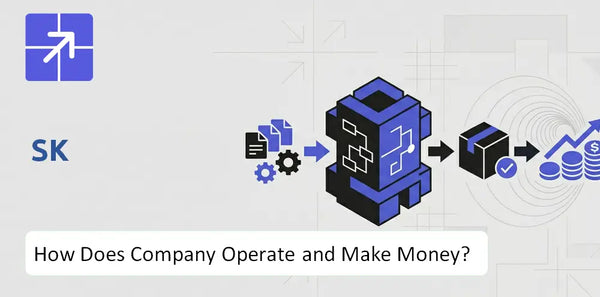
Watch free cash flow and dividend policy: SK Inc.'s 2025 investments in semiconductors raise capex needs but can lift revenues; monitor net debt/EBITDA and subsidiary spin-offs for value realization. See SK BCG Matrix Analysis
What Does SK Actually Sell?
SK Inc. sells exposure to a diversified industrial and tech ecosystem by directing capital, strategy, and shared services to subsidiaries that deliver semiconductors, energy, telecom, and advanced materials; customers pay for high-performance chips, energy and battery solutions, mobile and enterprise telecom services, and specialty materials across EV and semiconductor supply chains.
 Core offerings: industrial portfolio and tech products
SK Inc. operates by active portfolio management across SK Hynix (memory semiconductors), SK Innovation (energy and batteries), SK Telecom (telecom and platform services), and specialty materials units. The parent supplies capital, governance, and cross-group synergies rather than direct manufacturing at the holding level.
Main buyers: hyperscalers, OEMs, enterprises, consumers
Customers include global hyperscalers like Nvidia and Microsoft for HBM memory, EV and auto OEMs for battery and materials, millions of South Korean mobile subscribers for telecom services, and electronics manufacturers for specialty semiconductors and components.
Customer value: performance, scale, and integrated supply
Clients pay for high-performance memory (SK Hynix held over 50% share of the global High Bandwidth Memory market for AI servers as of early 2026), scalable battery and energy solutions, reliable telecom connectivity, and supply-chain-grade materials that reduce sourcing risk and speed product development.
Differentiators: technology leadership plus capital and coordination
SK Inc.'s competitive advantage is portfolio-level capital allocation, cross-unit R&D coordination, and scale in memory and energy – driving higher-margin growth at subsidiaries. For detailed growth metrics see Growth Outlook of SK Company.
SK SWOT Analysis
- Complete SWOT Breakdown
- Fully Customizable
- Editable in Excel & Word
- Professional Formatting
- Investor-Ready Format

How Does SK Run Its Business Day to Day?
SK Inc. runs daily as an investment holding and governance hub: executives monitor subsidiary performance, allocate capital, and coordinate group-level projects while systems track cash flow, capex, and strategic KPIs across businesses.

Operating model: centralized stewardship, decentralized execution
Senior management sets strategy and capital allocation; subsidiaries execute operations. The delivery flow moves from board decisions to subsidiary budgets, then to project management and performance reviews using centralized financial controls and KPI dashboards.
Product and service delivery: integrated offerings via partnerships
Customers access products through subsidiary channels – telecom services via SK Telecom, semiconductors via SK Hynix, energy products via SK On and merged SK Innovation/E&S. Cross-subsidiary bundles combine AI software and hardware for integrated AI solutions.
Production, sourcing and development: targeted capex into growth areas
R&D and manufacturing prioritize AI infrastructure, batteries, and green hydrogen. Group capex reached approximately 25 trillion KRW in 2025, funding fabs, battery plants, and hydrogen projects; procurement balances global suppliers with local partners.
Sales channels and distribution: multi-channel reach through subsidiaries
Main channels are subsidiary-led: retail and enterprise sales for telecom, OEM and direct sales for semiconductors and batteries, and B2B energy contracts. Corporate deals and cross-selling leverage group relationships.
Key assets, systems and partnerships: capital-intensive infrastructure and tech alliances
Key assets include semiconductor fabs, battery factories (SK On), energy fields, and AI/data centers. Strategic partnerships align SK Telecom AI stacks with SK Hynix hardware; treasury and ERP systems centralize cash management and capex tracking.
What makes the model work: capital allocation and governance
Daily efficiency comes from active portfolio management: optimizing cash flow from traditional energy to fund capital-intensive battery and semiconductor growth, tight coordination on R&D, and disciplined KPIs that tie subsidiary performance to group strategy.
Related reading: Sales and Marketing Strategy of SK Company
SK Business Model Canvas
- One-time Payment
- No Research Needed – Save Hours of Work
- Built by Experts, Trusted by Consultants
- Instant Download, Ready to Use
- 100% Editable, Fully Customizable

How Does Revenue Flow Through SK?
Revenue at SK Inc. flows from dividend income, brand royalties, and internal IT services at the parent level, while consolidated sales are dominated by semiconductor and energy operations; demand for AI and telecom needs converts into high-margin chip pricing and annuity-like network cash flows.
Semiconductors: the primary revenue engine
SK Hynix generated the largest share of operating profit in fiscal 2025, driven by record HBM3E and HBM4 prices; AI chip demand translated into higher ASPs and gross margins, making semiconductors the main cash generator for SK Company business model.
Dividend, royalties, and telecom annuities
At the SK Inc. parent level, dividend income from subsidiaries and brand royalty fees provide steady non-operating revenue, while the telecom arm supplies annuity-like cash flows that stabilize group EBITDA across cycles.
Pricing and monetization: premium chip pricing and fees
Revenue converts from demand into cash via high-margin chip sales (spot and contractual), recurring telecom service fees, dividends, and licensing/IT service charges; in 2025 SK Hynix's realized ASP lift pushed consolidated margins materially higher.
Key revenue drivers and capital allocation
Primary drivers are AI-driven HBM demand and energy segment project EBITDA; SK Inc. uses free cash to pay down debt, fund a dividend targeting over 30 percent of adjusted free cash flow, and reinvest in biopharma and clean energy to diversify the SK Company revenue model – see Ownership and Control of SK Company for structure context.
SK Marketing Mix
- Complete Marketing Mix Analysis
- Effortlessly Communicate Your Business Strategy
- Investor-Ready Format
- 100% Editable and Customizable
- Clear and Structured Layout

What Makes SK's Model Sustainable or Fragile?
The SK Inc. model is sustained by an AI-first pivot anchored on SK Hynix cash flows and scale, but remains fragile due to capital-heavy battery investments, high subsidiary leverage, and semiconductor geopolitics. Structural strengths include dominant memory positions and cash generation; key risks are EV battery capital intensity and trade restrictions that could reallocate capital away from profitable segments.
Core Balance: AI memory cash buffer
SK Company business model benefits from SK Hynix generating $30 – 35 billion free cash flow range in strong years (2025 pro forma mix), which finances R&D and cushions memory cyclicality while enabling an AI-First strategy.
Key Assets and Capabilities
How SK Company works hinges on scale in DRAM and NAND manufacturing, proprietary wafer-level IP, supply contracts with hyperscalers, and vertical integration into materials and fabs that deliver cost advantages and high utilization potential.
Dependencies and Constraints
The model depends on continued memory market outperformance, high fab utilization, and policy-stable export routes; battery segment breakeven requires sustained subsidies, >80% plant utilization, and $/kWh cost declines versus legacy targets.
Durability in 2025 – 2026
In 2025/2026 the model looks cautiously resilient: AI memory positions make SK Company indispensable in the tech stack, but balance-sheet repair is critical – high subsidiary leverage and geopolitical export risks leave fragility unless management prioritizes deleveraging and caps battery cash burn.
For a focused industry comparison see Competitive Landscape of SK Company
SK Boston Consulting Group Matrix
- Built by Experts, Trusted by Consultants
- Structured for Consultants, Students, and Founders
- 100% Editable in Microsoft Word & Excel
- Instant Digital Download – Use Immediately
- Compatible with Mac & PC – Fully Unlocked

Related Blogs
- What Is the History of SK Company and How Did It Evolve?
- What Is the Competitive Landscape of SK Company and How Does It Compete?
- What Is the Growth Outlook of SK Company and Where Is It Heading?
- How Does SK Company Reach Customers and Turn Demand into Sales?
- What Do the Mission, Vision, and Core Values of SK Company Reveal?
- Who Are the Core Customers in SK Company's Target Market?
- Who Owns SK Company Today and Who Holds Control?
Frequently Asked Questions
SK sells access to a diversified industrial and tech ecosystem. The article says customers pay for high-performance chips, energy and battery solutions, telecom services, and specialty materials. SK does this through subsidiaries like SK Hynix, SK Innovation, and SK Telecom, while the parent focuses on capital, strategy, and shared services.
Disclaimer
All information, articles, and product details provided on this website are for general informational and educational purposes only. We do not claim any ownership over, nor do we intend to infringe upon, any trademarks, copyrights, logos, brand names, or other intellectual property mentioned or depicted on this site. Such intellectual property remains the property of its respective owners, and any references here are made solely for identification or informational purposes, without implying any affiliation, endorsement, or partnership.
We make no representations or warranties, express or implied, regarding the accuracy, completeness, or suitability of any content or products presented. Nothing on this website should be construed as legal, tax, investment, financial, medical, or other professional advice. In addition, no part of this site - including articles or product references - constitutes a solicitation, recommendation, endorsement, advertisement, or offer to buy or sell any securities, franchises, or other financial instruments, particularly in jurisdictions where such activity would be unlawful.
All content is of a general nature and may not address the specific circumstances of any individual or entity. It is not a substitute for professional advice or services. Any actions you take based on the information provided here are strictly at your own risk. You accept full responsibility for any decisions or outcomes arising from your use of this website and agree to release us from any liability in connection with your use of, or reliance upon, the content or products found herein.