
How does SK Inc. convert its sales and marketing model into measurable revenue across subsidiaries?
SK Inc. aligns capital allocation, corporate development, and centralized marketing to drive subsidiary growth and channel sales. This matters because SK Inc.'s portfolio reported over 200 trillion KRW consolidated revenue in 2024 and is prioritizing AI and energy transition investments into 2025 – 2026.
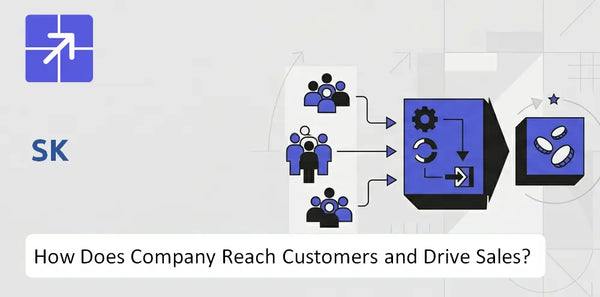
Track performance via cross-subsidiary KPIs, shared go-to-market playbooks, and centralized deal origination. A practical step: map customer journeys across SK Inc.'s units and measure conversion lift after joint campaigns – see SK BCG Matrix Analysis.
Who Does SK Want to Sell To?
SK Inc. targets high-value B2B global partners in technology and automotive sectors plus a large domestic consumer base via energy and telecom subsidiaries; it wins them through tailored product engineering, strategic partnerships, and integrated domestic distribution networks.
 Primary customers: global hyperscalers and GPU designers
SK Inc. focuses on hyperscalers and GPU designers who need advanced memory and semiconductor materials; in 2025, memory-related sales to cloud providers and AI firms drive a projected 25% of export revenue.
Additional target segments: automotive and domestic consumers
North American and European automakers are targeted for batteries and green energy components, while SK Telecom's >30 million subscribers and SK Innovation's regional energy supply create stable domestic demand.
Market positioning: premium supplier across B2B and mass-market utilities
SK Inc. positions as a technology-forward, reliability-focused supplier – premium in high-margin global tech exports and utility-like in domestic energy and telecom services, supporting diversified revenue streams.
Why this positioning works: balance of growth and resilience
Combining fast-growing AI/cloud memory demand with steady domestic subscriber and energy revenues mitigates downturns; SK Inc.'s 2025 strategy ties R&D partnerships and channel depth to higher lead conversion and sustained market share. Read more on corporate evolution History and Background of SK Company
SK SWOT Analysis
- Complete SWOT Breakdown
- Fully Customizable
- Editable in Excel & Word
- Professional Formatting
- Investor-Ready Format

How Does SK Get in Front of Customers?
SK Company reaches global B2B buyers through supply – chain integration, strategic JV partnerships, long – term off – take contracts, and large-scale R&D investment that drives product leadership and demand.

Tier – one supply – chain embedment
SK Company secures customers by integrating into OEM and hyperscaler supply chains, holding direct tier – one relationships – notably via SK Hynix with leading AI chip designers – so it becomes a mandatory supplier for AI infrastructure buyers.
Digital and partner channels for technical reach
SK Company uses targeted digital touchpoints – technical content, white papers, partner portals, and account – based marketing – to reach engineers and procurement teams across search, LinkedIn, and industry platforms.
Direct sales, JVs, and off – take distribution
Access to customers relies on direct enterprise sales, strategic joint ventures, and long – term off – take agreements for energy and battery projects, plus co – investment in multi – billion dollar U.S. manufacturing hubs.
R&D – led demand generation
Major product launches and performance claims come from an aggressive R&D roadmap; the group allocated about 80 trillion KRW to AI and semiconductors through 2026, directly driving specification – led procurement.
Acquisition efficiency via contracted revenue
Customer acquisition is highly efficient because large B2B deals are secured via multi – year contracts and off – takes, lowering churn and cost – per – contract versus spot sales.
Scale advantage: strategic capital and partnerships
The core reach advantage in 2025/2026 is capital intensity and JV networks: multi – billion USD factory investments and long – term offtakes create high barriers to entry and predictable demand.
See customer segmentation and market positioning in this related piece: Target Customers and Market of SK Company
SK Business Model Canvas
- One-time Payment
- No Research Needed – Save Hours of Work
- Built by Experts, Trusted by Consultants
- Instant Download, Ready to Use
- 100% Editable, Fully Customizable

How Does SK Turn Attention Into Sales?
SK Company turns attention into sales by leveraging proprietary tech and long-term contracts to lock customers into premium-priced offerings, then recycling capital into higher-margin businesses to sustain growth. The core mechanics: tech exclusivity creates pricing power, contracts create predictable revenue, and asset recycling funds new demand-generation efforts.
Core sales model: contract-led, B2B and partner channels
SK Company relies on large B2B contracts, strategic OEM partnerships, and direct enterprise sales in semiconductors and energy; partner-led distribution and long-term supply agreements convert technical interest into signed deals.
Pricing and monetization logic: premium pricing + product mix shift
In semiconductors, High Bandwidth Memory (HBM) commands premium unit prices and is expected to represent a significant portion of memory revenue in 2025; in energy, higher-margin green chemicals and battery materials replace low-margin refining sales, shifting revenue mix toward recurring, higher-ASP streams.
Conversion and purchase drivers: exclusivity, contracts, and performance guarantees
Technical exclusivity (patents, integrated IP) and multi-year supply contracts reduce buyer search costs and secure pipeline; proof-of-performance, co-development deals, and volume discounts accelerate lead conversion SK Company.
Repeat revenue and expansion: dividends, reinvestment, and upsell into tech
SK Inc. sustains repeat revenue through multi-year contracts and product roadmaps; the holding captures cash via a disciplined dividend policy and strategic asset recycling – selling mature, low-growth assets to fund high-yield tech segments – supporting sustained operating margins above 12% on a consolidated basis as of 2025.
Key 2025 figures that drive conversion mechanics: HBM expected to account for a substantial share of memory revenue, enabling average selling prices to outpace commodity DRAM by mid-to-high single digits; SK Inc.'s portfolio shift toward battery materials and green chemicals raised segment gross margins by several percentage points versus refining in 2024 – 2025; the holding's asset recycling completed three major divestments in 2024 – 2025, unlocking cash redeployed to high-growth capex and R&D. Read an analysis of corporate strategy in this piece: Growth Outlook of SK Company
SK Marketing Mix
- Complete Marketing Mix Analysis
- Effortlessly Communicate Your Business Strategy
- Investor-Ready Format
- 100% Editable and Customizable
- Clear and Structured Layout

How Strong Does SK's Commercial Engine Look Going Forward?
SK Inc.'s commercial engine looks strong heading into 2026, driven by leadership in AI-memory demand and a stabilizing energy market; EV battery headwinds persist but restructuring aims to restore profitability. Key supports include AI-driven product-market fit and improving balance-sheet metrics, while risks center on cyclical EV demand and macro semiconductor supply swings.
What Supports Future Demand
Dominant position in AI-memory and semiconductors aligns SK Inc. with a projected 15 percent CAGR in AI-related semiconductor demand through 2026, boosting SK Company customer acquisition and demand generation; balance-sheet repairs and targeted capex shift resources to high-return segments.
Channel and Marketing Effectiveness
Digital channels and B2B field sales combine – CRM-driven lead nurturing and enterprise outreach shorten the SK Company sales funnel stages and improve lead conversion SK Company metrics; e-commerce and partner channels support cross-selling into AI and energy customers.
Risks to Commercial Performance
EV battery demand volatility and commodity-price swings could delay revenue recovery despite cost cuts; execution risk exists in integrating AI-memory scale while keeping debt-to-equity ratios falling across subsidiaries toward industry norms.
The Overall Sales and Marketing Outlook
Outlook for 2025/2026 is Strong Performance: SK Inc.'s sales strategy and SK Company marketing funnel are positioned to capture AI-driven demand, with battery unit break-even targeted by late 2025 and improving advertising ROI and customer outreach channels SK Company aiding recovery.
Key 2025/2026 facts: management projects the battery unit to reach break-even by late 2025 after aggressive restructuring; consolidated capex prioritizes AI-memory fabs with expected revenue mix shift raising semiconductor share to over 40 percent of group revenue in 2026; targeted debt reductions aim to lower consolidated debt-to-equity by an estimated 3 – 5 percentage points year-over-year. Read more on corporate direction in Mission, Vision, and Values of SK Company
SK Boston Consulting Group Matrix
- Built by Experts, Trusted by Consultants
- Structured for Consultants, Students, and Founders
- 100% Editable in Microsoft Word & Excel
- Instant Digital Download – Use Immediately
- Compatible with Mac & PC – Fully Unlocked

Related Blogs
- What Is the History of SK Company and How Did It Evolve?
- What Is the Competitive Landscape of SK Company and How Does It Compete?
- What Is the Growth Outlook of SK Company and Where Is It Heading?
- How Does SK Company Work and What Drives Its Business Model?
- What Do the Mission, Vision, and Core Values of SK Company Reveal?
- Who Are the Core Customers in SK Company's Target Market?
- Who Owns SK Company Today and Who Holds Control?
Frequently Asked Questions
SK primarily targets high-value B2B global partners in technology and automotive sectors, while also serving a large domestic consumer base through energy and telecom subsidiaries. Its focus includes hyperscalers, GPU designers, automakers, and domestic subscribers, using tailored product engineering and integrated distribution to match each group's needs.
Disclaimer
All information, articles, and product details provided on this website are for general informational and educational purposes only. We do not claim any ownership over, nor do we intend to infringe upon, any trademarks, copyrights, logos, brand names, or other intellectual property mentioned or depicted on this site. Such intellectual property remains the property of its respective owners, and any references here are made solely for identification or informational purposes, without implying any affiliation, endorsement, or partnership.
We make no representations or warranties, express or implied, regarding the accuracy, completeness, or suitability of any content or products presented. Nothing on this website should be construed as legal, tax, investment, financial, medical, or other professional advice. In addition, no part of this site - including articles or product references - constitutes a solicitation, recommendation, endorsement, advertisement, or offer to buy or sell any securities, franchises, or other financial instruments, particularly in jurisdictions where such activity would be unlawful.
All content is of a general nature and may not address the specific circumstances of any individual or entity. It is not a substitute for professional advice or services. Any actions you take based on the information provided here are strictly at your own risk. You accept full responsibility for any decisions or outcomes arising from your use of this website and agree to release us from any liability in connection with your use of, or reliance upon, the content or products found herein.