
How does Waystar convert healthcare billing complexity into recurring revenue through its software and services?
Waystar automates claims, payments, and patient billing to reduce provider administrative costs and speed reimbursements. This matters as 2025 data show rising demand for revenue-cycle tech amid persistent staffing shortages and payer consolidation. Waystar BCG Matrix Analysis
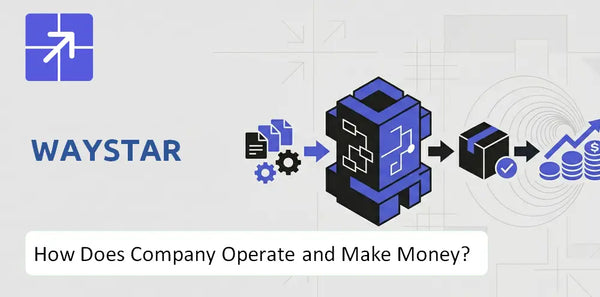
Focus on margin-rich subscription fees plus transaction-based revenue; monitor payer integrations and churn as leading indicators of growth in 2025.
What Does Waystar Actually Sell?
Waystar sells a cloud-native Revenue Cycle Management (RCM) platform that automates the medical claim lifecycle – eligibility, prior authorization, claim scrubbing, adjudication, and payment collection – so providers reduce denials and accelerate cash flow. Customers pay for transaction processing, analytics, integrations, and ongoing support via subscription and usage fees tied to revenue collections.
 Core RCM platform and payment tools
Waystar offers a cloud-native suite for claims management, eligibility verification, prior authorization, patient billing, and payments. The platform includes analytics and integrations with EHR and practice management systems to automate workflows and reduce manual billing.
Primary buyers and users
Buyers include hospitals, health systems, medical groups, and ambulatory clinics plus revenue cycle teams and practice managers. Payors and large health networks evaluate Waystar for enterprise deployments and integration with existing financial systems.
Tangible customer value
Customers get faster collections, fewer denials, and lower administrative headcount – Waystar reports customers see average denial rate reductions and claim acceptance improvements that translate into shorter days in accounts receivable. Providers realize measurable lift in cash flow and net collections.
Differentiators and ease of adoption
Waystar stands out for its unified cloud platform, real-time claim scrubbing, and broad EHR integrations that speed deployment. The company pairs subscription pricing with transaction-based fees, offering implementation services and analytics to prove ROI during rollout – see Sales and Marketing Strategy of Waystar Company for related go-to-market context.
Waystar SWOT Analysis
- Complete SWOT Breakdown
- Fully Customizable
- Editable in Excel & Word
- Professional Formatting
- Investor-Ready Format

How Does Waystar Run Its Business Day to Day?
Waystar runs day-to-day as a high-volume SaaS data processor embedded in Electronic Health Record (EHR) systems, applying thousands of payer rules to millions of transactions to prevent claim errors before submission. Updates to billing codes and payer requirements are pushed centrally to 30,000-plus provider clients, and operations depend on continuous EHR integrations, payer connectivity, and real-time rule engines.

Operational core: real-time rule engine
Waystar uses a centralized rules engine that evaluates eligibility, coding, and payer-specific requirements across incoming claims and transactions. The engine processes millions of daily transactions to catch errors, route exceptions, and trigger automated remediation workflows.
Service delivery: SaaS updates and access
Providers access Waystar via embedded modules inside EHRs and practice management systems; the pure SaaS delivery means billing code and compliance updates are pushed to all clients simultaneously, reducing local IT burden and ensuring uniform compliance.
Product development: continuous rule and connector updates
Engineering teams maintain payer rule libraries, connectors to payer portals, and EHR integrations; product updates include CMS billing code changes, payer policy shifts, and machine-learning improvements to denials prediction and automated appeals.
Sales and distribution: embedded vendor partnerships
Waystar reaches customers through direct sales and strategic placements inside major EHR vendors such as Epic and Oracle Health, enabling embedded purchasing, rapid deployment, and broad distribution across hospitals and ambulatory clinics.
Key assets: integrations and network scale
Critical assets include a payer connectivity network, EHR embeds, a proprietary rules database, and data-security infrastructure for PHI; these allow Waystar to operate at scale and support over 30,000 provider clients processing millions of transactions daily.
Why the model works: frictionless embedding and centralized updates
The embedded workflow makes Waystar effectively invisible to clinicians while catching denials early; central SaaS updates and deep EHR partnerships lower integration friction and drive consistent uptime, improving cash flow and reducing claim denials for providers.
For background on corporate direction and values see Mission, Vision, and Values of Waystar Company
Waystar Business Model Canvas
- One-time Payment
- No Research Needed – Save Hours of Work
- Built by Experts, Trusted by Consultants
- Instant Download, Ready to Use
- 100% Editable, Fully Customizable

How Does Revenue Flow Through Waystar?
Revenue flows into Waystar through subscription contracts plus per-transaction fees: providers pay access fees and per-claim or per-payment charges, converting demand into predictable, recurring cash flow and transaction-linked upside.
Core subscription and transaction revenue
Waystar healthcare payments earns most revenue from fixed subscription fees for platform access and volume-based transaction charges for each claim processed or payment collected; this mix creates recurring income and high revenue visibility.
High-margin modular add-ons
Additional revenue comes from premium modules – predictive denials, patient propensity-to-pay analytics, revenue integrity tools – and professional services like implementation and system integration.
Pricing and monetization mechanics
Waystar pricing blends ARR-style subscriptions with per-claim or per-payment transaction fees and occasional success-based or percentage-of-recovery charges, enabling fixed-base revenue plus scale-linked growth.
Primary revenue drivers
Revenue grows through land-and-expand: hospitals adopt core claims submission then add high-margin modules; in fiscal 2025 Waystar passed USD 1,000,000,000 in revenue with adjusted EBITDA margins near 40%, and over 95% of revenue is recurring by early 2026.
Key operational flow: providers onboard (often integrated with EHR or practice management systems), pay subscription fees, submit claims via Waystar, and incur per-transaction charges; upsell and value-based modules drive higher ARPU and margin expansion – see market segmentation in Target Customers and Market of Waystar Company.
Waystar Marketing Mix
- Complete Marketing Mix Analysis
- Effortlessly Communicate Your Business Strategy
- Investor-Ready Format
- 100% Editable and Customizable
- Clear and Structured Layout

What Makes Waystar's Model Sustainable or Fragile?
Waystar's model is sustainable because hospitals face high switching costs and billing is non – discretionary, but it's fragile where customer concentration and platform dependence create pricing and distribution risks. Scale, data and recurring revenue support resilience; provider consolidation and EHR channel disruptions threaten margins and renewal leverage.
Scale and Sticky Revenue
Waystar processes billions of transactions annually, creating recurring subscription and transaction revenue and high switching costs that make churn low and the model defensive during downturns.
Data Moat and AI Advantage
Large transaction volumes feed machine learning for denial reduction and automation, improving outcomes and raising the cost for competitors to match Waystar healthcare payments' predictive models.
Concentration of Buyers
Consolidation among hospitals and health systems concentrates purchasing power, increasing pricing pressure at renewals and the risk that a few large customers can extract discounts or switch providers.
EHR and Distribution Dependency
Waystar's primary distribution relies on integrations with major EHRs and practice management systems; any disruption or loss of preferred integrations would reduce go – to – market reach and slow new customer acquisition.
Retention and Monetization Traction
In 2025 Waystar maintained a net retention rate above 108 percent, indicating upsell strength; continued scaling of AI – driven automation improves unit economics and supports sustainable margin expansion.
Resilience vs. Exposure in 2025/2026
Professional judgment for 2025/2026 is stable and defensive: Waystar's revenue model and scale suggest resilience, but exposure remains where large client consolidation and EHR channel shifts could materially impact growth and pricing.
For more context on corporate evolution and integrations see History and Background of Waystar Company
Waystar Boston Consulting Group Matrix
- Built by Experts, Trusted by Consultants
- Structured for Consultants, Students, and Founders
- 100% Editable in Microsoft Word & Excel
- Instant Digital Download – Use Immediately
- Compatible with Mac & PC – Fully Unlocked

Related Blogs
- What Is the History of Waystar Company and How Did It Evolve?
- What Is the Competitive Landscape of Waystar Company and How Does It Compete?
- What Is the Growth Outlook of Waystar Company and Where Is It Heading?
- How Does Waystar Company Reach Customers and Turn Demand into Sales?
- What Do the Mission, Vision, and Core Values of Waystar Company Reveal?
- Who Are the Core Customers in Waystar Company's Target Market?
- Who Owns Waystar Company Today and Who Holds Control?
Frequently Asked Questions
Waystar sells a cloud-native Revenue Cycle Management platform for medical billing and payments. It automates eligibility, prior authorization, claim scrubbing, adjudication, and payment collection so providers can reduce denials, speed cash flow, and manage the claim lifecycle more efficiently.
Disclaimer
All information, articles, and product details provided on this website are for general informational and educational purposes only. We do not claim any ownership over, nor do we intend to infringe upon, any trademarks, copyrights, logos, brand names, or other intellectual property mentioned or depicted on this site. Such intellectual property remains the property of its respective owners, and any references here are made solely for identification or informational purposes, without implying any affiliation, endorsement, or partnership.
We make no representations or warranties, express or implied, regarding the accuracy, completeness, or suitability of any content or products presented. Nothing on this website should be construed as legal, tax, investment, financial, medical, or other professional advice. In addition, no part of this site - including articles or product references - constitutes a solicitation, recommendation, endorsement, advertisement, or offer to buy or sell any securities, franchises, or other financial instruments, particularly in jurisdictions where such activity would be unlawful.
All content is of a general nature and may not address the specific circumstances of any individual or entity. It is not a substitute for professional advice or services. Any actions you take based on the information provided here are strictly at your own risk. You accept full responsibility for any decisions or outcomes arising from your use of this website and agree to release us from any liability in connection with your use of, or reliance upon, the content or products found herein.