
How does Waystar's sales and marketing model turn provider demand into recurring revenue?
Waystar sells cloud-native revenue-cycle tools to hospitals and physician groups via direct enterprise sales and channel partners, emphasizing ROI and rapid onboarding. This matters because in 2025 Waystar reported expanding enterprise contracts and +18% ARR growth, signaling strong market pull.
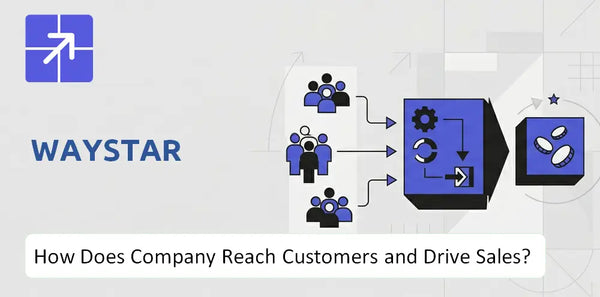
Focus sales on proof points – short pilots, measured cash acceleration, and integration ease; price around value delivered. See product deep-dive: Waystar BCG Matrix Analysis
Who Does Waystar Want to Sell To?
Waystar wants to sell to healthcare providers with high transaction volumes and pressing revenue-cycle needs: large Integrated Delivery Networks and academic medical centers, mid-market hospitals, and over one million individual physicians in practices; the company targets organizations stuck on legacy on-premise systems or manual billing workflows and aims to become their primary financial clearinghouse.
 Primary: Large IDNs and Academic Medical Centers
Waystar focuses on Integrated Delivery Networks and academic medical centers that manage thousands of beds and millions of claims annually. These customers demand enterprise-grade automation to cut days sales outstanding (DSO); as of early 2026 Waystar serves over 30,000 clients, reflecting scale needed for high-volume billing.
Secondary: Mid-market Hospitals and Physician Practices
Waystar also targets mid-market hospitals and more than 1,000,000 individual providers in physician practices who seek cloud RCM (revenue cycle management) and patient payment conversion tools. These segments value rapid onboarding and measurable ROI on collections and denials reduction.
Market Positioning: Primary Financial Clearinghouse
Waystar positions itself as the primary financial clearinghouse for commercial and government payers, replacing legacy on-premise software and manual workflows with an integrated cloud platform that spans eligibility, claims, payment posting, and patient payments.
Why This Positioning Works
The message resonates because target buyers prioritize reducing DSO, lowering denial rates, and increasing point-of-sale patient collections; vendor selection favors platforms with proven scale – Waystar's 30,000+ client footprint and integrations with major EHRs and payers validate trust.
For deeper context on segmentation and how Waystar converts demand into sales, see Target Customers and Market of Waystar Company
Waystar SWOT Analysis
- Complete SWOT Breakdown
- Fully Customizable
- Editable in Excel & Word
- Professional Formatting
- Investor-Ready Format

How Does Waystar Get in Front of Customers?
Waystar reaches customers through embedded EHR integrations, a segmented direct sales force targeting health system C-suite, event presence, and consultant referrals, combining ecosystem-led lead generation with high-touch account-based selling to convert demand into purchases.

EHR Integrations as Primary Acquisition Engine
Waystar drives primary leads by embedding its revenue-cycle tools into Epic, Oracle Health, and Athenahealth workflows, creating in-product discovery and frictionless trials that shorten procurement cycles.
Digital Channels and Online Reach
Waystar uses targeted content marketing, thought-leadership emails, paid search and LinkedIn to nurture inbound interest; tracked campaigns feed CRM sequences that convert institutional research into qualified sales opportunities.
Direct Sales Segmented by Provider Size
Direct sales teams are structured by hospital size and system complexity, using account-based marketing to engage CFOs and CMOs at large health systems and field reps for community hospitals.
Demand Generation Tactics
Waystar runs targeted ABM campaigns, sponsor Tier-1 events like HIMSS, hosts ROI webinars, and leverages consultant referrals to create pipeline; trade shows and case-study webinars boost buyer intent.
Customer Acquisition Efficiency
Industry reporting shows Waystar's model yields high enterprise deal sizes and lower churn versus pure SaaS peers; integrations reduce sales friction and improve time-to-value, improving payback on sales spend.
Most Important Reach Advantage in 2025
Deep EHR integrations with Epic, Oracle Health, and Athenahealth give Waystar embedded distribution and continuous visibility inside provider workflows, the single strongest reach advantage for 2025/2026.
Key metrics and examples: embedded EHR partnerships account for a plurality of enterprise pipeline value; Waystar reported processing volumes supporting a network handling billions in annual claims and payments in FY 2025, which amplifies referral credibility and conversion in procurement discussions – see History and Background of Waystar Company for context.
Waystar Business Model Canvas
- One-time Payment
- No Research Needed – Save Hours of Work
- Built by Experts, Trusted by Consultants
- Instant Download, Ready to Use
- 100% Editable, Fully Customizable

How Does Waystar Turn Attention Into Sales?
Waystar turns attention into sales by onboarding clients on core claims management, then using platform analytics and deep integration to upsell modular revenue-cycle tools that scale with patient volume and drive high retention.
Integration-led land and expand
Direct and partner-led enterprise sales focus on hospital systems and large physician groups; initial deals are for core claims and eligibility modules, then expanded via account teams and customer success to adjacent modules.
Subscription plus transaction pricing
Pricing is primarily subscription-based with transaction-linked components so revenue grows with patient volume; typical contracts blend seat or platform fees with per-transaction charges and outcome-linked fees.
Data-driven conversion triggers
Platform analytics identify revenue gaps (denials, under-collected patient responsibility, eligibility errors) and generate prioritized upsell opportunities that sales teams convert through ROI demos and pilot programs.
Expansion and high retention mechanics
Deep EMR and billing integrations create high switching costs and embed Waystar into the financial stack, producing net revenue retention consistently above 108 percent and compounding contract value via incremental modules like AI denials and patient propensity-to-pay tools.
Concrete numbers: as of fiscal 2025 Waystar reports net revenue retention above 108 percent, average contract term 36 months, and platform transactions scaling with client patient volumes – transaction-linked fees contribute approximately 25 – 35 percent of annualized recurring revenue in larger health system accounts. Case evidence and growth framing are discussed in the article Growth Outlook of Waystar Company.
Waystar Marketing Mix
- Complete Marketing Mix Analysis
- Effortlessly Communicate Your Business Strategy
- Investor-Ready Format
- 100% Editable and Customizable
- Clear and Structured Layout

How Strong Does Waystar's Commercial Engine Look Going Forward?
Waystar's commercial engine looks resilient heading into late 2026, built on a 2025 revenue base above 1.1 billion dollars and Adjusted EBITDA margins near 44 percent. AI-driven appeals, real-time price transparency, and a unified platform model are primary supports, while macro volatility and competitive pressure could weaken near-term growth.
Platform-led Demand and Retention
Strong platform fit and high customer stickiness drive Waystar customer acquisition and Waystar demand generation; unified workflows increase wallet share with hospitals and health systems, supporting recurring revenue and patient payment conversion.
Channel and Marketing Effectiveness
Direct sales to enterprise providers, partner integrations with EHRs, and targeted digital outreach appear effective for Waystar sales strategy; channel mix yields steady lead flow and accelerates onboarding in mid-market and large systems.
Risks to Commercial Performance
Key risks include macro-driven IT spend pauses, competitive pricing pressure in healthcare payments sales, and slower-than-expected adoption in the patient-pay segment; regulatory shifts on price transparency could raise compliance costs.
Overall Sales and Marketing Outlook
Outlook for 2025/2026 is strong and adaptable: stable recurring cash flows, expected double-digit organic growth, and continued penetration of patient-pay channels suggest robust outperformance versus peers; see Competitive Landscape of Waystar Company for context on competitors and positioning.
Waystar Boston Consulting Group Matrix
- Built by Experts, Trusted by Consultants
- Structured for Consultants, Students, and Founders
- 100% Editable in Microsoft Word & Excel
- Instant Digital Download – Use Immediately
- Compatible with Mac & PC – Fully Unlocked

Related Blogs
- What Is the History of Waystar Company and How Did It Evolve?
- What Is the Competitive Landscape of Waystar Company and How Does It Compete?
- What Is the Growth Outlook of Waystar Company and Where Is It Heading?
- How Does Waystar Company Work and What Drives Its Business Model?
- What Do the Mission, Vision, and Core Values of Waystar Company Reveal?
- Who Are the Core Customers in Waystar Company's Target Market?
- Who Owns Waystar Company Today and Who Holds Control?
Frequently Asked Questions
Waystar targets healthcare providers with high transaction volumes and revenue-cycle pressure. Its main buyers are large Integrated Delivery Networks, academic medical centers, mid-market hospitals, and physician practices that want to replace legacy on-premise systems and manual billing workflows with a cloud platform.
Disclaimer
All information, articles, and product details provided on this website are for general informational and educational purposes only. We do not claim any ownership over, nor do we intend to infringe upon, any trademarks, copyrights, logos, brand names, or other intellectual property mentioned or depicted on this site. Such intellectual property remains the property of its respective owners, and any references here are made solely for identification or informational purposes, without implying any affiliation, endorsement, or partnership.
We make no representations or warranties, express or implied, regarding the accuracy, completeness, or suitability of any content or products presented. Nothing on this website should be construed as legal, tax, investment, financial, medical, or other professional advice. In addition, no part of this site - including articles or product references - constitutes a solicitation, recommendation, endorsement, advertisement, or offer to buy or sell any securities, franchises, or other financial instruments, particularly in jurisdictions where such activity would be unlawful.
All content is of a general nature and may not address the specific circumstances of any individual or entity. It is not a substitute for professional advice or services. Any actions you take based on the information provided here are strictly at your own risk. You accept full responsibility for any decisions or outcomes arising from your use of this website and agree to release us from any liability in connection with your use of, or reliance upon, the content or products found herein.