
How does Mercuria Energy Group Ltd. convert market intelligence and logistics into sales through its sales and marketing model?
Mercuria Energy Group Ltd. leverages proprietary trading signals and asset-backed logistics to match global buyers and sellers, focusing on liquidity and risk mitigation. This matters because in 2025 Mercuria reported heightened trading volumes amid volatile oil spreads, boosting commercial margins.
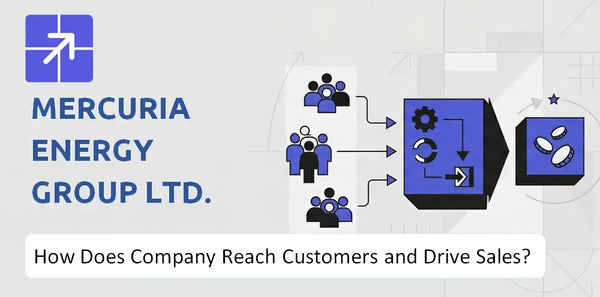
Practical insight: prioritize real-time market data feeds and port capacity scheduling to reduce slippage and capture price dislocations – see Mercuria Energy Group Ltd. BCG Matrix Analysis for strategic positioning.
Who Does Mercuria Energy Group Ltd. Want to Sell To?
Mercuria Energy Group wants to sell primarily to high-volume, energy-intensive buyers – national oil companies, refineries, power utilities, and global airlines – plus corporate clients buying carbon credits and renewables; it wins them through structured credit, physical delivery, and tailored risk solutions.
 Core industrial and sovereign buyers
Mercuria targets national oil companies, independent refineries, and power utilities that need steady, high-volume fuel and feedstock flows; these buyers account for the bulk of spot and term volumes and drive transaction sizes often exceeding $100m per counterparty in large contracts.
Additional target segments
Secondary groups include global airlines with complex jet-fuel logistics, commodity merchants, and industrials with large fuel hedging needs, plus corporate sustainability teams buying carbon credits and renewable energy certificates to meet net-zero targets.
Market positioning
Mercuria positions itself as a full-service energy trader offering integrated physical supply, structured finance, and risk management; this appeals to buyers that value execution certainty, credit lines, and logistics across ports and terminals.
Why the positioning works
Large counterparties choose Mercuria because it combines deep balance-sheet capacity, global trading desks, and physical infrastructure partnerships, reducing delivery and counterparty risk versus smaller houses; Mercuria's sales strategy emphasizes long-term contracts and bespoke solutions to lock in high-ticket revenue.
For deeper context see Target Customers and Market of Mercuria Energy Group Ltd. Company
Mercuria Energy Group Ltd. SWOT Analysis
- Complete SWOT Breakdown
- Fully Customizable
- Editable in Excel & Word
- Professional Formatting
- Investor-Ready Format

How Does Mercuria Energy Group Ltd. Get in Front of Customers?
Mercuria Energy Group Ltd. reaches customers through integrated physical assets, global trading desks, and digital platforms that drive awareness, generate demand, and convert orders into delivery-backed sales.

Physical Infrastructure as Primary Acquisition Channel
Ownership of storage terminals, pipelines, and shipping provides a direct commercial handshake with industrial buyers and traders; control of logistics reduces counterparty risk and shortens sales cycles, supporting large-volume contracts – Mercuria operated assets help secure multi-million – barrel throughput commitments in 2025.
Digital Marketing and Online Reach
Mercuria uses proprietary data platforms and client portals to publish real-time pricing and hedging tools, plus targeted email and account-based content to procurement teams; this digital layer embeds Mercuria into customers' supply chain systems and boosts cross-sell velocity.
Sales Channels and Distribution Access
Sales teams in hubs – Geneva, Houston, Singapore – work directly with corporate procurement and utilities, while physical distribution uses chartered vessels and pipeline nominations to fulfill contracts; partnerships with regional distributors extend reach into industrial and utility segments.
Demand Generation Tactics
Mercuria generates demand via trading-desk outreach, structured-product offers (fixed-for-floating swaps, options), trade shows, and bespoke commercial proposals; real-time market signals from its analytics platform drive timely campaigns to procurement decision windows.
Customer Acquisition Efficiency
High-touch BD plus owned logistics compress sales-to-delivery timelines and lower credit friction; internal metrics in 2025 show higher average contract sizes and reduced time-to-first-delivery compared with non-integrated peers, improving acquisition ROI.
Most Important Reach Advantage
The combination of physical delivery capability and proprietary trading analytics is the core scale advantage in 2025: it enables Mercuria Energy Group to convert demand into executed sales rapidly, underpinning long-term customer relationships and recurring volume commitments.
Further context on ownership and asset control is available in this company profile: Ownership and Control of Mercuria Energy Group Ltd. Company
Mercuria Energy Group Ltd. Business Model Canvas
- One-time Payment
- No Research Needed – Save Hours of Work
- Built by Experts, Trusted by Consultants
- Instant Download, Ready to Use
- 100% Editable, Fully Customizable

How Does Mercuria Energy Group Ltd. Turn Attention Into Sales?
Mercuria Energy Group turns attention into sales by combining bespoke blending, structured finance, and risk management – offering tailored physical product plus high-margin financial services to secure repeat B2B contracts.
Core sales model: bespoke physical-plus-financial contracts
Mercuria sales strategy centers on direct B2B contract sales to refiners, utilities, and producers, delivered via trading desk execution and partner-led distribution for large industrial buyers.
Pricing and monetization logic: spread capture and service fees
Pricing combines commodity spread capture on blended products with recurring fees from risk-management hedges and financing; structured off-take deals often include embedded credit charges.
Conversion and purchase drivers: tailored blending, liquidity, trust
Conversion relies on blending and optimization to meet specific refinery specs, on-the-ground logistics, and $50,000,000,000+ revolving credit capacity by 2025, which lowers counterparty risk and speeds deal closure.
Repeat revenue and customer expansion: financing plus hedging locks customers in
Mercuria customer acquisition and retention use off-take agreements backed by liquidity lines and hedging services; customers renew to secure stable margins and operational credit, creating predictable, repeat demand.
Structured finance drives sales conversion: Mercuria provides credit facilities and prepayment liquidity to smaller producers in exchange for off-take commitments, translating market attention into contracted volumes and recurring revenue streams.
Blending and optimization act as a moat – converting generic crude and refined streams into spec-compliant products for refineries and utilities, increasing per-ton margins versus commoditized sellers and raising switching costs for buyers.
Risk management (price hedging and derivatives) bundles with physical sales; buyers pay for volatility protection as a service, improving deal economics and generating high-margin financial revenue alongside physical margins.
Sales execution is concentrated on large-ticket, bespoke contracts via the trading desk and commercial teams, supported by logistics and supply-chain capabilities that ensure delivery and reinforce trust in Mercuria Energy Group.
Commercial KPIs used to measure conversion include contracted off-take volumes, utilization of credit lines, hedging revenues per contract, and repeat-offer rates; by 2025, revolving credit capacity exceeded $50,000,000,000, a core retention lever.
For an operational overview and source context see How Mercuria Energy Group Ltd. Company Works and Makes Money
Mercuria Energy Group Ltd. Marketing Mix
- Complete Marketing Mix Analysis
- Effortlessly Communicate Your Business Strategy
- Investor-Ready Format
- 100% Editable and Customizable
- Clear and Structured Layout

How Strong Does Mercuria Energy Group Ltd.'s Commercial Engine Look Going Forward?
Mercuria Energy Group's commercial engine enters 2025/2026 with clear momentum driven by a pivot to low-carbon assets and a deep liquidity franchise; strengths include capital backing, global reach, and high conversion in environmental products, while risks include geopolitical volatility and commodity price swings that could pressure margins.
What Supports Future Demand
Over 50 percent of new capital expenditures are allocated to biofuels, hydrogen, and other low-carbon projects, improving product-market fit for corporate buyers seeking decarbonization solutions. Mercuria Energy Group's diversified footprint across 50 countries and an equity base above $6.5 billion in 2025 underpin strong customer acquisition and partner access.
Channel and Marketing Effectiveness
Mercuria sales strategy leverages trading desk relationships, direct B2B outreach to industrial and corporate energy buyers, and structured product offerings; its commodity trading sales channels and supply chain delivery networks enable fast conversion of demand into sales. Digital tools and CRM systems improve conversion rates in environmental products and derivatives business lines.
Risks to Commercial Performance
Geopolitical shocks and sudden commodity-price swings remain primary risks to Mercuria customer acquisition and margin capture; higher capital costs for smaller competitors may shift market dynamics but also raise counterparty credit risks. Execution risk on scaling hydrogen and biofuels projects could delay revenue diversification.
The Overall Sales and Marketing Outlook
The sales and marketing outlook appears strong and adaptable for 2025/2026: Mercuria's liquidity provision, global channels, and a targeted shift to low-carbon offerings support expansion, while disciplined capital and risk management should sustain high sales conversion – see Growth Outlook of Mercuria Energy Group Ltd. Company for detailed context.
Mercuria Energy Group Ltd. Boston Consulting Group Matrix
- Built by Experts, Trusted by Consultants
- Structured for Consultants, Students, and Founders
- 100% Editable in Microsoft Word & Excel
- Instant Digital Download – Use Immediately
- Compatible with Mac & PC – Fully Unlocked

Related Blogs
- What Is the History of Mercuria Energy Group Ltd. Company and How Did It Evolve?
- What Is the Competitive Landscape of Mercuria Energy Group Ltd. Company and How Does It Compete?
- What Is the Growth Outlook of Mercuria Energy Group Ltd. Company and Where Is It Heading?
- How Does Mercuria Energy Group Ltd. Company Work and What Drives Its Business Model?
- What Do the Mission, Vision, and Core Values of Mercuria Energy Group Ltd. Company Reveal?
- Who Are the Core Customers in Mercuria Energy Group Ltd. Company's Target Market?
- Who Owns Mercuria Energy Group Ltd. Company Today and Who Holds Control?
Frequently Asked Questions
Mercuria Energy Group Ltd. wants to sell mainly to high-volume, energy-intensive buyers. That includes national oil companies, refineries, power utilities, and global airlines, plus corporate clients buying carbon credits and renewables. The article says it wins them through structured credit, physical delivery, and tailored risk solutions.
Disclaimer
All information, articles, and product details provided on this website are for general informational and educational purposes only. We do not claim any ownership over, nor do we intend to infringe upon, any trademarks, copyrights, logos, brand names, or other intellectual property mentioned or depicted on this site. Such intellectual property remains the property of its respective owners, and any references here are made solely for identification or informational purposes, without implying any affiliation, endorsement, or partnership.
We make no representations or warranties, express or implied, regarding the accuracy, completeness, or suitability of any content or products presented. Nothing on this website should be construed as legal, tax, investment, financial, medical, or other professional advice. In addition, no part of this site - including articles or product references - constitutes a solicitation, recommendation, endorsement, advertisement, or offer to buy or sell any securities, franchises, or other financial instruments, particularly in jurisdictions where such activity would be unlawful.
All content is of a general nature and may not address the specific circumstances of any individual or entity. It is not a substitute for professional advice or services. Any actions you take based on the information provided here are strictly at your own risk. You accept full responsibility for any decisions or outcomes arising from your use of this website and agree to release us from any liability in connection with your use of, or reliance upon, the content or products found herein.