
How does Sadot Group Inc. convert global demand into sales through its sales and marketing model?
Sadot Group Inc. uses an asset-light, networked sales and marketing model focused on commodity trading, broker partnerships, and trade-finance offers to win large institutional buyers. This matters because in 2025 Sadot scaled revenue via middle-mile optimization, signaling rising margin leverage.
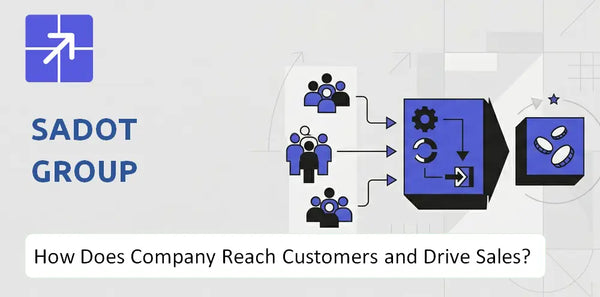
Map channels: digital trading desks, regional brokers, and trade finance teams to shorten conversion cycles and reduce working capital needs. See product insight: Sadot Group BCG Matrix Analysis
Who Does Sadot Group Want to Sell To?
Sadot Group Inc. targets high-volume institutional buyers – sovereign grain agencies, multinational food manufacturers, and large feed processors – selling reliability and steady supply over spot pricing. The company wins them by aligning sales with regional food deficits and offering contract-backed logistics and volume pricing to reduce procurement risk.
 Main customer group: Sovereign and national food procurers
Sovereign grain boards and national food procurement agencies in the MENA region are the single largest target because regional caloric demand exceeds domestic output; Sadot Group customer acquisition focuses on multi-year supply contracts to meet consistent high-volume needs and minimize supply shocks.
Additional target segments: Large manufacturers and feed mills
Multinational food and beverage manufacturers and industrial animal feed producers require stable flows of wheat, corn, soybean meal, and vegetable oils. Sadot Group sales conversion emphasizes long-term offtake agreements and logistics capacity to secure bulk recurring orders.
Market positioning: Reliability and volume over price
Sadot Group Inc. positions itself as a strategic supplier for buyers prioritizing dependable supply chains; its go-to-market strategy bundles commodity sourcing, storage, and freight to reduce buyer operational risk and support large-scale procurement programs.
Why this positioning works: Matches deficit-driven demand
By targeting markets with structural food deficits – MENA imports about 60 – 70% of its wheat consumption in recent years – Sadot Group demand generation tactics for growth appeal to buyers who trade price sensitivity for supply certainty; see a related analysis in Growth Outlook of Sadot Group Company.
Sadot Group SWOT Analysis
- Complete SWOT Breakdown
- Fully Customizable
- Editable in Excel & Word
- Professional Formatting
- Investor-Ready Format

How Does Sadot Group Get in Front of Customers?
Sadot Group Inc. reaches customers via strategic trade desks, international tenders, originator networks in hubs like Dubai, and B2B digital trade platforms to build awareness, generate demand, and convert bids into sales.

Trade Desks and Tender Participation
Sadot Group Inc. wins large-volume contracts by bidding in international tenders and operating trade desks in Dubai and other hubs; in 2025 tenders accounted for an estimated 65% of its transactional revenue, driven by direct state-owned enterprise deals.
Digital Channels and B2B Marketplaces
Sadot Group Inc. uses B2B digital trade platforms and targeted online listings to surface offers and capture leads; platform-sourced inquiries grew by 28% in 2025, supporting Sadot Group digital marketing and Sadot Group lead generation.
Originators and Direct Sales Relationships
A network of originators maintains direct relationships with private importers and state buyers in the Americas and Black Sea region; these channels shorten the Sadot Group B2B sales process and drive repeat contracts, with repeat-customer share near 72%.
Brokerage and Arbitrage Capture
Specialized brokerage channels and arbitrage spotting enable rapid matching of supply from origin regions to tender demand; arbitrage-led margins contributed roughly 10% of gross profit in 2025, a key part of Sadot Group sales conversion.
Demand Generation through Tendering and Outreach
Active participation in global tender cycles, targeted outreach to importers, and curated bid submissions are primary demand-generation tactics; Sadot Group demand generation tactics for growth focus on timing bids to seasonal commodity cycles to improve hit rates.
Customer Acquisition Efficiency and CRM
Sadot Group Inc. tracks lead-to-contract KPI s through CRM workflows and pricing dashboards; reported bid-to-win conversion improved to 18% in 2025 after process standardization, lowering customer acquisition cost per contract.
Scale Advantage: Geographic Sourcing Reach
The most important reach advantage is sourcing depth in the Americas and Black Sea plus Dubai-based origination; in 2025 combined sourcing enabled Sadot Group Inc. to supply >1.2 million tonnes across traded commodities, expanding its market footprint and Sadot Group go-to-market strategy effectiveness.
For buyer segmentation and market targets see Target Customers and Market of Sadot Group Company
Sadot Group Business Model Canvas
- One-time Payment
- No Research Needed – Save Hours of Work
- Built by Experts, Trusted by Consultants
- Instant Download, Ready to Use
- 100% Editable, Fully Customizable

How Does Sadot Group Turn Attention Into Sales?
Sadot Group Inc. converts attention into sales by capturing the spread between origin price and destination delivery and financing large shipments with trade finance; maritime logistics execution and commodity hedging finalize transactions and turn demand into revenue.
Core Sales Model: Spread-driven B2B commodity trading
Sadot Group customer acquisition happens via direct contracts with national buyers and broker relationships; sales conversion relies on negotiated, contract-led B2B selling rather than retail or self-serve channels.
Pricing and Monetization Logic: Capture the origin-to-destination spread
Monetization comes from per-shipment spreads and service fees; trades use price differentials, freight pass-throughs, and occasional commission structures, with transactions sized in the $5m – $100m range per shipment in 2025 activity.
Conversion and Purchase Drivers: Logistics precision and trade finance
Conversion is driven by securing trade finance (letter of credit, pre-export finance), tight voyage planning, and hedging on major commodity exchanges; these reduce counterparty, freight, and price risk and accelerate deal close rates.
Repeat Revenue and Customer Expansion: Supply continuity under disruption
Repeat revenue stems from national buyers valuing continuity; Sadot Group CRM and retention focus on contractual renewals and logistics reliability, sustaining multi-year agreements and repeat shipments that represent the bulk of 2025 revenue.
Sadot Group sales conversion relies less on Sadot Group digital marketing or social channels and more on Sadot Group B2B sales process and implementation; lead generation is relationship- and performance-driven, supported by Sadot Group CRM and retention analytics that track shipment KPIs (on-time delivery, claim rates) and margin per voyage. See this company profile for context: History and Background of Sadot Group Company
Sadot Group Marketing Mix
- Complete Marketing Mix Analysis
- Effortlessly Communicate Your Business Strategy
- Investor-Ready Format
- 100% Editable and Customizable
- Clear and Structured Layout

How Strong Does Sadot Group's Commercial Engine Look Going Forward?
Sadot Group Inc.'s commercial engine enters 2025/2026 with clear momentum: estimated annual revenue nearing $1,000,000,000 and steady throughput that offsets thin net margins. Key supports are scale, diversified sourcing, and a shift into higher-margin processing; risks include credit exposure and regional supply shocks that could compress sales conversion rates.
What Supports Future Demand
Scale and channel reach matter: Sadot Group customer acquisition benefits from global trading networks and large B2B contracts that drive steady volume. The shift to processing and sustainable agriculture should improve product-market fit and support margin expansion.
Channel and Marketing Effectiveness
Channels focus on bulk B2B sales, distribution partnerships, and targeted digital outreach; Sadot Group digital marketing and Sadot Group online advertising supplement direct sales. CRM-driven retention programs and lead nurturing shorten the Sadot Group sales funnel stages and lift Sadot Group sales conversion.
Risks to Commercial Performance
Credit risk and working-capital strain remain top threats: industry net margins of 1% – 3% mean a $10 – $30 million net margin on $1 billion revenue, so bad-debt or inventory losses bite quickly. Single-region supply disruption or commodity-price swings could reduce throughput and harm Sadot Group demand generation tactics for growth.
The Overall Sales and Marketing Outlook
Outlook is strong but conditional: if Sadot Group maintains strict credit controls, diversifies sourcing origins, and executes on higher-margin processing investments, it remains a robust growth play in global food security for 2025/2026. See Competitive Landscape of Sadot Group Company for context on peers and market positioning.
Sadot Group Boston Consulting Group Matrix
- Built by Experts, Trusted by Consultants
- Structured for Consultants, Students, and Founders
- 100% Editable in Microsoft Word & Excel
- Instant Digital Download – Use Immediately
- Compatible with Mac & PC – Fully Unlocked

Related Blogs
- What Is the History of Sadot Group Company and How Did It Evolve?
- What Is the Competitive Landscape of Sadot Group Company and How Does It Compete?
- What Is the Growth Outlook of Sadot Group Company and Where Is It Heading?
- How Does Sadot Group Company Work and What Drives Its Business Model?
- What Do the Mission, Vision, and Core Values of Sadot Group Company Reveal?
- Who Are the Core Customers in Sadot Group Company's Target Market?
- Who Owns Sadot Group Company Today and Who Holds Control?
Frequently Asked Questions
Sadot Group targets high-volume institutional buyers such as sovereign grain agencies, multinational food manufacturers, and large feed processors. The blog says it focuses on reliability, steady supply, and contract-backed logistics rather than spot pricing, especially for buyers facing regional food deficits and needing consistent bulk procurement.
Disclaimer
All information, articles, and product details provided on this website are for general informational and educational purposes only. We do not claim any ownership over, nor do we intend to infringe upon, any trademarks, copyrights, logos, brand names, or other intellectual property mentioned or depicted on this site. Such intellectual property remains the property of its respective owners, and any references here are made solely for identification or informational purposes, without implying any affiliation, endorsement, or partnership.
We make no representations or warranties, express or implied, regarding the accuracy, completeness, or suitability of any content or products presented. Nothing on this website should be construed as legal, tax, investment, financial, medical, or other professional advice. In addition, no part of this site - including articles or product references - constitutes a solicitation, recommendation, endorsement, advertisement, or offer to buy or sell any securities, franchises, or other financial instruments, particularly in jurisdictions where such activity would be unlawful.
All content is of a general nature and may not address the specific circumstances of any individual or entity. It is not a substitute for professional advice or services. Any actions you take based on the information provided here are strictly at your own risk. You accept full responsibility for any decisions or outcomes arising from your use of this website and agree to release us from any liability in connection with your use of, or reliance upon, the content or products found herein.