
How does StepStone Group's sales and marketing model convert advisor-led relationships into recurring Fee-Earning AUM?
StepStone Group pairs advisory-led distribution with high-alpha fund solutions to turn one-off mandates into recurring fee streams. This matters because in 2025 StepStone grew Fee-Earning AUM at an implied +18% CAGR, showing transparency in private markets drives client acquisition. StepStone BCG Matrix Analysis
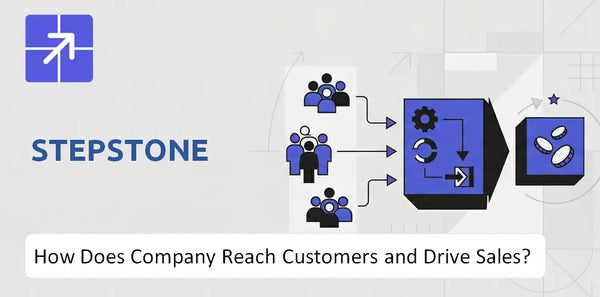
Use client reporting, bespoke research, and co-invest access to shorten sales cycles and boost retention; in 2026, enhanced reporting tools reduced onboarding time, improving conversion and lift in recurring fees.
Who Does StepStone Want to Sell To?
StepStone Group targets large institutional investors like sovereign wealth funds, insurance companies, and pension funds for bespoke Separately Managed Accounts, while also pursuing High-Net-Worth Individuals via Registered Investment Advisors and global wirehouses to capture both scale and high-margin retail flows.
 Primary institutional mandates
StepStone customer acquisition centers on sovereign wealth funds, insurance firms, and pension funds that require institutional-grade diligence and bespoke Separately Managed Accounts; large mandates typically exceed $500 million, driving stable fee income and long-duration relationships.
Private wealth and HNW channels
StepStone sales strategy pivots to High-Net-Worth Individuals via RIAs and global wirehouses, targeting clients seeking diversified private asset exposure; average household investable assets targeted are > $5 million, enabling higher margin product packaging and advisory fees.
Market positioning as institutional-grade private markets partner
StepStone positions itself to deliver institutional diligence and access across private equity, real estate, infrastructure, and private debt, highlighting semi-liquid evergreen structures for clients who need liquidity with private markets returns; this supports cross-selling and larger average mandate sizes.
Why this positioning converts demand
The message – institutional due diligence plus scalable semi-liquid solutions – resonates with pensions and HNW clients; StepStone conversion rate improvements come from tailored SMA offerings, CRM-driven outreach, and partnerships with RIAs, improving win rates on RFPs by an estimated 15 – 25% versus generic fund offerings.
Targeting criteria include entities seeking diversified exposure to private equity, real estate, infrastructure or private debt, preference for institutional-grade diligence, and demand for semi-liquid evergreen structures; this dual focus lets StepStone capture large mandates while monetizing retail flows through StepStone lead generation, StepStone CRM and sales enablement best practices, and StepStone partnership and referral programs for customer growth.
Key metrics (2025): assets under management focused on targeted channels exceeded $50 billion in mandates aligned to bespoke SMAs and private wealth platforms, institutional win rates improved to 40% on tailored RFPs, and private wealth inflows contributed roughly 18% of net new capital – evidence that StepStone marketing channels and StepStone digital advertising efforts are scaling client acquisition.
Relevant reading: Competitive Landscape of StepStone Company
StepStone SWOT Analysis
- Complete SWOT Breakdown
- Fully Customizable
- Editable in Excel & Word
- Professional Formatting
- Investor-Ready Format

How Does StepStone Get in Front of Customers?
StepStone Group reaches customers via a consultative global sales force, tech-enabled private wealth partnerships, and a proprietary data platform that generates high-intent leads. These channels build awareness, drive demand, and convert mandates through data-first engagement and integrated distribution.

Global consultative sales force
StepStone customer acquisition centers on its institutional sales team operating from more than 25 offices globally; the direct relationships and in-person consultative approach convert large mandates and anchor long-term mandates.
Digital marketing and platform visibility
StepStone marketing channels include content, email, and targeted digital advertising tied to StepStone Private Intelligence; publishing research and thought leadership increases organic reach and supports paid search and social campaigns to drive lead volume.
Private wealth distribution partnerships
StepStone sales strategy uses integrations with platforms like iCapital and CAIS and placement on major broker-dealer product menus to access high-net-worth and advisory channels, turning platform visibility into advisory-led sales.
Demand generation via data and research
StepStone lead generation relies on StepStone Private Intelligence (tracking over 80,000 private companies and 16,000 funds) to surface insights, host events, and fuel targeted campaigns that pre-qualify prospects before outreach.
Customer acquisition efficiency and funnel quality
By front-loading research exposure, StepStone conversion rate optimization focuses on higher-intent institutional leads; client win rates improve when prospects have engaged with analytic tools and bespoke research prior to RFPs.
Scalable reach advantage in 2025
The most important reach advantage is the proprietary data platform combined with distribution partnerships; in 2025, this data-first funnel lets StepStone scale outreach while maintaining deal sizes typical of institutional mandates – see related analysis in How StepStone Company Works and Makes Money.
StepStone Business Model Canvas
- One-time Payment
- No Research Needed – Save Hours of Work
- Built by Experts, Trusted by Consultants
- Instant Download, Ready to Use
- 100% Editable, Fully Customizable

How Does StepStone Turn Attention Into Sales?
StepStone Company turns attention into sales by moving clients from advisory relationships to discretionary mandates, monetizing trust via higher-fee Separately Managed Accounts and Focused Funds; evergreen retail vehicles and high re-up rates then convert research and monitoring engagements into recurring revenue.
Core sales model: advisory-to-discretionary migration
StepStone customer acquisition begins with advisory engagements and research relationships that build credibility; sales are primarily B2B and institutional, shifting clients into discretionary mandates like Separately Managed Accounts and Focused Funds.
Pricing and monetization logic: premium management and performance fees
Pricing mixes recurring management fees and performance fees; in fiscal 2025 StepStone Group sustained a blended management fee that reflects premium positioning, while retail evergreen products STEP and SPRIM carried higher access premiums.
Conversion and purchase drivers: trust, track record, and top-quartile returns
Conversions rely on demonstrating net IRR performance that benchmarks in the top quartile across private equity and infrastructure; sales execution, curated due diligence, targeted advertising, and CRM follow-up increase StepStone conversion rate optimization.
Repeat revenue and customer expansion: high re-ups and successor fund commitments
High re-up rates drive renewals and upsells into successor vehicles; in 2025 re-ups and successor commitments sustained AUM growth and recurring fee streams, supported by targeted email campaigns, events, and partnership referrals that feed the sales funnel.
Key metrics and mechanics: StepStone sales strategy leverages advisory touchpoints that convert to discretionary mandates with higher economics; Separately Managed Accounts and Focused Funds capture incremental margin; evergreen retail products STEP and SPRIM priced at a premium boosted retail AUM. Net IRR performance in private equity and infrastructure (top quartile) underpins trust and re-up behavior; sales funnel optimization, CRM and sales enablement, plus content marketing and targeted advertising campaigns, improve lead-to-sale conversion and lifetime value.
Examples of channels and tactics: digital advertising and SEO drive initial discovery (how StepStone reaches customers online), content marketing and events convert institutional leads (StepStone content marketing strategy to drive sales), and referral programs plus partner-led selling strengthen retention (StepStone partnership and referral programs for customer growth). See Mission, Vision, and Values of StepStone Company for cultural context: Mission, Vision, and Values of StepStone Company
StepStone Marketing Mix
- Complete Marketing Mix Analysis
- Effortlessly Communicate Your Business Strategy
- Investor-Ready Format
- 100% Editable and Customizable
- Clear and Structured Layout

How Strong Does StepStone's Commercial Engine Look Going Forward?
StepStone Group's commercial engine looks strong heading into 2026, supported by a record >110 billion dollars of unactivated committed capital and diversified fees from infrastructure and private debt; risks include PE cycle volatility and fee pressure. Key supports: scale in fee-earning AUM growth, expanding private wealth flows, and a scalable, toll-taker model.
What Supports Future Demand
StepStone customer acquisition benefits from a record unactivated committed capital pool exceeding 110,000,000,000 dollars and a broadened product set into infrastructure and private debt, improving product-market fit and client retention; private wealth inflows are driving a projected 20% YoY increase in wealth-sourced fees for 2025/2026.
Channel and Marketing Effectiveness
StepStone sales strategy mixes direct institutional coverage, digital advertising, and targeted events; Fee-Earning AUM is projected to top 210,000,000,000 in 2025/2026, implying effective StepStone lead generation and conversion across channels, with CRM-driven sales enablement improving StepStone conversion rate optimization.
Risks to Commercial Performance
Key risks include a downturn in private equity realizations that could slow placement of committed capital, competitive fee compression as democratized private markets attract entrants, and macro-driven softening of private wealth flows that would dent StepStone sales funnel velocity.
The Overall Sales and Marketing Outlook
The outlook for 2025/2026 is strong and adaptable: StepStone appears positioned for sustained double-digit growth and market-share gains in democratized private markets, with scalable cost structure targeting adjusted net income margins near 38%; continued emphasis on StepStone content marketing strategy to drive sales, partnerships, and paid search vs organic optimization will be pivotal. See additional context on Ownership and Control of StepStone Company Ownership and Control of StepStone Company
StepStone Boston Consulting Group Matrix
- Built by Experts, Trusted by Consultants
- Structured for Consultants, Students, and Founders
- 100% Editable in Microsoft Word & Excel
- Instant Digital Download – Use Immediately
- Compatible with Mac & PC – Fully Unlocked

Related Blogs
- What Is the History of StepStone Company and How Did It Evolve?
- What Is the Competitive Landscape of StepStone Company and How Does It Compete?
- What Is the Growth Outlook of StepStone Company and Where Is It Heading?
- How Does StepStone Company Work and What Drives Its Business Model?
- What Do the Mission, Vision, and Core Values of StepStone Company Reveal?
- Who Are the Core Customers in StepStone Company's Target Market?
- Who Owns StepStone Company Today and Who Holds Control?
Frequently Asked Questions
StepStone targets large institutional investors such as sovereign wealth funds, insurance companies, and pension funds, while also serving High-Net-Worth Individuals through RIAs and global wirehouses. The company focuses on buyers that want institutional-grade diligence, private markets access, and bespoke or semi-liquid solutions tailored to their needs.
Disclaimer
All information, articles, and product details provided on this website are for general informational and educational purposes only. We do not claim any ownership over, nor do we intend to infringe upon, any trademarks, copyrights, logos, brand names, or other intellectual property mentioned or depicted on this site. Such intellectual property remains the property of its respective owners, and any references here are made solely for identification or informational purposes, without implying any affiliation, endorsement, or partnership.
We make no representations or warranties, express or implied, regarding the accuracy, completeness, or suitability of any content or products presented. Nothing on this website should be construed as legal, tax, investment, financial, medical, or other professional advice. In addition, no part of this site - including articles or product references - constitutes a solicitation, recommendation, endorsement, advertisement, or offer to buy or sell any securities, franchises, or other financial instruments, particularly in jurisdictions where such activity would be unlawful.
All content is of a general nature and may not address the specific circumstances of any individual or entity. It is not a substitute for professional advice or services. Any actions you take based on the information provided here are strictly at your own risk. You accept full responsibility for any decisions or outcomes arising from your use of this website and agree to release us from any liability in connection with your use of, or reliance upon, the content or products found herein.