
How does Vivendi convert its content-led sales and marketing model into repeatable revenue?
Vivendi ties creative IP to owned channels to drive subscriptions, ad sales, and licensing, aiming to boost lifetime value and margin. The 2025 push to separate Canal+, Havas, and Lagardère signals a shift to pure-play monetization and clearer go-to-market focus.
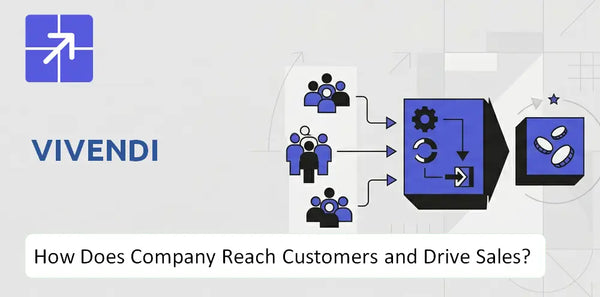
Vivendi nests content, distribution, and ad sales to shorten conversion paths and lift ARPU; expect tighter cross-sell after the 2025 asset split. See Vivendi BCG Matrix Analysis for portfolio plays.
Who Does Vivendi Want to Sell To?
Vivendi targets three high-value segments: the 27.8 million Canal+ subscribers who pay for premium sports and cinema, global corporate clients served by Havas, and travelers/readers reached via Lagardère and Hachette; post-2025 MultiChoice integration expands focus to the African middle class with a goal of >50 million households by 2030. The group wins them via subscription, B2B retainers, retail concessions, and data-driven personalization.
 Main customer: Premium entertainment subscribers
Canal+ is the core B2C audience: 27.8 million subscribers across Europe, Africa, and Asia as of 2025, prioritizing live sports and first-run cinema; Vivendi marketing strategy focuses on subscription bundles and exclusive rights to retain high ARPU users.
Additional targets: Brands and travel consumers
Havas targets thousands of global B2B clients needing integrated advertising and data-led marketing, while Lagardère (travel retail) and Hachette reach high-frequency travelers and readers in over 40 countries; these channels drive direct sales and cross-sell opportunities.
Market positioning: Integrated media & services platform
Vivendi positions itself as an end-to-end media and communications group combining Universal Music, Canal+, Havas, Lagardère/Hachette and MultiChoice to offer content, distribution, and marketing services; this enables a diversified Vivendi sales strategy across subscriptions, advertising, licensing, and retail.
Why this positioning works: scale, exclusivity, and data
Scale gives bargaining power for content rights and ad rates; exclusive sports and music catalogs boost conversion and renewal rates; combined CRM and data analytics across units improve personalization, lifting monetization and retention – key to Vivendi customer acquisition and converting streaming demand into revenue. Read a company analysis: Growth Outlook of Vivendi Company
Vivendi SWOT Analysis
- Complete SWOT Breakdown
- Fully Customizable
- Editable in Excel & Word
- Professional Formatting
- Investor-Ready Format

How Does Vivendi Get in Front of Customers?
Vivendi gets in front of customers via a hybrid model: digital platforms and apps plus physical retail and media sales teams. It uses Canal+ set-top boxes and myCanal, Havas agency relationships, Lagardère travel retail, and Gameloft mobile distribution to build awareness, generate demand, and convert viewers and users into subscribers and buyers.

Canal+ aggregation and owned platforms
Canal+ is the main acquisition channel, delivering content via proprietary set-top boxes and the myCanal streaming hub that bundles third-party services; this drives subscription sign-ups and retention across pay-TV and OTT.
Digital marketing and platform distribution
Vivendi leverages paid media, social, app-store optimization, and platform partnerships; Gameloft reaches > 55 million monthly active users, while myCanal and Canal+ support cross-promo campaigns to increase installs and conversions.
Retail, travel hubs, and direct sales
Lagardère operates 5,100 stores in airports and railway stations, giving front-and-center visibility and impulse revenue; physical retail complements direct-to-consumer and subscription sales for publishing and merchandising.
Demand generation: campaigns and high-touch agency sales
Havas runs global campaigns and uses Havas Villages to maintain CMO and procurement relationships; Vivendi combines branded content, events, promo bundles, and influencer activations to stimulate trial and renewals.
Customer acquisition efficiency and monetization
Integration across Canal+, myCanal, Gameloft and Havas improves cross-sell economics; focusing on subscriptions and in-app purchases increases lifetime value (LTV) and lowers payback periods versus one-off sales.
Most important reach advantage in 2025
Owned distribution (Canal+ set-top boxes and myCanal) plus Lagardère travel retail form a dual advantage: scalable digital reach and captive physical audiences, letting Vivendi convert streaming demand into revenue more reliably.
See related market and customer analysis: Target Customers and Market of Vivendi Company
Vivendi Business Model Canvas
- One-time Payment
- No Research Needed – Save Hours of Work
- Built by Experts, Trusted by Consultants
- Instant Download, Ready to Use
- 100% Editable, Fully Customizable

How Does Vivendi Turn Attention Into Sales?
Vivendi turns attention into sales by combining recurring subscriptions with high-margin transactions and IP recycling, using targeted bundles, retail optimization, and AI-driven client services to convert interest into steady revenue.
Core sales model: subscriptions plus transactional and B2B retainers
Vivendi sells via subscription streaming (Canal+), transactional retail (Lagardère Travel Retail), and agency retainers (Havas), plus licensing and content syndication across partners and telcos.
Pricing and monetization logic: bundles, high margins, and uplift pricing
Revenue mix relies on recurring subscription fees, high-margin one-off retail and licensing sales, and agency retainers; pricing uses sport/content bundles, localized retail premiums, and performance-linked agency fees.
Conversion and purchase drivers: exclusive content, data, and layout optimization
Canal+ keeps churn near 11.5% by bundling exclusive sports and local shows; Havas leverages AI performance marketing to turn briefs into multi-year retainers; Lagardère uses analytics to boost impulse buys.
Repeat revenue and customer expansion: cross-selling and IP flywheel
Hachette-to-Canal+ adaptations extend book lifecycles and cut acquisition costs; Havas raised average revenue per client by 4.8% in 2025 via integrated offers; Lagardère reported an 8% YoY spend-per-passenger uplift through merchandising tweaks.
Vivendi marketing strategy centers on cross-divisional monetization: using Universal Music Group and Hachette IP across Canal+ and retail channels lowers customer acquisition costs and increases lifetime value; see company context in History and Background of Vivendi Company.
Vivendi Marketing Mix
- Complete Marketing Mix Analysis
- Effortlessly Communicate Your Business Strategy
- Investor-Ready Format
- 100% Editable and Customizable
- Clear and Structured Layout

How Strong Does Vivendi's Commercial Engine Look Going Forward?
Vivendi's commercial engine looks resilient going into 2025 – 2026, driven by the demerger crystallizing value and targeted regional growth; key supports include Canal+ scale, Havas advertising momentum, and African expansion, while US streamer competition and emerging-market volatility could weaken growth.
Value crystallization from the demerger
The Canal+ demerger and planned listings in London and Johannesburg should unlock investor value and sharpen commercial incentives; Canal+ targets 31 million subscribers by year-end 2026, which supports recurring revenue and distribution leverage across Africa and Europe.
Havas and advertising recovery
Havas is projected to sustain organic growth near 3.5% in 2025 as global ad spend rebounds and ethical AI marketing drives premium services, reinforcing Vivendi marketing strategy and Vivendi advertising strategies for Universal Music Group.
Distribution, channels, and CRM effectiveness
Vivendi's mix of direct-to-consumer streaming (Canal+), music platforms (Universal), agency channels (Havas), and telecom partnerships provides broad reach; CRM and retention efforts plus data analytics appear to strengthen Vivendi customer acquisition and keep subscription renewal rates healthy.
Content monetization and pricing
Having multiple monetization levers – advertising, subscriptions, licensing, and travel-retail – supports revenue conversion; professional judgment projects consolidated revenues above 19.8 billion euros in 2025, helped by African expansion and a stabilized travel retail sector.
Risks from streaming competition and macro volatility
US-based streaming giants exert pricing and content pressure, potentially slowing subscriber growth and ARPU; emerging-market currency swings and advertising cyclicality pose downside to Vivendi sales strategy and Vivendi distribution network performance.
Operational and execution risks
Execution risk exists in separating specialized entities and in integrating ethical AI across Havas; if demerger timelines slip or Canal+ listings underperform, market value crystallization and agility gains may be delayed.
Overall sales and marketing outlook for 2025/2026
Outlook appears strong-to-mixed: the transition to specialized entities should make Vivendi more agile and responsive to regional shifts, supporting Vivendi sales strategy and Vivendi customer segmentation and personalization tactics, but substantial competitive and macro risks keep vigilance necessary. See company context in Mission, Vision, and Values of Vivendi Company.
Vivendi Boston Consulting Group Matrix
- Built by Experts, Trusted by Consultants
- Structured for Consultants, Students, and Founders
- 100% Editable in Microsoft Word & Excel
- Instant Digital Download – Use Immediately
- Compatible with Mac & PC – Fully Unlocked

Related Blogs
- What Is the History of Vivendi Company and How Did It Evolve?
- What Is the Competitive Landscape of Vivendi Company and How Does It Compete?
- What Is the Growth Outlook of Vivendi Company and Where Is It Heading?
- How Does Vivendi Company Work and What Drives Its Business Model?
- What Do the Mission, Vision, and Core Values of Vivendi Company Reveal?
- Who Are the Core Customers in Vivendi Company's Target Market?
- Who Owns Vivendi Company Today and Who Holds Control?
Frequently Asked Questions
Vivendi mainly sells to premium entertainment subscribers, global corporate clients, and travelers or readers. Canal+ serves the core B2C audience with sports and cinema, while Havas, Lagardère, and Hachette reach business buyers and consumers in travel and publishing channels. MultiChoice also expands its focus to the African middle class.
Disclaimer
All information, articles, and product details provided on this website are for general informational and educational purposes only. We do not claim any ownership over, nor do we intend to infringe upon, any trademarks, copyrights, logos, brand names, or other intellectual property mentioned or depicted on this site. Such intellectual property remains the property of its respective owners, and any references here are made solely for identification or informational purposes, without implying any affiliation, endorsement, or partnership.
We make no representations or warranties, express or implied, regarding the accuracy, completeness, or suitability of any content or products presented. Nothing on this website should be construed as legal, tax, investment, financial, medical, or other professional advice. In addition, no part of this site - including articles or product references - constitutes a solicitation, recommendation, endorsement, advertisement, or offer to buy or sell any securities, franchises, or other financial instruments, particularly in jurisdictions where such activity would be unlawful.
All content is of a general nature and may not address the specific circumstances of any individual or entity. It is not a substitute for professional advice or services. Any actions you take based on the information provided here are strictly at your own risk. You accept full responsibility for any decisions or outcomes arising from your use of this website and agree to release us from any liability in connection with your use of, or reliance upon, the content or products found herein.