
Who are Constellation Software's core customers in niche verticals like healthcare and public sector?
Constellation Software sells mission-critical VMS to small-to-midsize organizations in regulated, specialist industries; these customers deliver recurring, high-margin revenue. In 2025 the firm reported sustained ROIC above 20%, underscoring demand stability.
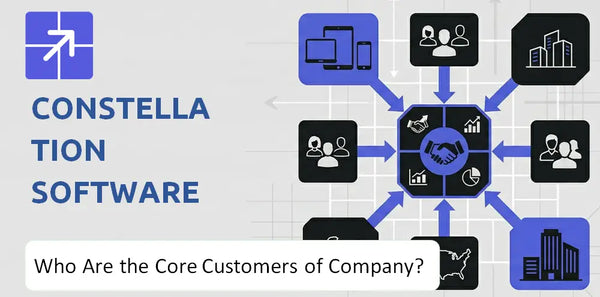
Focus on customers that need long-term compliance and uptime; retention drives cash for acquisitions. See product analysis: Constellation Software BCG Matrix Analysis
Who Is Constellation Software Trying to Win?
Constellation Software tries to win owners of vertical market software (VMS) businesses and mission-critical end-users across narrow industry niches, focusing on SMB VMS firms with $5 – 100 million revenue and operators in public transit, utilities, healthcare, and local government.
 Main customer group: SMB VMS owners
Constellation Software target market centers on small-to-mid VMS firms that produce must-have software for narrow industries; these acquisition targets typically generate between $5 million and $100 million in annual revenue and offer high-margin, recurring license and maintenance streams.
Secondary groups: larger software firms and partners
Secondary segments include larger enterprise software sellers, reseller partners, and adjacent ISVs where tuck-ins or partnerships can expand reach; Constellation prioritizes niche stickiness over chasing broad-market platforms.
Customer type and market role
Constellation Software core customers are predominantly businesses and institutions – mission-critical operators in over 100 verticals – including public sector software clients, healthcare customers, education, manufacturing, utilities, and local government IT teams.
Most important segment by revenue and stickiness
The highest-value segment is vertical leaders with embedded workflows and high retention – these vertical market software customers drive recurring maintenance revenue and allow Constellation to deploy a best-practices playbook to improve pricing and margins without disrupting culture; see this analysis on Ownership and Control of Constellation Software Company for context: Ownership and Control of Constellation Software Company
Constellation Software SWOT Analysis
- Complete SWOT Breakdown
- Fully Customizable
- Editable in Excel & Word
- Professional Formatting
- Investor-Ready Format

What Do Constellation Software's Customers Care About Most?
End-users in Constellation Software target market prioritize long-term stability, deep domain expertise, and uninterrupted operations; they buy software that minimizes switching risk and aligns with industry rules. Purchase drivers are reliability, tailored functionality for vertical market software customers, and a vendor committed to product longevity.

Stability over Flashy Features
End-users want software that runs reliably day after day for mission-critical tasks, not broad horizontal functionality. For municipal utilities or regional hospitals, uptime and predictable release cycles matter most.
Practical Buying Drivers: Fit and Support
Customers choose vendors who know sector rules (billing rules for water districts, scheduling for hospitals) and offer continuous support and low total cost of ownership. SMB software buyers in Constellation Software customer segments weigh vendor support and upgrade paths heavily.
Emotional Appeal: Trust and Predictability
Buyers derive confidence from a vendor that promises permanence and employee continuity, reducing anxiety about future disruptions. Public sector software clients prize vendors who understand regulatory responsibilities.
What Customers Value Most: Deep Vertical Expertise
Customers value narrowly tailored features that map to workflows and compliance. In Constellation Software core customers, value is measured in reduced manual work, regulatory compliance, and reliable support SLAs.
Loyalty and Repeat Demand Drivers
High switching costs, embedded data, and continuous vendor support create stickiness; retention is driven by steady product maintenance and industry-specific roadmaps. Analysts note renewal rates in well-run vertical portfolios often exceed 90%.
Why Customers Choose Constellation Software
Business sellers and buyers cite the permanent home philosophy as decisive: it avoids private equity-style cost cutting and resale, preserving software legacy and jobs. See the Sales and Marketing Strategy of Constellation Software Company for deeper context on customer targeting and retention tactics.
Constellation Software Business Model Canvas
- One-time Payment
- No Research Needed – Save Hours of Work
- Built by Experts, Trusted by Consultants
- Instant Download, Ready to Use
- 100% Editable, Fully Customizable

Where Is Demand Strongest for Constellation Software?
Demand concentrates in public sector and regulated industries, which account for approximately 50% of Constellation Software's revenue in fiscal 2025; North America and Europe lead, with rising Asia-Pacific traction as localized digital transformation grows.
Primary Market: Public and Regulated Sectors
Public sector software clients and regulated industries (utilities, transit, financial services) form the Constellation Software target market core because they need compliance-driven, mission-critical systems; together these vertical market software customers made about 50% of revenue in FY2025.
Secondary Markets: Geography and SMBs
North America and Europe remain strongest for Constellation Software core customers; SMB software buyers dominate the long tail, while Asia-Pacific is the fastest-growing regional market as SMBs and public clients adopt cloud-hybrid solutions.
Where Constellation Software Is Strongest
Decentralized operating groups such as Volaris and Harris drive strength: specialized ERP and vertical market offerings deliver recurring revenue and sticky customer relationships, with transit and utility customers showing high retention and upsell on cloud-hybrid transitions.
Fastest-Growing Demand Areas
Demand is accelerating for cloud-hybrid migrations of legacy on-prem systems in transit and utilities, and for compliance-integrated ERP in regulated industries; Asia-Pacific adoption and industry-specific automation are key growth drivers into 2026. Read more on market positioning in this Competitive Landscape of Constellation Software Company: Competitive Landscape of Constellation Software Company
Constellation Software Marketing Mix
- Complete Marketing Mix Analysis
- Effortlessly Communicate Your Business Strategy
- Investor-Ready Format
- 100% Editable and Customizable
- Clear and Structured Layout

How Does Constellation Software Keep Its Audience Growing?
Constellation Software keeps its audience growing through disciplined buy-and-hold acquisitions, aggressive reinvestment of free cash flow, and strong organic retention programs that expand adjacent segments and deepen customer relationships.
How Constellation Software Expands Its Customer Base
Constellation Software target market expansion relies on hundreds of small-scale acquisitions annually plus targeted spin-offs (Topicus.com, Lumine Group) to enter new geographies and verticals. The firm deploys capital from projected free cash flow of $2.4 billion+ in 2026 and leverages decentralized operating teams to win SMB software buyers, public sector software clients, and vertical market software customers.
Customer Retention Drivers
Retention rests on high-touch service and product stability; Constellation targets net maintenance revenue retention rates above 90 percent, minimizing churn among Constellation Software core customers. Localized support, long-tail vertical functionality, and continuous product reinvestment keep public sector and SMB software buyers renewing annually.
Loyalty, Repeat Demand, and Customer Depth
Customer depth grows via upsells, maintenance renewals, and cross-sell across niche suites; repeat demand is fueled by mission-critical workflows in healthcare, education, financial services, and manufacturing. Constellation Software customer segments show stickiness – SMB client characteristics include long-term contracts and high lifetime value.
The Strongest Customer-Base Growth Lever
The dominant lever is the relentless M&A pipeline combined with decentralized operators who sustain niche product-market fit; this lets Constellation Software deploy capital at scale while keeping responsiveness to vertical market software customers. For strategy context see Mission, Vision, and Values of Constellation Software Company.
Constellation Software Boston Consulting Group Matrix
- Built by Experts, Trusted by Consultants
- Structured for Consultants, Students, and Founders
- 100% Editable in Microsoft Word & Excel
- Instant Digital Download – Use Immediately
- Compatible with Mac & PC – Fully Unlocked

Related Blogs
- What Is the History of Constellation Software Company and How Did It Evolve?
- What Is the Competitive Landscape of Constellation Software Company and How Does It Compete?
- What Is the Growth Outlook of Constellation Software Company and Where Is It Heading?
- How Does Constellation Software Company Work and What Drives Its Business Model?
- How Does Constellation Software Company Reach Customers and Turn Demand into Sales?
- What Do the Mission, Vision, and Core Values of Constellation Software Company Reveal?
- Who Owns Constellation Software Company Today and Who Holds Control?
Frequently Asked Questions
Constellation Software's core customers are mainly owners of vertical market software businesses and mission-critical end-users in narrow industries. The blog highlights SMB VMS firms with $5-100 million in revenue, plus operators in public transit, utilities, healthcare, education, manufacturing, and local government.
Disclaimer
All information, articles, and product details provided on this website are for general informational and educational purposes only. We do not claim any ownership over, nor do we intend to infringe upon, any trademarks, copyrights, logos, brand names, or other intellectual property mentioned or depicted on this site. Such intellectual property remains the property of its respective owners, and any references here are made solely for identification or informational purposes, without implying any affiliation, endorsement, or partnership.
We make no representations or warranties, express or implied, regarding the accuracy, completeness, or suitability of any content or products presented. Nothing on this website should be construed as legal, tax, investment, financial, medical, or other professional advice. In addition, no part of this site - including articles or product references - constitutes a solicitation, recommendation, endorsement, advertisement, or offer to buy or sell any securities, franchises, or other financial instruments, particularly in jurisdictions where such activity would be unlawful.
All content is of a general nature and may not address the specific circumstances of any individual or entity. It is not a substitute for professional advice or services. Any actions you take based on the information provided here are strictly at your own risk. You accept full responsibility for any decisions or outcomes arising from your use of this website and agree to release us from any liability in connection with your use of, or reliance upon, the content or products found herein.