
How does Constellation Software's decentralized sales and marketing model convert niche demand into recurring sales?
Constellation Software sells through >1,000 autonomous vertical market units that use local, high-touch sales and low-cost digital retention to lock recurring revenue. This matters because in 2025 the firm reported sustained high-margin cashflows supporting a 25%+ ROIC signal across acquisitions.
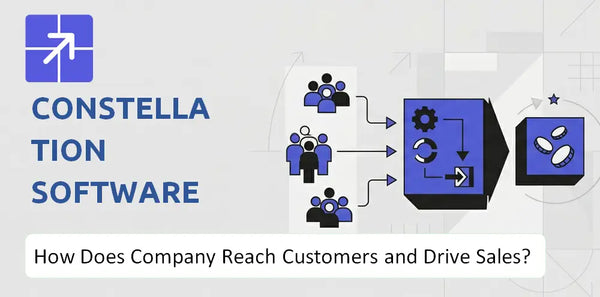
Practical insight: prioritize localized sales teams and product-led retention; target verticals where switching costs and regulation raise lifetime value. See Constellation Software BCG Matrix Analysis
Who Does Constellation Software Want to Sell To?
Constellation Software sells to mission-critical buyers in niche verticals – public transit, utilities, specialized retail, and local government – targeting functional heads and operational executives who prioritize stability and deep domain features; it wins by offering low-elasticity, high-switching-cost systems that become core operating platforms.
 Primary target: mission-critical operational leaders
Constellation Software customer acquisition focuses on department heads and operational executives in niche verticals where software is the core operating system; these buyers value long-term stability, regulatory compliance, and deep functionality. Win rate rises where demand is inelastic and switching costs exceed implementation budgets.
Additional segments: adjacent verticals and municipal buyers
Secondary targets include adjacent niches (e.g., specialized retail chains, utilities subsidiaries) and local government agencies that share similar operational needs; acquisitions expand reach into these long-tail markets and feed the sales funnel for Constellation Software.
Market positioning: mission-critical, niche dominance
Constellation Software sales strategy positions the firm as the stable vendor-of-record for vertical market software, emphasizing deep product fit over horizontal feature breadth; pricing and packaging reflect multi-year contracts and recurring maintenance revenue.
Why this positioning works: stickiness and low churn
The strategy converts demand into recurring revenue because customers face high cost of switching and low elasticity of demand; direct sales, channel partner strategy Constellation Software and targeted acquisitions yield customers that typically remain for decades, boosting lifetime value and predictable cash flows – see operational model in How Constellation Software Company Works and Makes Money.
Constellation Software SWOT Analysis
- Complete SWOT Breakdown
- Fully Customizable
- Editable in Excel & Word
- Professional Formatting
- Investor-Ready Format

How Does Constellation Software Get in Front of Customers?
Constellation Software reaches customers through localized, bottom-up go-to-market efforts: independent business-unit sales forces, industry-specific marketing, trade shows, and direct B2B outreach, supplemented by acquisitions that bring established customer bases and recurring revenue immediately.

Acquisitions as Primary Acquisition Channel
Constellation Software uses M&A as its main customer acquisition engine: by buying vertical market software (VMS) firms it gains immediate access to entrenched customers and recurring contracts, helping add >100 verticals by early 2026 and preserving low customer acquisition costs versus modern SaaS spend.
Digital Marketing and Online Reach
Digital channels are decentralized: individual business units run SEO, targeted paid search, email campaigns, and niche content aimed at vertical buyers; corporate-level digital branding is minimal compared with unit-driven lead generation.
Sales Channels and Distribution Access
Each business unit maintains its own direct sales force and channel partners tailored to the vertical; units sell via direct B2B, reseller networks, and integrations within industry ecosystems to shorten the sales funnel for Constellation Software solutions.
Demand Generation Tactics
Demand comes from trade shows, vertical conferences, case-study marketing, targeted outreach, and cross-sell after acquisitions; many units rely on product reputation and customer referrals rather than large-scale brand campaigns.
Customer Acquisition Efficiency
Acquisition-driven growth keeps customer acquisition cost low: instead of heavy paid media, Constellation often pays acquisition multiples to obtain customers with existing lifetime value and recurring revenue, improving payback periods versus greenfield SaaS sales.
Most Important Reach Advantage
The dominant advantage is scale through M&A plus localized sales: owning >100 verticals by early 2026 gives Constellation Software customer acquisition breadth few incumbents match, enabling highly efficient vertical penetration.
For governance and ownership context that shapes these go-to-market choices see Ownership and Control of Constellation Software Company.
Constellation Software Business Model Canvas
- One-time Payment
- No Research Needed – Save Hours of Work
- Built by Experts, Trusted by Consultants
- Instant Download, Ready to Use
- 100% Editable, Fully Customizable

How Does Constellation Software Turn Attention Into Sales?
Constellation Software turns attention into sales by selling mission-critical, vertical-market software that customers can't easily replace; it converts interest through targeted modules, strong pricing power, and a focus on net revenue retention to lock in recurring fees.
Core sales model: direct, acquisition-led, and specialist field teams
Sales rely on direct sales and acquired, specialist field teams that sell subscription and maintenance contracts into verticals; many business units use partner-led and channel strategies for local reach.
Pricing and monetization logic: recurring maintenance and SaaS-first
Pricing emphasizes recurring maintenance, SaaS fees, and modular add-ons; after acquisitions, pricing is often realigned upward to reflect mission-critical value and increase ARPU.
Conversion and purchase drivers: indispensability, fit, and sales execution
Conversion is driven by product fit for regulatory or operational pain points, strong renewal signals, and sales execution that packages modules aligned to customer workflows; trust and low switching risk speed decisions.
Repeat revenue and expansion: high retention and cross-sell
For fiscal 2025 Constellation Software reported total revenue of 11.2 billion dollars, with the majority from recurring maintenance and SaaS; renewal rates exceed 90 percent, and net revenue retention and module upsell drive predictable growth.
Key mechanics: acquisition-led demand generation and vertical lead pipelines feed a sales funnel where tailored demos, pricing realignment, and service contracts convert attention into recurring cash flow; see Growth Outlook of Constellation Software Company for more context: Growth Outlook of Constellation Software Company
Constellation Software Marketing Mix
- Complete Marketing Mix Analysis
- Effortlessly Communicate Your Business Strategy
- Investor-Ready Format
- 100% Editable and Customizable
- Clear and Structured Layout

How Strong Does Constellation Software's Commercial Engine Look Going Forward?
The commercial engine of Constellation Software looks resilient entering 2026 – 2027, driven by strong inorganic deal flow and stable cash conversion; modest organic growth and rising competition for larger VMS deals are potential headwinds.
What Supports Future Demand
Constellation Software customer acquisition benefits from deep vertical focus and portfolio diversity, enabling predictable cross-sell and renewal rates; brand trust in niche markets supports steady demand generation. The company deployed 2.4 billion dollars in capital in 2025, showing deal-sourcing strength that feeds long-term revenue growth.
Channel and Marketing Effectiveness
Channels mix direct sales, specialized channel partners, and account-level M&A-led expansion; this hybrid approach keeps the sales funnel for Constellation Software full. Marketing spends are lean relative to scale, and a ~22 percent Free Cash Flow margin in 2025 sustains reinvestment into demand-generation and sales enablement.
Risks to Commercial Performance
Main risks include intensifying competition for larger VMS deals, integration complexity as Constellation pursues bigger carve-outs, and modest organic growth of roughly 2 – 3 percent that limits internal revenue momentum. If acquisition pace slows, aggregate growth could compress the sales pipeline.
The Overall Sales and Marketing Outlook
Overall outlook is positive and adaptable: expect mid-teens Free Cash Flow per share growth in 2026 underpinned by disciplined operational oversight, carve-out driven scale, and unparalleled portfolio diversification. For more on target segments and go-to-market specifics see Target Customers and Market of Constellation Software Company.
Constellation Software Boston Consulting Group Matrix
- Built by Experts, Trusted by Consultants
- Structured for Consultants, Students, and Founders
- 100% Editable in Microsoft Word & Excel
- Instant Digital Download – Use Immediately
- Compatible with Mac & PC – Fully Unlocked

Related Blogs
- What Is the History of Constellation Software Company and How Did It Evolve?
- What Is the Competitive Landscape of Constellation Software Company and How Does It Compete?
- What Is the Growth Outlook of Constellation Software Company and Where Is It Heading?
- How Does Constellation Software Company Work and What Drives Its Business Model?
- What Do the Mission, Vision, and Core Values of Constellation Software Company Reveal?
- Who Are the Core Customers in Constellation Software Company's Target Market?
- Who Owns Constellation Software Company Today and Who Holds Control?
Frequently Asked Questions
Constellation Software targets mission-critical buyers in niche verticals like public transit, utilities, specialized retail, and local government. Its focus is on functional heads and operational executives who value stability, deep domain features, and software that becomes part of the core operating system.
Disclaimer
All information, articles, and product details provided on this website are for general informational and educational purposes only. We do not claim any ownership over, nor do we intend to infringe upon, any trademarks, copyrights, logos, brand names, or other intellectual property mentioned or depicted on this site. Such intellectual property remains the property of its respective owners, and any references here are made solely for identification or informational purposes, without implying any affiliation, endorsement, or partnership.
We make no representations or warranties, express or implied, regarding the accuracy, completeness, or suitability of any content or products presented. Nothing on this website should be construed as legal, tax, investment, financial, medical, or other professional advice. In addition, no part of this site - including articles or product references - constitutes a solicitation, recommendation, endorsement, advertisement, or offer to buy or sell any securities, franchises, or other financial instruments, particularly in jurisdictions where such activity would be unlawful.
All content is of a general nature and may not address the specific circumstances of any individual or entity. It is not a substitute for professional advice or services. Any actions you take based on the information provided here are strictly at your own risk. You accept full responsibility for any decisions or outcomes arising from your use of this website and agree to release us from any liability in connection with your use of, or reliance upon, the content or products found herein.