
How does Constellation Software scale by buying vertical-market software businesses and run them profitably?
Constellation Software buys and holds niche software firms, centralizes capital allocation, and preserves founder-led operations to drive steady margins and cash flow. By March 2026 it operated over 1,000 businesses across 100+ industries, showing repeatable small-ticket M&A works.
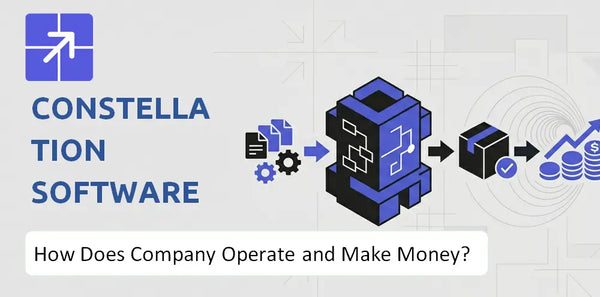
Focus on retention and margin improvement post-acquisition; tighter cross-sell is rare but operational discipline yields high returns. See Constellation Software BCG Matrix Analysis for product-level positioning.
What Does Constellation Software Actually Sell?
Constellation Software sells mission-critical, industry-specific software that runs core operations for niche businesses; customers pay for deeply integrated, reliable vertical market applications and associated support, maintenance, and hosting. The portfolio spans hundreds of independent brands delivering subscription and licence-based recurring revenue plus professional services.
 Core product offering: mission-critical vertical market software
Constellation Software delivers vertical market software tailored to narrow niches – examples include public transit scheduling, local government administration, and specialized medical billing – acting as the operating system for customer workflows. Revenue mixes include recurring subscriptions, maintenance contracts, licence fees, hosting and implementation services; in fiscal 2025 the group reported high recurring revenue contributing to overall stability.
Primary buyers: niche operators and public entities
Buyers are small-to-medium enterprises, public sector agencies, and specialist providers who need domain-focused systems that replace general-purpose software. Purchases are driven by operational dependency rather than price, creating high switching costs and low churn rates across micro-markets.
Customer value: reliability, domain depth, low replacement risk
Customers get software that encodes business rules and daily processes, reducing manual work and regulatory risk; typical install lifecycles exceed a decade, supporting steady maintenance and recurring revenue. This drives strong lifetime value and conversion of acquired companies to predictable cash flows.
Differentiators: decentralized brands and buy-and-hold M&A
Rather than a single brand, Constellation Software owns hundreds of independent vertical market leaders and uses a decentralized operating model to preserve domain expertise post-acquisition; the Constellation M&A strategy focuses on durable cash-generating businesses, contributing to consistently high margins and low churn. See Competitive Landscape of Constellation Software Company for comparisons.
Constellation Software SWOT Analysis
- Complete SWOT Breakdown
- Fully Customizable
- Editable in Excel & Word
- Professional Formatting
- Investor-Ready Format

How Does Constellation Software Run Its Business Day to Day?
Constellation Software runs day-to-day as a hyper-decentralized software conglomerate: hundreds of small operating units focus on product delivery and customer retention while corporate and six operating groups drive high-frequency acquisitions and capital allocation. Daily work splits between unit-level operational excellence using a shared playbook and group-level sourcing, due diligence, and integration of new vertical market software assets.

Decentralized operating model and governance
Managers in six operating groups run autonomous business units that own P&L and customer relationships. Corporate provides capital, acquisition oversight, and a decades-old playbook for margin improvement and retention.
Product and service delivery to customers
Customers access vertical market software via direct sales, renewals, and support channels maintained by local units; recurring subscriptions and maintenance drive predictable cash flows and high retention rates.
Development, sourcing, and product maintenance
Units develop and maintain niche vertical-market features; codebases remain largely localized, with operational best practices and incremental product roadmaps propagated through the corporate playbook.
Sales channels and distribution systems
Sales rely on direct relationships, renewals, channel partners in specific industries, and cross-selling inside operating groups; low churn and high lifetime value make direct channels efficient.
Key assets, systems, and partnerships
Critical assets include proprietary vertical market software, recurring maintenance contracts, and a distributed M&A sourcing network of hundreds of employees; corporate provides financing, tax, and legal support.
What makes the model work in practice
High-frequency, small-ticket acquisitions plus local unit autonomy create scale without central bureaucracy; in fiscal 2025 Constellation Software completed hundreds of acquisitions, many under $5,000,000, sustaining growth and margin expansion.
Daily capital allocation centers on identifying tuck-ins and deploying cash: hundreds of employees source deals, due diligence is standardized, and closing workflows prioritize speed to preserve seller relationships. See more on target markets in Target Customers and Market of Constellation Software Company.
Constellation Software Business Model Canvas
- One-time Payment
- No Research Needed – Save Hours of Work
- Built by Experts, Trusted by Consultants
- Instant Download, Ready to Use
- 100% Editable, Fully Customizable

How Does Revenue Flow Through Constellation Software?
Revenue at Constellation Software flows mainly from recurring maintenance and support fees and subscription-like contracts, turning steady customer demand for vertical market software into predictable cash. New acquisitions add recurring streams, and free cash flow from existing units funds further purchases.
Recurring maintenance and support: the backbone
Maintenance and support account for approximately 72 percent of turnover as of early 2026, creating a high-margin, predictable revenue base that underpins Constellation Software business model and supports valuation stability.
Transaction and professional services
Implementation, customization, and one-off licence sales and professional services provide incremental revenue and customer stickiness, complementing the recurring maintenance-led model and boosting near-term cash inflows.
Monetization via buy-and-build cash recycling
Constellation monetizes demand through software licences, ongoing support contracts, and services; the software conglomerate business model reinvests nearly all free cash flow into acquisitions rather than high payout policies.
Main drivers: recurring revenue and high cash conversion
By March 2026 annual revenue exceeded $11.5 billion, and the firm converts nearly 100 percent of adjusted net income into free cash flow, which funds Constellation Software acquisitions at disciplined hurdle rates, creating compounding growth across vertical market software portfolios. See Mission, Vision, and Values of Constellation Software Company
Constellation Software Marketing Mix
- Complete Marketing Mix Analysis
- Effortlessly Communicate Your Business Strategy
- Investor-Ready Format
- 100% Editable and Customizable
- Clear and Structured Layout

What Makes Constellation Software's Model Sustainable or Fragile?
Constellation Software's model is sustainable thanks to extreme diversification across vertical market software and high customer switching costs; concentrated risks are small but the law of large numbers and need to deploy billions annually create fragility as deal sizes grow. Structural strengths include decentralized ops and recurring revenue, while constraints are acquisition capacity and integration at scale.
Why diversification and switching costs matter
Revenue sits across hundreds of vertical market software businesses, so failure of one unit barely moves consolidated results; high switching costs (custom workflows, integrations) sustain recurring subscriptions and margins. This diversification plus long customer lifecycles underpins the Constellation Software business model.
Key assets and operating capabilities
Decentralized operating model, experienced local management teams, and a repeatable M&A playbook are core assets. In 2025 Constellation Software held roughly ~CAD 5.2 billion in cash and equivalents and generated free cash flow that funds acquisitions and buybacks, enabling continued rollout of the Constellation Software acquisitions strategy.
Main dependencies and constraints
Growth depends on sourcing and closing enough acquisition targets; by 2025 Constellation must deploy ~CAD 3 – 5 billion annually to move the needle, creating pressure to accept larger deal sizes and higher valuation multiples. Currency exposure, integration of larger platforms, and competition for quality vertical market software assets are binding constraints.
Durability assessment for 2025/2026
Professional judgment for 2025/2026: model remains highly sustainable driven by recurring revenue and a conservative capital allocation culture that avoids overpaying even with significant cash. Organic growth of 2 – 3% keeps margins predictable, while successful larger acquisitions and expansion into emerging markets provide a clear runway for continued capital compounding. See Ownership and Control of Constellation Software Company for governance context: Ownership and Control of Constellation Software Company
Constellation Software Boston Consulting Group Matrix
- Built by Experts, Trusted by Consultants
- Structured for Consultants, Students, and Founders
- 100% Editable in Microsoft Word & Excel
- Instant Digital Download – Use Immediately
- Compatible with Mac & PC – Fully Unlocked

Related Blogs
- What Is the History of Constellation Software Company and How Did It Evolve?
- What Is the Competitive Landscape of Constellation Software Company and How Does It Compete?
- What Is the Growth Outlook of Constellation Software Company and Where Is It Heading?
- How Does Constellation Software Company Reach Customers and Turn Demand into Sales?
- What Do the Mission, Vision, and Core Values of Constellation Software Company Reveal?
- Who Are the Core Customers in Constellation Software Company's Target Market?
- Who Owns Constellation Software Company Today and Who Holds Control?
Frequently Asked Questions
Constellation Software sells mission-critical, industry-specific vertical market software. The company serves niche businesses and public entities that need deeply integrated applications, plus support, maintenance, hosting, and implementation services. Its portfolio is made up of hundreds of independent brands with recurring subscription and licence-based revenue.
Disclaimer
All information, articles, and product details provided on this website are for general informational and educational purposes only. We do not claim any ownership over, nor do we intend to infringe upon, any trademarks, copyrights, logos, brand names, or other intellectual property mentioned or depicted on this site. Such intellectual property remains the property of its respective owners, and any references here are made solely for identification or informational purposes, without implying any affiliation, endorsement, or partnership.
We make no representations or warranties, express or implied, regarding the accuracy, completeness, or suitability of any content or products presented. Nothing on this website should be construed as legal, tax, investment, financial, medical, or other professional advice. In addition, no part of this site - including articles or product references - constitutes a solicitation, recommendation, endorsement, advertisement, or offer to buy or sell any securities, franchises, or other financial instruments, particularly in jurisdictions where such activity would be unlawful.
All content is of a general nature and may not address the specific circumstances of any individual or entity. It is not a substitute for professional advice or services. Any actions you take based on the information provided here are strictly at your own risk. You accept full responsibility for any decisions or outcomes arising from your use of this website and agree to release us from any liability in connection with your use of, or reliance upon, the content or products found herein.