
Who are Essential Utilities core customers across its regulated water, wastewater, and gas service territories?
Essential Utilities serves residential, municipal, and commercial customers across 10 states, with revenue tied to population and rate-base growth. This matters because in 2025 the company served 5.5 million residents and is expanding infrastructure to capture high-growth corridors.
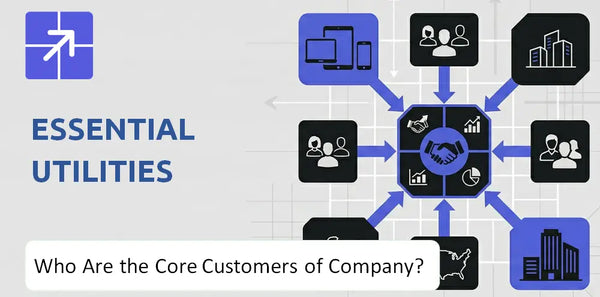
Focus on households and municipal contracts where aging systems and new housing drive capital deployment; see the Essential Utilities BCG Matrix Analysis for asset-level prioritization.
Who Is Essential Utilities Trying to Win?
Essential Utilities tries to win three core customer groups: residential households, commercial and industrial users, and municipal sellers of water/wastewater assets – residential accounts are the largest base by volume and revenue contribution.
 Main customer group: Residential households
Residential customers form roughly 70 percent of Essential Utilities customers in the water segment and the majority of the natural gas base, driving steady consumption and predictable recurring revenue across suburban and small-city service areas.
Secondary groups: Commercial and industrial users
Commercial and industrial customers require high-volume, high-reliability delivery; they account for disproportionate throughput and peak-demand revenue, especially from manufacturing, real estate, and large facilities in Essential Utilities' service territories.
Customer type and market role: Mixed consumer + institutional
Essential Utilities serves a mixed base: consumer households for steady retail billing, businesses for volume and margins, and institutions – chiefly municipal governments – as corporate sellers of assets and large-scale customers for water/wastewater operations.
Most important segment: Municipal asset transactions (strategic priority)
Winning municipal sellers enables rapid scale: purchases of aging municipal systems onboard thousands of end-users at once, expanding customer counts and regulated rate bases – a core growth lever discussed in How Essential Utilities Company Works and Makes Money.
Essential Utilities SWOT Analysis
- Complete SWOT Breakdown
- Fully Customizable
- Editable in Excel & Word
- Professional Formatting
- Investor-Ready Format

What Do Essential Utilities's Customers Care About Most?
In 2025 essential utilities customers prioritize safety, regulatory compliance, and stable pricing; they want reliably clean water, leak-free gas delivery, and predictable bills. Major purchase drivers are EPA compliance for PFAS and lead, pipeline safety, and digital billing plus real-time alerts.

Regulatory compliance and health safety
Water and wastewater customers demand PFAS removal and lead service line replacement to meet EPA rules; Essential Utilities committed $450,000,000 to PFAS remediation technology in 2025 to address clean drinking water needs.
Practical buying drivers: price and reliability
Residential customers essential utilities and commercial customers essential utilities choose providers for steady rates, efficient delivery, and minimal downtime; gas customers value the multi-decade pipeline replacement program that reduces leaks and improves pressure.
Emotional trust and community assurance
Homeowners and small businesses prefer utilities they trust for family safety and local resilience; seeing public investments in remediation and pipe upgrades builds confidence and pride in civic stewardship.
What customers value most
Across essential utilities customer segments and profiles the top valued outcomes are safe, compliant water, uninterrupted gas service, and predictable billing – backed by measurable investments and clear timelines.
Loyalty and repeat demand drivers
Retention hinges on consistent delivery, transparent rate-setting, and modern digital tools; mobile-first billing and real-time outage or leak notifications cut complaint volumes and churn risk.
Why customers choose Essential Utilities
The clearest reason essential utilities wins core customers essential utilities is delivering EPA-aligned remediation spending, a long-term pipeline replacement plan, and upgraded digital customer interfaces that match modern expectations. See Mission, Vision, and Values of Essential Utilities Company for context: Mission, Vision, and Values of Essential Utilities Company
Essential Utilities Business Model Canvas
- One-time Payment
- No Research Needed – Save Hours of Work
- Built by Experts, Trusted by Consultants
- Instant Download, Ready to Use
- 100% Editable, Fully Customizable

Where Is Demand Strongest for Essential Utilities?
Demand for Essential Utilities customers is strongest in Pennsylvania, which drives roughly 75 percent of net income and offers a stable regulatory base; growth hotspots are in southern and mid-Atlantic states where migration fuels new residential connections.
Main Market: Pennsylvania Anchors Demand
Pennsylvania concentrates the Essential Utilities target market and core customers essential utilities rely on, delivering ~75 percent of net income in 2025 and a predictable regulatory environment that supports steady capital recovery and rate filings.
Secondary Markets: Southern and Mid-Atlantic Growth
North Carolina and Texas show the fastest growth for residential customers essential utilities is targeting, with new connections growing above the national average due to population migration and housing starts in 2025.
Where Essential Utilities Is Strongest
Essential Utilities is strongest in regulated water and gas distribution reach in Pennsylvania and the Appalachia gas footprint; the revenue mix in 2025 remains weighted to water and regulated utilities, with gas benefiting from proximity to low-cost shale reserves.
Fastest-Growing Demand: Wastewater and Appalachian Gas
The wastewater segment is the primary growth channel in 2025 as small-to-mid municipalities seek divestiture and capital relief, while gas demand stays robust in the Appalachian region near shale gas supplies; municipalities and suburban homeowners are key buyer types. Read the company history for context: History and Background of Essential Utilities Company
Essential Utilities Marketing Mix
- Complete Marketing Mix Analysis
- Effortlessly Communicate Your Business Strategy
- Investor-Ready Format
- 100% Editable and Customizable
- Clear and Structured Layout

How Does Essential Utilities Keep Its Audience Growing?
Essential Utilities keeps its audience growing by combining organic infrastructure upgrades with targeted municipal acquisitions, expanding its customer footprint while raising rate base per customer through sustained capital spending and regulated retention benefits.
How Essential Utilities Expands Its Customer Base
Essential Utilities acquires municipal and smaller investor-owned systems with an annual acquisition target of 250,000,000 to 500,000,000 dollars, and invests 1,300,000,000 to 1,400,000,000 dollars annually in capital projects to connect adjacent residential customers and commercial customers essential utilities needs in expanded service areas.
Customer Retention Drivers
Regulated tariffs and service monopolies create structural retention; reliability investments and compliance-driven upgrades reduce outages and ensure predictable bills, lowering churn among primary essential utilities customers and stabilizing revenue per customer.
Loyalty, Repeat Demand, and Customer Depth
Residential customers essential utilities show high repeat demand because water and wastewater are non-discretionary; commercial customers essential utilities maintain long-term accounts via service-level contracts and regulatory continuity, deepening customer lifetime value.
Strongest Customer-Base Growth Lever
The most important growth lever is the combined effect of scale-driven municipal acquisitions and a 1.3B – 1.4B annual capex program that raises rate base per customer; by March 2026 Essential Utilities is projected to sustain a 8 – 10% compound annual growth rate in rate base, turning environmental mandates into predictable earnings.
For context on ownership and strategic control that supports this growth approach, see Ownership and Control of Essential Utilities Company
Essential Utilities Boston Consulting Group Matrix
- Built by Experts, Trusted by Consultants
- Structured for Consultants, Students, and Founders
- 100% Editable in Microsoft Word & Excel
- Instant Digital Download – Use Immediately
- Compatible with Mac & PC – Fully Unlocked

Related Blogs
- What Is the History of Essential Utilities Company and How Did It Evolve?
- What Is the Competitive Landscape of Essential Utilities Company and How Does It Compete?
- What Is the Growth Outlook of Essential Utilities Company and Where Is It Heading?
- How Does Essential Utilities Company Work and What Drives Its Business Model?
- How Does Essential Utilities Company Reach Customers and Turn Demand into Sales?
- What Do the Mission, Vision, and Core Values of Essential Utilities Company Reveal?
- Who Owns Essential Utilities Company Today and Who Holds Control?
Frequently Asked Questions
Essential Utilities targets three core groups: residential households, commercial and industrial users, and municipal sellers of water and wastewater assets. Residential customers make up the largest base, while businesses and municipal transactions support revenue growth and expansion.
Disclaimer
All information, articles, and product details provided on this website are for general informational and educational purposes only. We do not claim any ownership over, nor do we intend to infringe upon, any trademarks, copyrights, logos, brand names, or other intellectual property mentioned or depicted on this site. Such intellectual property remains the property of its respective owners, and any references here are made solely for identification or informational purposes, without implying any affiliation, endorsement, or partnership.
We make no representations or warranties, express or implied, regarding the accuracy, completeness, or suitability of any content or products presented. Nothing on this website should be construed as legal, tax, investment, financial, medical, or other professional advice. In addition, no part of this site - including articles or product references - constitutes a solicitation, recommendation, endorsement, advertisement, or offer to buy or sell any securities, franchises, or other financial instruments, particularly in jurisdictions where such activity would be unlawful.
All content is of a general nature and may not address the specific circumstances of any individual or entity. It is not a substitute for professional advice or services. Any actions you take based on the information provided here are strictly at your own risk. You accept full responsibility for any decisions or outcomes arising from your use of this website and agree to release us from any liability in connection with your use of, or reliance upon, the content or products found herein.