
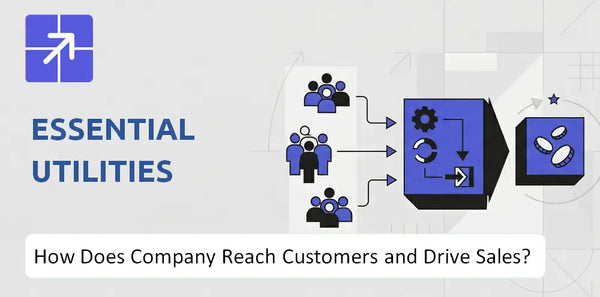
How does Essential Utilities convert regulated investments into sales through its sales and marketing model?
Essential Utilities sells value by investing in water and gas infrastructure and recovering costs via regulated rates; success hinges on regulatory approval and operational execution. In 2025 the company reported steady rate base growth across 10 states, underscoring revenue predictability.
Focus on regulatory pathways and targeted stakeholder engagement to speed approvals and shorten time to revenue recovery; tie capital projects to clear customer-service metrics. See Essential Utilities BCG Matrix Analysis
Who Does Essential Utilities Want to Sell To?
Essential Utilities, Inc. targets residential households, commercial enterprises, and industrial users across its multi-state regulated footprint, plus municipal governments as acquisition targets; the company wins them through regulated service reliability, scale-driven capital investments, and tailored billing and outreach programs.
 Primary: Residential and Small Commercial Customers
Essential Utilities focuses on serving roughly 5.6 million people across its system, with the Regulated Water segment covering about 1.1 million customer connections and Regulated Gas serving around 750,000 connections as of early 2026; winning here depends on reliable service, clear billing, and customer retention programs that reduce churn.
Secondary: Industrial, Large Commercial, and Municipal Buyers
Large commercial and industrial users demand customized metering, demand-response options, and service-level agreements, while municipal governments are pursued as sellers of distressed or underfunded water/wastewater systems – a channel that drives customer acquisition through acquisitions and system integrations.
Market Positioning: Regulated, Scale-Based Utility Operator
Essential Utilities positions itself as a regulated, investment-grade utility that leverages scale to fund infrastructure upgrades, compliance, and digital customer engagement – framing marketing and sales around reliability, compliance, and capital-backed service improvement.
Why This Positioning Resonates
The message works because regulators and municipal sellers favor financially strong operators, customers prioritize uninterrupted water and gas service, and scale reduces per-customer capital cost – supporting essential utilities marketing and essential utilities customer acquisition through targeted outreach, billing-based conversions, and acquisition-led growth; see Ownership and Control of Essential Utilities Company for related context: Ownership and Control of Essential Utilities Company
Essential Utilities SWOT Analysis
- Complete SWOT Breakdown
- Fully Customizable
- Editable in Excel & Word
- Professional Formatting
- Investor-Ready Format

How Does Essential Utilities Get in Front of Customers?
Essential Utilities, Inc. reaches customers mainly through municipal M&A and tuck-in acquisitions, supplemented by digital engagement and participation in community regulatory hearings to convert local demand into sales across its Pennsylvania, Ohio, and Texas territories.

Municipal M&A Pipeline
Essential Utilities marketing centers on municipal privatizations and targeted acquisitions; in 2025 the firm pursued tuck-in deals adding roughly 1% – 3% to its customer base annually, using local leader engagement to secure geographic monopoly positions and immediate customer access.
Digital Marketing and Online Reach
Digital channels – website enrollment, email campaigns, search and targeted paid media – support utility customer engagement and online enrollment; these tools help convert regulatory outreach into measurable leads and improve billing and payments as a sales conversion tool.
Sales Channels and Local Access
Distribution is local and direct: acquisitions transfer existing customer bases, while partnerships with municipalities and regulated retail arrangements provide the primary energy service sales channels and minimize the need for retail marketing spend.
Demand Generation Tactics
Demand generation utilities tactics focus on regulatory hearings, community events, and targeted content that explains service improvements; digital outreach and email marketing strategies for utility companies amplify messaging during acquisition cycles.
Customer Acquisition Efficiency
Acquisition via municipal deals yields low incremental marketing cost per customer; in 2025 reported regulated ratebase growth and 1% – 3% annual customer additions imply a more efficient cost of acquisition vs. traditional advertising channels.
Most Important Reach Advantage
The strongest reach advantage is geographic monopoly through regulated acquisitions in Pennsylvania, Ohio, and Texas – this secures long-term revenue streams and minimizes churn, so municipal M&A remains the core of Essential Utilities sales strategy in 2025.
See the company context and expansion history: History and Background of Essential Utilities Company
Essential Utilities Business Model Canvas
- One-time Payment
- No Research Needed – Save Hours of Work
- Built by Experts, Trusted by Consultants
- Instant Download, Ready to Use
- 100% Editable, Fully Customizable

How Does Essential Utilities Turn Attention Into Sales?
Essential Utilities turns attention into sales by converting captured customers and territory rights into regulated revenue through infrastructure investment and formal rate recovery; customer acquisition is supported by meter-to-bill activation and targeted outreach. The firm's commercial mechanics rest on regulated rate base growth and timely cost recovery via state filings and interim riders.
Core Sales Model: Regulated Asset-Backed Revenue
Essential Utilities relies on contract-like implicit service provision through utility territory rights and customer hookups; sales are effectively realized when capital investments join the regulated rate base and customers are metered and billed. Customer acquisition mixes direct outreach, digital enrollment, and third-party developer/municipal agreements to secure long-term retail load.
Pricing and Monetization Logic: Rate Base × Allowed Return
Revenue equals the regulatory-approved rate base multiplied by the allowed rate of return; usage charges and fixed customer fees flow through tariffs set in state rate cases. For 2025 the company's authorized returns and tariff structures are the binding monetization mechanism that converts capital spend into recurring cash flows.
Conversion and Purchase Drivers: Regulatory Recovery and Infrastructure
Investments in pipe replacement, new mains, and treatment plants increase the rate base; regulatory tools such as the Distribution System Improvement Charge (DSIC) and similar interim riders accelerate cost recovery and shorten the cash conversion cycle. Sales conversion is driven by reliable service, mandated service territory exclusivity, and billing reliability – meter-to-bill activation converts attention into paying customers.
Repeat Revenue or Customer Expansion: Steady Utility Demand
Once on the system, customers provide recurring volumetric and fixed charges, producing predictable retention and expansion as population or consumption grows. Upside comes from new connections, rate case-approved increases, and cost-recovery riders; Essential Utilities budgeted capital expenditures of approximately $1.45 billion for 2026 to grow rate base and future revenue.
Key measurable levers: file timely rate cases to secure an allowed ROE, deploy DSIC-like riders to recover capital costs faster, and convert demand through online enrollment, targeted essential utilities marketing, and meter activation processes; see the Growth Outlook of Essential Utilities Company for further financial context.
Essential Utilities Marketing Mix
- Complete Marketing Mix Analysis
- Effortlessly Communicate Your Business Strategy
- Investor-Ready Format
- 100% Editable and Customizable
- Clear and Structured Layout

How Strong Does Essential Utilities's Commercial Engine Look Going Forward?
Essential Utilities, Inc.'s commercial engine appears strong into fiscal 2026, driven by a $7.2 billion capital plan through 2028 and an expected rate base CAGR of 8% – 10%; higher 2025 financing costs are a headwind but the essential nature of water and gas services supports stable demand and margins.
What Supports Future Demand
Regulated rate base growth and the multi-year $7.2 billion investment plan underpin demand generation and service expansion; utility customer engagement benefits from predictable consumption patterns and mandatory service needs, aiding essential utilities marketing and customer acquisition.
Channel and Marketing Effectiveness
Channels mix regulatory-driven billing, digital enrollment, and targeted outreach – billing and payments act as a sales conversion tool while online enrollment and signup and email marketing strategies for utility companies improve retention; energy service sales channels are efficient given low churn and long contract durations.
Risks to Commercial Performance
Higher 2025 interest rates increased financing costs and could compress ROE recovery between rate cases; regulatory outcomes, weather-driven demand swings, and slower developer activity pose risks to essential utilities sales strategy and demand generation utilities efforts.
The Overall Sales and Marketing Outlook
Outlook for 2025/2026 is favorable and defensive: stable cash flows, likely investment-grade ratings, and sustained rate base expansion support steady earnings per share growth of 5% – 7%; customer segmentation strategies for energy providers and partnership and channel strategies for utilities should maintain steady customer acquisition and retention. Read a related operational overview: How Essential Utilities Company Works and Makes Money
Essential Utilities Boston Consulting Group Matrix
- Built by Experts, Trusted by Consultants
- Structured for Consultants, Students, and Founders
- 100% Editable in Microsoft Word & Excel
- Instant Digital Download – Use Immediately
- Compatible with Mac & PC – Fully Unlocked

Related Blogs
- What Is the History of Essential Utilities Company and How Did It Evolve?
- What Is the Competitive Landscape of Essential Utilities Company and How Does It Compete?
- What Is the Growth Outlook of Essential Utilities Company and Where Is It Heading?
- How Does Essential Utilities Company Work and What Drives Its Business Model?
- What Do the Mission, Vision, and Core Values of Essential Utilities Company Reveal?
- Who Are the Core Customers in Essential Utilities Company's Target Market?
- Who Owns Essential Utilities Company Today and Who Holds Control?
Frequently Asked Questions
Essential Utilities targets residential households, small commercial customers, industrial users, and municipal governments. The blog says its primary focus is on residential and small commercial customers, while larger commercial, industrial, and municipal buyers are secondary targets supported by regulated service reliability, clear billing, and tailored outreach.
Disclaimer
All information, articles, and product details provided on this website are for general informational and educational purposes only. We do not claim any ownership over, nor do we intend to infringe upon, any trademarks, copyrights, logos, brand names, or other intellectual property mentioned or depicted on this site. Such intellectual property remains the property of its respective owners, and any references here are made solely for identification or informational purposes, without implying any affiliation, endorsement, or partnership.
We make no representations or warranties, express or implied, regarding the accuracy, completeness, or suitability of any content or products presented. Nothing on this website should be construed as legal, tax, investment, financial, medical, or other professional advice. In addition, no part of this site - including articles or product references - constitutes a solicitation, recommendation, endorsement, advertisement, or offer to buy or sell any securities, franchises, or other financial instruments, particularly in jurisdictions where such activity would be unlawful.
All content is of a general nature and may not address the specific circumstances of any individual or entity. It is not a substitute for professional advice or services. Any actions you take based on the information provided here are strictly at your own risk. You accept full responsibility for any decisions or outcomes arising from your use of this website and agree to release us from any liability in connection with your use of, or reliance upon, the content or products found herein.