
How does Bank Central Asia's sales and marketing model convert its transactional reach into sustained lending and cross-sell revenue?
Bank Central Asia focuses marketing on transaction flows and low-cost deposits to seed lending relationships and product cross-sells. This matters because in 2026 BCA serves over 31 million customers and sustains margins via scale of payments and deposits, limiting rate stress.
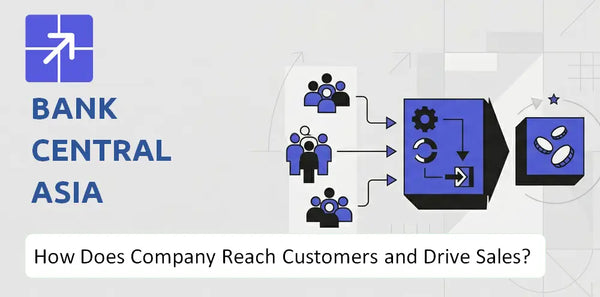
BCA ties product offers to payment and payroll channels, boosting conversion from transaction users to credit and wealth clients. See product fit in Bank Central Asia BCG Matrix Analysis.
Who Does Bank Central Asia Want to Sell To?
Bank Central Asia targets affluent retail clients, SMEs, and top-tier corporates, using digital payment products, wealth management, and integrated corporate solutions to convert demand into fee and interest income.
 Retail affluent customers (middle & upper class)
BCA targets digitally active middle and upper-class Indonesians seeking reliable payment services and wealth management; by 2025 BCA Prioritas and Solitaire segments account for roughly 25% of fee income and AUM growth at a 12 – 15% annual rate.
SMEs as growth engine
SMEs receive priority for working capital, trade finance, and digital cash management; SME lending and transaction fees drive volume across BCA digital banking channels and the branch and ATM network.
Top-tier corporate and institutional clients
Large corporates use BCA for capital expenditure financing, treasury, and syndication; corporate relationships produce stable interest income and large-ticket transaction fees.
Market positioning
BCA positions itself as Indonesia's premier private and corporate bank, combining a wide branch and ATM network with high-converting digital channels and strong BCA customer acquisition programs.
Why this positioning works
BCA converts demand into sales via targeted advertising, data-driven segmentation, cross-selling techniques, and streamlined online onboarding; reported 2025 metrics show digital onboarding conversion improving and fee income contribution rising, supporting retention through loyalty programs and BCA customer relationship management.
Further reading on target customers
See Target Customers and Market of Bank Central Asia Company for a focused profile of BCA customer segments and market share data.
Bank Central Asia SWOT Analysis
- Complete SWOT Breakdown
- Fully Customizable
- Editable in Excel & Word
- Professional Formatting
- Investor-Ready Format

How Does Bank Central Asia Get in Front of Customers?
Bank Central Asia gets in front of customers through a hybrid bricks-and-clicks model: a physical footprint of over 1,200 branches and 19,000 ATMs plus the myBCA digital ecosystem and API integrations that place BCA at the point of purchase, driving awareness, demand, and conversions.

Main acquisition channel: myBCA ecosystem
myBCA is the primary acquisition engine, combining mobile banking, payments, and lifestyle services to keep BCA top-of-wallet and enable cross-selling of loans, deposits, and cards.
Digital marketing and online reach
BCA uses paid search, social, in-app notifications, email, and content on myBCA to drive activation; app distribution and platform partnerships boost organic installs and retention.
Sales channels and distribution access
Physical branches and 19,000 ATMs support retail sales and onboarding, while API partnerships with e-commerce and fintechs position BCA as the preferred settlement bank at checkout.
Demand generation tactics
BCA runs targeted promotions, cashback and reward campaigns in myBCA, co-marketing with merchants, and fintech integrations to capture intent at purchase and convert with instant offers.
Customer acquisition efficiency
High organic touch via myBCA plus checkout-level presence reduces acquisition cost; recent metrics show digital onboarding and API settlements materially shorten time-to-first-transaction.
Most important reach advantage
The combined scale of a large branch/ATM network and the myBCA platform ensures omnipresence: BCA appears at in-person touchpoints and digital purchase flows, capturing customers at the moment of intent.
Read more on BCA history and strategy in History and Background of Bank Central Asia Company
Bank Central Asia Business Model Canvas
- One-time Payment
- No Research Needed – Save Hours of Work
- Built by Experts, Trusted by Consultants
- Instant Download, Ready to Use
- 100% Editable, Fully Customizable

How Does Bank Central Asia Turn Attention Into Sales?
Bank Central Asia turns attention into sales by using transaction data and automated prompts to funnel payment customers into higher-margin loans and services, converting everyday activity into profitable lending and fee income. Precision cross-selling, AI credit scoring for SMEs, and a high 80 percent CASA ratio make conversions efficient and scalable.
Core sales model: transaction-led cross-sell
Bank Central Asia primarily sells through its retail and digital banking channels, using payment and deposit touchpoints to seed product offers; branch and ATM network support in-person conversions. High-frequency transactions feed CRM and targeted advertising to close mortgages, auto loans, and personal credit.
Pricing and monetization logic: net interest and fee mix
Revenue comes from interest on loans and fees on services; the bank maintained a Net Interest Margin between 5.8 and 6.0 percent in 2025. High CASA lowers funding cost, boosting spread and supporting a dividend payout ratio near 70 percent.
Conversion and purchase drivers: data, automation, trust
Processing over 30 billion transactions annually gives BCA customer acquisition and marketing teams granular behavior signals. Automated marketing prompts, real-time offers, and AI-driven credit scoring (deployed in 2025) speed approvals for SME loans and increase conversion rates across products.
Repeat revenue and customer expansion: ecosystem lock-in
Once customers use BCA for payments, the transactional moat and CRM-driven cross-selling raise lifetime value through upsells and renewals of higher-margin products; high CASA retention sustains low funding costs and repeat revenue streams.
Key metrics: 80 percent CASA ratio, > 30 billion transactions/year, NIM 5.8 – 6.0 percent, dividend payout ~70 percent, AI credit scoring rolled out in 2025 to optimize SME approvals. See further operational and revenue mechanics in How Bank Central Asia Company Works and Makes Money
Bank Central Asia Marketing Mix
- Complete Marketing Mix Analysis
- Effortlessly Communicate Your Business Strategy
- Investor-Ready Format
- 100% Editable and Customizable
- Clear and Structured Layout

How Strong Does Bank Central Asia's Commercial Engine Look Going Forward?
Bank Central Asia's commercial engine looks very strong entering 2025/2026, with ROE above 24% and CAR near 29%; key supports include deep liquidity, scale, and growing digital revenue. Main risks are intensified digital competition and margin pressure from funding costs, but overall sales execution and risk control remain robust.
Scale, liquidity, and product mix support future demand
BCA customer acquisition benefits from a massive deposit base and a low cost of funds that fund higher-margin lending and wealth products; continued migration to digital wealth and credit lifts yields and cross-sell ratios.
Channel and marketing effectiveness across digital and branches
BCA digital banking channels and the extensive BCA branch and ATM network work together: digital onboarding and the mobile app raise conversion while branches handle complex sales, supporting sustained acquisition and revenue growth.
Risks to commercial performance
Key risks include margin compression if market rates spike, aggressive pricing from pure-play digital banks eroding share in low-value segments, and potential credit stress if GDP weakens – but NPLs remain below 2.0%.
Overall sales and marketing outlook for 2025/2026
Outlook is strong and adaptable: BCA conversion strategy and BCA customer relationship management are positioned to convert demand into sales via targeted advertising, data-driven segmentation, and cross-selling, so BCA should outperform regional peers.
Relevant metrics: projected loan growth of 10 – 12% y/y for 2025, NPL ratio below 2.0%, and sustained ROE > 24%; digital channels now account for a rising share of account openings and loan applications, improving BCA mobile banking app conversion rates and lowering acquisition costs. See Mission, Vision, and Values of Bank Central Asia Company for additional context.
Bank Central Asia Boston Consulting Group Matrix
- Built by Experts, Trusted by Consultants
- Structured for Consultants, Students, and Founders
- 100% Editable in Microsoft Word & Excel
- Instant Digital Download – Use Immediately
- Compatible with Mac & PC – Fully Unlocked

Related Blogs
- What Is the History of Bank Central Asia Company and How Did It Evolve?
- What Is the Competitive Landscape of Bank Central Asia Company and How Does It Compete?
- What Is the Growth Outlook of Bank Central Asia Company and Where Is It Heading?
- How Does Bank Central Asia Company Work and What Drives Its Business Model?
- What Do the Mission, Vision, and Core Values of Bank Central Asia Company Reveal?
- Who Are the Core Customers in Bank Central Asia Company's Target Market?
- Who Owns Bank Central Asia Company Today and Who Holds Control?
Frequently Asked Questions
Bank Central Asia mainly targets affluent retail clients, SMEs, and top-tier corporates. The blog says it uses digital payment products, wealth management, and integrated corporate solutions to convert that demand into fee and interest income, with each segment contributing differently to growth and sales.
Disclaimer
All information, articles, and product details provided on this website are for general informational and educational purposes only. We do not claim any ownership over, nor do we intend to infringe upon, any trademarks, copyrights, logos, brand names, or other intellectual property mentioned or depicted on this site. Such intellectual property remains the property of its respective owners, and any references here are made solely for identification or informational purposes, without implying any affiliation, endorsement, or partnership.
We make no representations or warranties, express or implied, regarding the accuracy, completeness, or suitability of any content or products presented. Nothing on this website should be construed as legal, tax, investment, financial, medical, or other professional advice. In addition, no part of this site - including articles or product references - constitutes a solicitation, recommendation, endorsement, advertisement, or offer to buy or sell any securities, franchises, or other financial instruments, particularly in jurisdictions where such activity would be unlawful.
All content is of a general nature and may not address the specific circumstances of any individual or entity. It is not a substitute for professional advice or services. Any actions you take based on the information provided here are strictly at your own risk. You accept full responsibility for any decisions or outcomes arising from your use of this website and agree to release us from any liability in connection with your use of, or reliance upon, the content or products found herein.